Showing posts sorted by relevance for query Ragsdale. Sort by date Show all posts

Tuesday, July 9, 2013

Screen Kiss

Robert Boyd


Britt Ragsdale, Still from Duet

If you have been following Britt Ragsdale's work over the past few years, the video work in Playback, curated by Paul Middendorf, won't be a big surprise. Ragsdale has been playing around with movie tropes since at least 2010. One of her Duets was in the Big Show in 2011. That same year, she started taping Screen Test, in which people mimed getting shot, Hollywood style. 2013's Scream Queens had actresses lip-synching famous horror movie screams.

Britt Ragsdale "Run Through 01"  from the series "The Chase" 2013
Britt Ragsdale, stills from The Chase

The Chase is the most prominent piece in Playback. In it, we see a young woman wearing a white shirt and a blue dress running toward the camera, looking at something offscreen, and gasping. Then she gathers herself, walks back to the starting point and repeats the action. It's done over and over. The highly dramatic quality of the run towards the camera and gasp are totally mitigated by the repetition. If you are a film director, you see film this way all the time. You look at rushes completely stripped of actual drama and must sit around with your editor at the Avid trying to take these ridiculous scraps of nothingness and turn them into something that is convincing to a viewer. The Chase reminds you for a second that the drama is a result of acting and editing.


DUET (possessed) from Britt Ragsdale on Vimeo.

The Duet videos are related but take on the artifice of movies quite differently. They specifically refer to another key part of the feature film world, the still, and more particularly, the still images of couples kissing. In each of the Duet videos (there were four in the show), a male/female couple are posed in a stereotypical embrace, either mid-kiss or about to kiss or thinking about kissing. But these are videos, not stills. The couples don't move--they hold the cliched pose they're in instead of carrying out the implied action. I say they don't move, but that's actually not quite right. After all, they aren't statues. There are tiny movements made by each person as they attempt to remain in their respective poses. (These are long videos--if you watch them all the way through, you can see the poses gradually change as the actors become more fatigued.) These tiny movements show how weird and probably uncomfortable these poses are. They remind us, the viewers, how strange these film conventions are.

Another aspect of Duet worth noting is the utter ordinariness of the actors. The preternatural beauty of movie stars is so common that we often forget it. So when you put average looking people in a place usually occupied by Hollywood Olympians, it again draws your attention to the artificiality of the convention under examination--the screen kiss.


Britt Ragsdale, still from Don't Talk to Strangers

The last piece in Playback is a collage of found video and audio called Don't Talk to Strangers. Ostensibly a warning to girls and young women, it contains surreal rapid-fire editing of disparate images (all from the Prelinger Archive). It reminds me of A MOVIE (1958) by Bruce Connor. However, Don't Talk to Strangers feels like an echo of Connor's pioneering work. This kind of found footage collage is a standard exercise for film students (I remember doing one for Brian Huberman's film class at Rice), and things like the Prelinger Archive make it quite easy now to get raw material. Don't Talk to Strangers displays a lot of wit, but the Duets and The Chase are more interesting works.

The show is up at Fresh Art's Winter Street gallery until July 12, but if you can't see it there, many of the videos from Playback are viewable on Ragsdale's website.


Share

Thursday, July 14, 2011

The Big Show 2011, part 2--Brainiacs

by Robert Boyd

In part 1 of this review, I discussed what seemed to me to be the dominant theme of the exhibit--big colorful paintings. But as I said, given the size of the show and the range of work submitted, it was inevitable that there would be variety. But this isn't a thesis-antithesis sort of situation. The work in the show that is not big colorful paintings goes out in all directions. There is sculpture, video, drawing, and mixed media work. There is a lot of quieter work, work in monochromatic shades, work where there is little if any chiaroscuro. This work generally has less of a visual punch (with a few exceptions, as you will see). In general, it's less visceral and more cerebral. In a way, it's almost as if there are three shows happening simultaneously, each with its own merits.

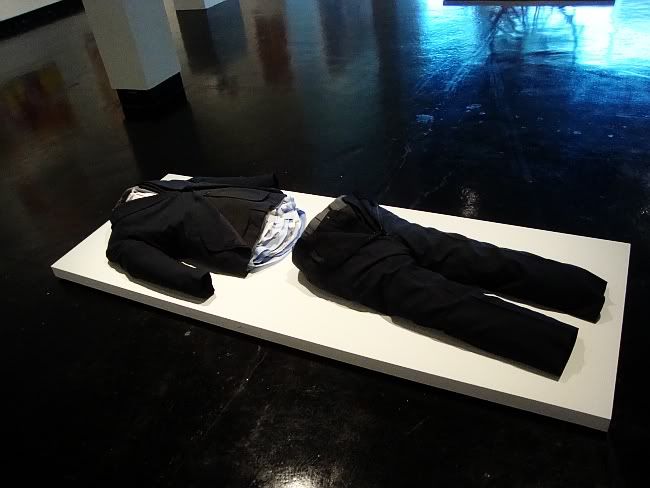
The first piece in the show that really struck me was Casualty in Formality by Britt Ragsdale.
Photobucket
Britt Ragsdale, Casualty in Formality, suits and dress shirts, 2011

This bodiless suit(s) made me think of Charles Ledray's great exhibit at the MFAH. Now here's a weird thing. When I first saw this piece, I thought Britt Ragsdale was a man. I had jumped to this conclusion months earlier because I knew a guy named Britt when I was in high school. It didn't occur to me for a second that "Britt" could be short for, say,  "Britney." This incorrect assumption makes a difference. When I saw Ragsdale's sculptures made of women's underwear at the U.H. MFA thesis show, I thought that is was a pretty interesting choice for a man. It seemed highly sexual--like he was saying that this is something he's into. Except "he" wasn't saying that at all. Later I attended a performance by Ragsdale at Skydive--but she was silent and behind a wall, so my illusions were maintained. It was only in a conversation with Sasha Dela a few days ago that I learned the truth.

Does it make a difference whether Ragsdale is a man or a woman? Well, yes. She is making sculptures out of clothing that is defined as "women's clothes" or "men's clothes." One's relationship to these clothes is likely to be different for men than for women.

A simple reading of Casualty in Formality is that it is a visualization of the old cliche "clothes make the man." But the position--prone and bisected--makes us think about that word "casualty" more. Men rarely wear suits anymore, except in certain professions. My dad put on a suit and tie every morning to go work in an office very similar to the one I now work in. If I showed up in a suit and tie, my coworkers would think I had a job interview. In my company of several thousand workers (hundreds of whom work in our offices), only the CEO regularly wears a suit to work, and his sartorial choices are considered a sign of eccentricity. So she might be talking about the death of that kind of everyday formality.

But what I like about it is that it is a mysterious object (or pair of objects). It's set low to the ground; it's made of cloth--in short, it is quite unlike traditional sculpture. Furthermore, it is made out of the thing it depicts! I like that self-referentiality.

Ragsdale also had a video in the show (one of two videos). You can see it below.


DUET from Britt Ragsdale on Vimeo. 2010

I liked Duet as well. The man appears to be whispering something into the woman's ear. She seems to like what she hears (based on her happy expression), but her expression never changes. Their eyes blink and we can see small bodily motions, but otherwise the pair seem frozen.It's almost like they are posing for a double portrait. And this video is, in fact, a double-portrait. I'm sure some people walking by on opening night didn't even notice that it was a video. So it plays with the tension between video (a medium that implies time and motion) and still portraiture.

Another recent UH MFA who had good work in the Big Show is Emily Peacock. Her pieces were among the relatively few photographs in the exhibit.
Photobucket
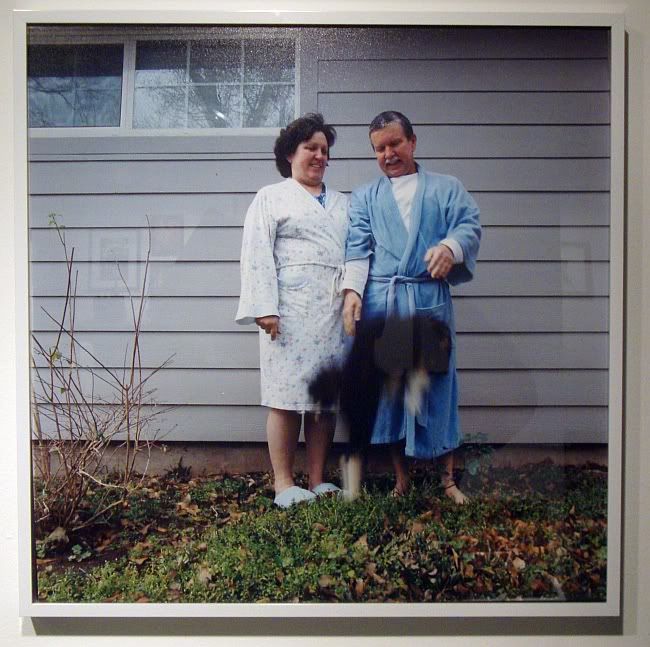
Emily Peacock, Family Portrait, C-print, 2010

When I look at Peacock's work, I feel like I am looking at a snapshot with at least one very weird thing going on. With Family Portrait, we have the blurred falling cat (or dog?). I won't say these strange features undermine the quotidian nature of the snapshots as much as they force us to concentrate on the usually invisible qualities of casual family snapshots. It's easy for our eyes to pass over a snapshot like this lightly. But add a blurred falling cat to the photo, and we're forced to linger.
 Photobucket
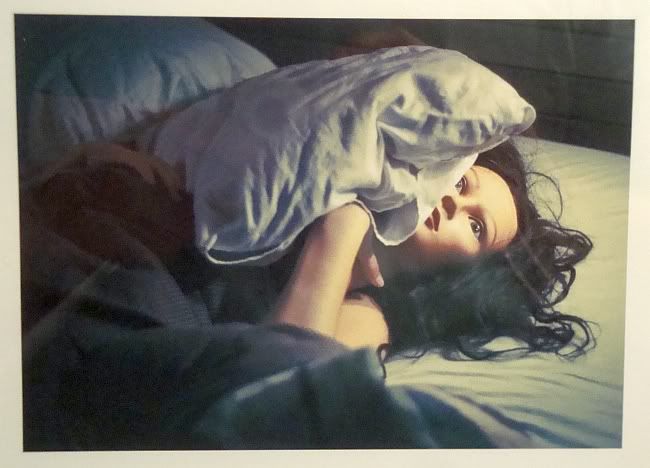
Brain Campbell, I can't believe I'm doing this, digital photograph, 2011

Brian Campbell's photos in the Big Show also have an underlying strangeness to them.What exactly are we looking at here? Is this a photo of a person or a doll--or is a doll's face superimposed onto a woman's body? The title implies an emotional response to a situation--regret, possibly, or shame--that is belied by the wide-eyed expressionlessness of the face.

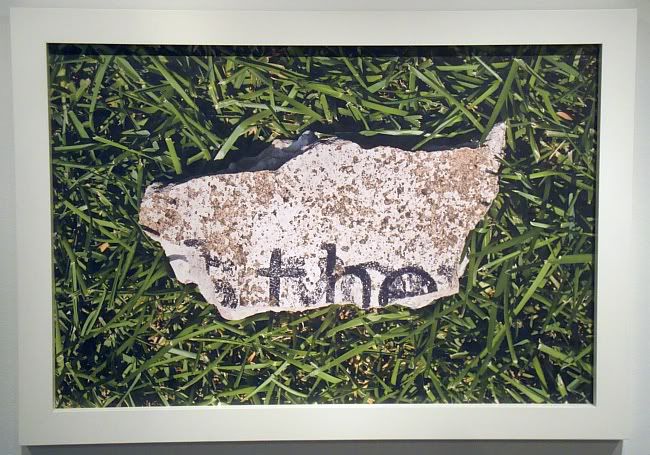
Like Britt Ragsdale, J.E. Theriot has two pieces in the show in two different media, sculpture and photography. The sculpture, Spraying Hands, is an image painted on a concrete block. the photo, Concrete The, is a photo of a word painted on a concrete block.
Photobucket
J.E. Theriot, Concrete The, photographic print on PVC, 2009

The "the" is cut off. It looks like it was typed with a manual typewriter, and we can see some ghost type underneath it. The word "concrete" in this context makes me think of "concrete poetry," poetry where the lines varied in length to create an image. It was a merging of visual art and poetry. (It had its heyday in the 1950s and 60s.) Aside from this, though, I see it as an interesting, enigmatic image.

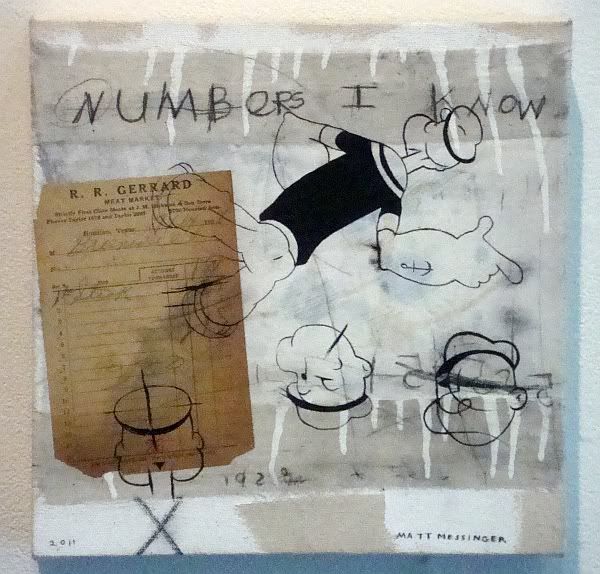
There are plenty of painters in this "other" Big Show, but they distinguish themselves by their restraint, eschewing bright colors and aggressive compositions. Matt Messinger does have one similarity with some of the other painters I discussed in the previous Big Show post--he draws from the world of comics and cartoons.
Photobucket
Matt Messinger, 1928 (Popeye), found linen, gesso, black gesso, 1928 receipt and charcoal, 2011

His drawings remind me of model sheets--drawings of a cartoon character in different poses from different angles that were used by animators to make sure the character looked right as they were animating him.One could imagine this as the blotter of a Fleischer Studios animator--receipts, little drawings, notes to himself.
Photobucket
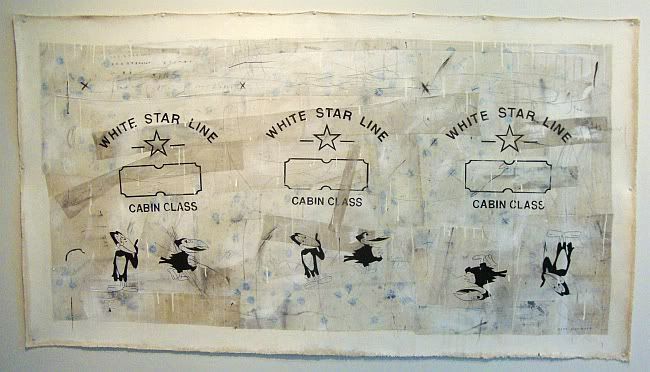
Matt Messinger, Whitestar Line (Heckle and Jeckle), Found linen, gesso, black gesso, pencil and charcoal, 2011

Messinger had three pieces in the show, each excellent. As I have said before about his work, his use of old cartoon/comic strip characters doesn't feel forced. I feel like he is evoking a working class nostalgia. Even his damaged, roughly gessoed canvases play into this--they look like whitewashed billboards and bleached-out hand-bills. The nostalgia evoked is not that of the nostalgia industry--the slick, licensed Betty Boop merchandise, for example. No, I would compare it to Cy Twombly, whose work likewise evokes old walls that have been covered repeatedly with graffiti. It is Twombly (and Paul Terry and E.C. Segar and Max Fleischer) I think of when I see Matt Messinger's work.
Photobucket
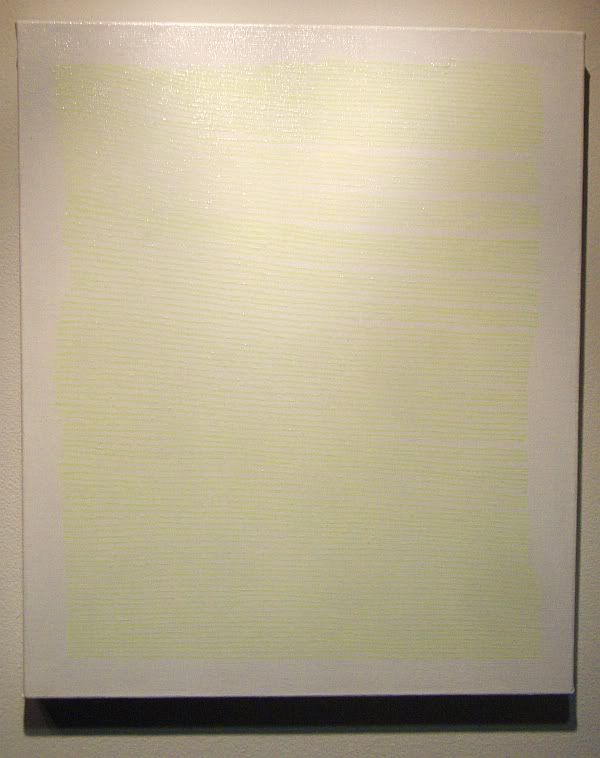
John Sturtevant, Almost There, acrylic on canvas, 2011


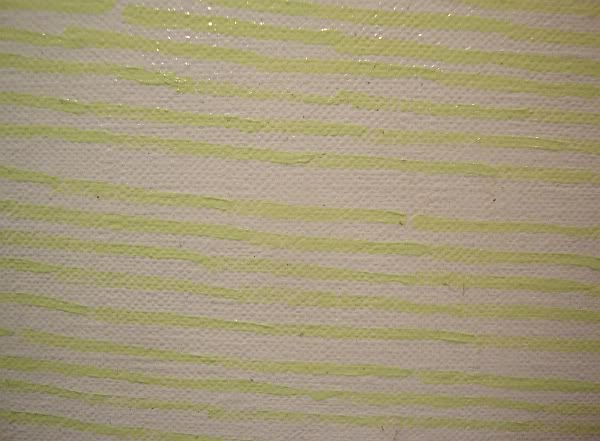
I want to apologize for this photo. The problem here is that the work is very subtle--parallel wavy yellow lines, with an extremely narrow range of values. It's an inherently difficult painting to photograph, and when you combine that fact with my terrible photography skills and cheap camera, this is what you get. I especially want to beg your indulgence here because I thought Sturtevant's paintings were two of the most interesting in the show.
Photobucket
John Sturtevant, Almost There (detail), acrylic on canvas, 2011

I'm afraid I'm quite fond of pale, difficult to photograph paintings and drawings.
Photobucket
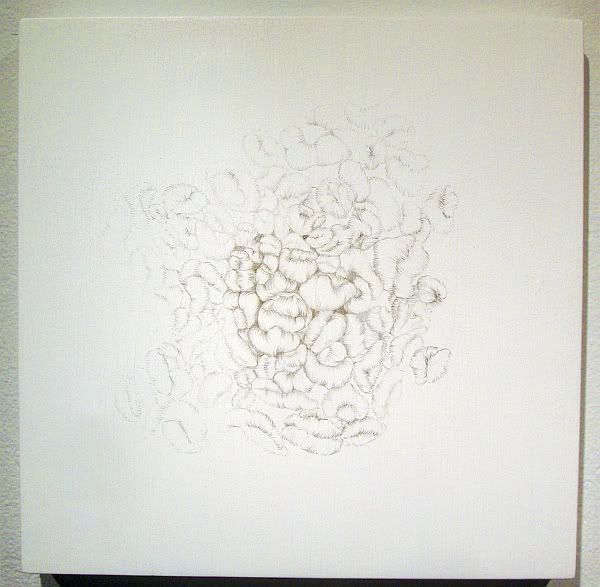
Loli Fernandez, Zu Lang (Too Long)...,  silverpoint on board quadtych, 2011

This pale drawing by Loli Fernandez looks like a biological illustration form the 19th century--perhaps one that has faded over time. It has a squishy, haunting beauty. My photo does it little justice--go see it in person. It is part of a four-drawing suite.
Photobucket
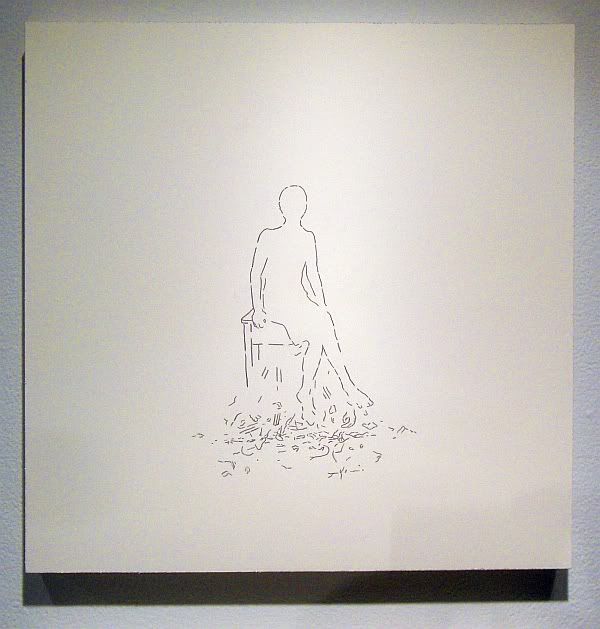
Dran Alessi, Pieces, pencil on paper/board, 2011

Dran Alessi is (as far as I can determine) a physician. That's one thing I like about the Big Show--it brings out the Sunday painters, artists who do something as their profession and also do art. I can relate--I work for and energy company and do this blog in my spare time. I love amateurs, especially when they produce work this good.  I like the spare drawing style, and the details left out. Her broken lines remind me of those of the cartoonist R.O. Blechman. The empty space inside the outline of the figure is a an intriguing emptiness, and the marks below the figure look as if they could be all the details that would particularize the figure, fallen out and piled on the floor.
Photobucket
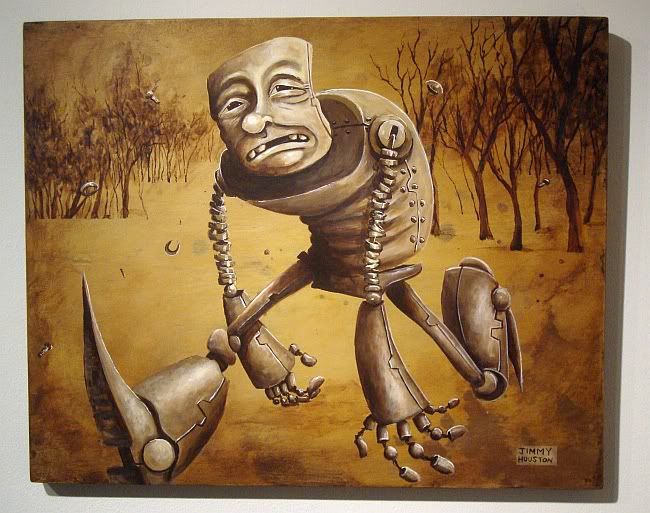
Jimmy Houston, Whimper, acrylic on panel, 2011

Jimmy Houston's two pieces in this show are monochrome stumblebum robots--very unlike the sleek robots of most science fiction. Houston has a great illustrational style and real humor in his work. But what is really weird is that he wasn't the only guy drawing monochromatic robots in the show.
Photobucket
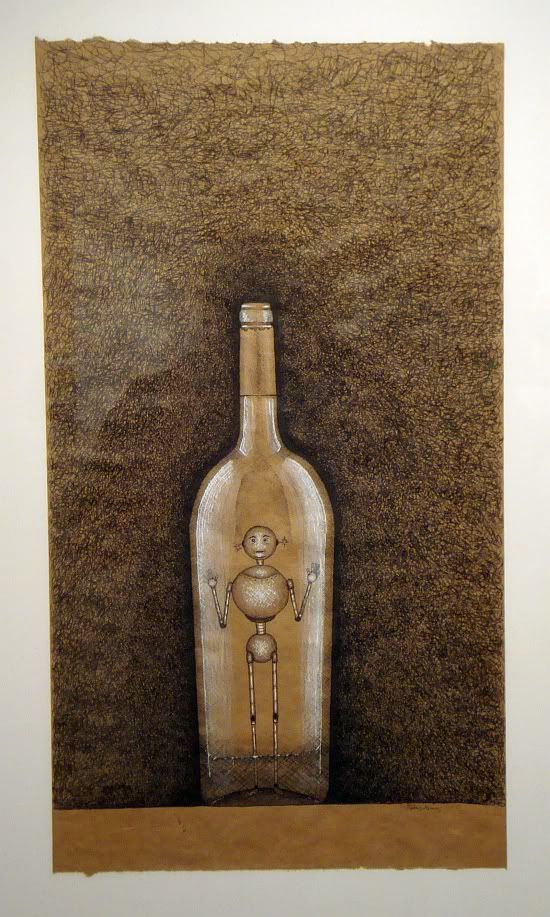
Rodney Flores, Safe Place, pen and ink and colored pencil on butcher paper, 2011

If Houston's robot is post-bender, Rodney Flores is mid-bender. (I suppose both these guys are cousins to Bender, the alcoholic robot from Futurama.) The title is accurate and ironic--for some, booze is a refuge. I like Flores' use of the colored ground (the butcher paper) with the dark pencil and white pencil to add value, form and texture.
Photobucket
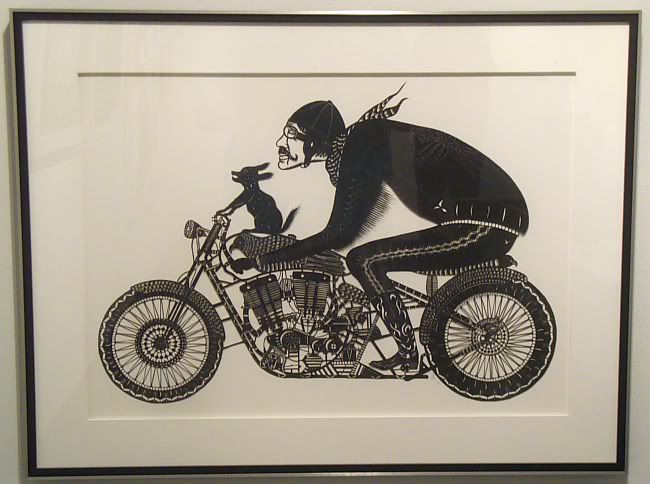
Catherine Winkler Rayroud, The Master of the Universe, papercutting made with scissors and scalpel, 2011

Another artist who uses humor in her work is Catherine Winkler Rayroud. She was also in last year's show.In those pieces, she cut silhouettes of lace underwear (a bra and panties) where the lace formed ironic images. With Master of the Universe, she is more straightforward. I saw this piece and thought of my brother-in-law, an avid motorcyclist. He's a successful upper-middle-class executive who likes to ride on the weekend with his buddies.This guy, as depicted by Winkler, in no way makes you think of someone powerful or rich. But the title reflects how he feels when he gets on his bike.

Britt Ragsdale's Casualty in Formalitywasn't the only sculpture in the show. In part three of this review, I'll discuss a few more sculptural objects. Whew--the Big Show is really demanding on a writer.


Share


Thursday, June 20, 2013

Pan Recommends for the week of June 20 to June 26

Robert Boyd

Here a few art things to do this weekend. 

FRIDAY

 
Britt Ragsdale, Run Through 1, from The Chase series, 2013, video. Photo courtesy of the artist 

Playback: An exhibition of new video works by Britt Ragsdale, curated by Paul Middendorf at Fresh Arts' Winter Street Gallery, 6 to 8 pm (runs through July 12). Britt Ragsdale's videos dissect popular film culture by laser focusing on one specific part of that language--being chased in The Chase series or romantic embraces in Duets.


LaToya Ruby Frazier, Holland Avenue Parking Lot, 2011. Silver gelatin print, 30 x 40 inches

LaToya Ruby Frazier: Witness at CAMH, 6:30 to 9:00 pm. You're thinking, summer's going great! I'm so happy! I need a splash of cold, depressing reality! Come see the LaToya Ruby Frazier exhibit which documents her hometown of Braddock, PA, a post-industrial town that has seen its population plummet from over twenty thousand to less than five thousand. Fun!

SATURDAY


Kathryn Spence's scrappy fox sculpture

Kathryn Spence at Front Gallery, 4 to 6 pm (runs through July 27). Kathryn Spence makes sculptural objects through the time-honored method of combining crap with crap. Among the crap used to create this exhibit is string, wire, mud, "how to wash" labels, "do not remove" upholstery and mattress tags, "do not eat" desiccant packets, hair, money, beanie babies, "Ken" dolls, and petroleum jelly.


Work in progress--beading Rosine Kouamen's piece for Coming Through the Gap in the Mountain on an Elephant

Coming Through the Gap in the Mountain on an Elephant featuring Regina Agu, Gregory Michael Carter,  Nathaniel Donnett, Robert Hodge, Autumn Knight, Rosine Kouamen, Lovie Olivia, Phillip Pyle II, Sehba Sarwar, Michael Kahlil Taylor, and Monica Villareal and curated by Robert Pruitt at Texas Southern University - University Museum, 7:30 pm (runs through August 25). This show has something to do with old World's Fairs, and the title seems to reference Hannibal. That's all I know, but this line-up of artists makes it a pretty safe bet!

Share

Friday, July 15, 2011

Self-Referential Many Mini Post

by Robert Boyd

I'm sitting at Skydive right now for my Many Mini residency (Friday, July 15. I'll be here until 11:30 am. Feel free to stop by for a visit). The photo below was taken as I wrote the previous words.

The author in the act of writing this post (photo by Ryan Thayer)

I wasn't sure what I'd write during my Many Mini residency, but one of the requirements of the residency is this:
We request at least one digital photo and a short statement but can also accept video, links or other supporting material posted onliine. Please send one image immediately following your residency to be updated the same day.
So I am fulfilling my obligation with this post.

A series of small personal emergencies kept me from coming out to Skydive early this week until last night. When I showed up, Britt Ragsdale was just starting her residency.

Britt Ragsdale at the Many Mini (photo by Robert Boyd)

She was using the space to film people pretending to get shot. I was one of the "victims." The group that was following her residency was Sketchy Neighbors, so she recruited a bunch of them to die for the camera.

Shooting a shooting (photo by Robert Boyd)

Double Homicide at Skydive (photo by Robert Boyd)

Meanwhile, on the porch, Matt Gorgol was hand-shaving ice to make snow-cones. They were delish and very refreshing on a hot night. He's a sculpture major at UH, so I guess you could call this a social sculpture or a relational artwork.

Matt Gorgol and his ice (photo by Robert Boyd)

The Sketchy Neighbors did a performance piece called The worst thing you can do to people is forget them.  This is apparently the group's first performance piece. The performance required that viewers enter a room one at a time. So they had people line up.

Folks lined up for The worst thing you can do to people is forget them (photo by Robert Boyd)

A doorman controlled access to the performance, letting people enter for arbitrary reasons of style.

The doorman The worst thing you can do to people is forget them (photo by Robert Boyd)

When you walked into the main room (where I am currently typing these words), the Sketchy Neighbors began cheering wildly. And it was all for you. The viewer would hear cries of "You're number one!" and "You! You! You!"

Me getting well-deserved cheers The worst thing you can do to people is forget them (photo by Robert Boyd)

But they didn't stop until you left. So the longer the viewer stood there, the more uncomfortable it became. Eventually it was obvious what the strategy was, and viewers moved on (to the porch, where they could get a snow cone).

The Many Mini residency is going on for today and tomorrow--and there are lots of public hours. Feel free to stop by--even if there is no performance or event happening, you might find yourself roped into helping someone with their artwork, or at least having some interesting conversation. But also check out the events--this evening, there are two. The Chapel, a meditation period by Rachel Hecker, featuring her portrait of Dave Gilmour as Jesus. Come out and get comfortably numb. Then following that is Death Star, about which I don't know what to expect. Jonatan Lopez seems to be the prime mover here, but a bunch of people are involved.


Share


Wednesday, March 14, 2012

Goin' Mobile with the Lens Capsule

by Robert Boyd

FotoFest is upon us. It opens officially on March 16, but many satellite shows have already opened. And one gallery has openings every week from from March 3rd through March 31st. It's called The Lens Capsule, and it's a gallery in a truck. (I wonder if this pop-up marathon takes its inspiration from the food trucks that we see nowadays at almost every gallery or museum show opening.) It is a project of two 2011 UH MFA graduates, Emily Peacock and Britt Ragsdale.


The Lens Capsule at Lawndale, March 9

Each week, The Lens Capsule will feature a mini-exhibit of a different emerging photographer. You can see where they will set up on their calendar. Their next show is tomorrow (Thursday) at The Houston Center for Photography with photographer Teresa Munisteri.



The Lens Capsule at Isabelle Court, March 3

The set-up is minimal and clever. Inside the truck, walls have been constructed out of some kind of board (I couldn't tell whether it was plywood or masonite or some other kind of board). This board is white and extends from a couple of feet above the floor to about five and a half or six feet up. It is attached to the wall of the truck somehow. This is your typical U-Haul type truck, which has an uneven wall with regular intrusions. That means that there is a gap between the board and the truck's inner wall. This is where the light are place.


The Lens Capsule interior at Lawndale, March 9

The lights are on bendable metal necks. They are battery powered lights, and the battery-pack is slotted between the board wall and the truck wall. It's a tight fit, which is what holds the light in place. So in the end, you have an elegant (if a bit cramped) exhibition space using the absolute minimum amount of hardware and fixtures.


The Lens Capsule interior at Isabella Court, March 3

This is such a good idea that I hope other artists/curators copy it. What better way to have a micro-pop-up gallery. If someone were willing to shell out between twelve and fifteen thousand, they could own their own pop-up gallery (and perhaps start up a small art transportation business on the side).

For now, you have five more chances to see The Lens Capsule and the artists Peacock and Ragsdale have chosen for their mobile curatorial project.


Share