Friday, September 11, 2009
Notice to Haters of Children and Grumpy Misanthropes
If you are seeking a serene, contemplative art-viewing experience, I suggest you stay away from Houston's various art museums this Saturday. (On the other hand, if you are looking for something fun and cultural to do with the kids, this might be perfect.)


Tuesday, September 8, 2009
Super-Secret Sale at The Joanna!
This is a good ad, but it would have been improved if Michael J. Pollack had personally invited you to experience the fabulous new lifestyle he had created at the Joanna!
Monday, September 7, 2009
The $12 Million Stuffed Shark
Robert Boyd


I have been mentioning this book in recent posts, whenever talking about values of art. The value of artworks has long been a fascination, especially since the 80s when auction prices went crazy (think of the Japanese collectors paying tens of millions for Impressionists and Van Gogh). The source of high prices has always been mysterious, and The $12 Million Stuffed Shark: The Curious Economics of Contemporary Art by Don Thompson doesn't necessarily provide a complete answer. Right off the bat, it must be said that Thompson looks almost exclusively on the supply side of art values. He doesn't talk about the fact that money needs to go somewhere--that Japan in the 80s had excess money that could not be spent on rational investments (because all the rational investments had been made), so Japanese would spend insane amounts for real estate or artwork. Or that hedge fund managers in the 90s and 00s had gathered a huge quantity of wealth that had to go somewhere. So at least some of it went towards status building--hence buying expensive art, or high-profile philanthropy. Thompson touches on this, but the main thrust is where the artwork itself gets value before someone buys it.
He concentrates on the values added by dealers, auction houses, and, yes, collectors. The subject is very high priced art. The only dealers that add to the price of a super-expensive piece of art are dealers he calls "branded" dealers. Think of the Gagosian Gallery or White Cube. He has a taxonomy of dealers. Branded dealers are the top. They exist primarily in New York and London, with subsidiary locations (or reciprocal arrangements with mainstream dealers in secondary markets). Next are what he calls mainstream dealers. The most successful of these are still in art capitals like New York, London, Los Angeles, or Berlin, but they can exist anywhere. I think something like the McClain Gallery in Houston would count. But Thompson writes, better to be the 50th gallery in New York and to be number one in Baltimore. (This is yet another example of the clustering of particular industries and trades in certain geographic locations, despite globalization and the internet. A recent Harvard Business Review article discussed this phenomenon and why it was good thing for those industries, and why outsourcing was therefore bad.) A mainstream gallery is likely to be where an art career really begins. Below that are "High Street" galleries--artists rejected by or not yet ready for mainstream galleries and artists cooperatives. At the bottom are the vanity galleries. He discusses the chances for success for a gallery (low) and how each show by a new artist is a huge risk. The initial shows won't pay for themselves, and the odds that any given artist will still be showing (or worth showing) five years after her initial show is slight. Given this, for mainstream galleries, most of their investments in new artists are dead losses. But one blockbuster makes up for it.
But of course, a real blockbuster will be stolen away by a branded gallery. It may be better for a mainstream gallery to have an artist who never achieves blockbuster status, but reaches a certain level where he can expect reasonably good prices for his work for an entire career. Think of artists like Jim Nutt or Karl Wirsum (two of my favorites). They have their collectors and can command decent prices for their galleries, but are in little danger of being stolen away by Larry Gagosian.
The branded dealers do a lot of work to preserve their brand. The value of their brand is visible purely in the additional prices they can command for the art they sell. If it sounds like the difference between buying Tums and chemically identical store-brand antacids, it is. But a branded gallery, even though it is selling things, is more of a service. For example, let's say Gagosian is going to have a show by Cindy Sherman. You are a wealthy collector. Before the show, someone from the gallery might call you up and say, "Larry thinks you need this piece for your collection." Of course, Larry is intimately familiar with your collection. So you buy it sight unseen before the show even opens. Then, to keep you happy about your million dollar purchase, Larry does a lot of publicity for the show, buys lots of ads in Artforum and other magazines, etc. This publicity is not to help sell the art--it has been presold. It is to use the gallery's brand to reassure the collectors they made the right decision. Given a show can generate millions of dollars in revenue, a $10,000 display ad is a small investment in continued relationships with wealthy collectors.
So dealers--the powerhouses of the art world, right? Wrong. From Thompson's point of view, certain "branded" collectors have more effect on the price of a work (if it is known that an artist is being collected by Charles Saatchi, for example), but most especially, Sotheby's and Christie's affect the price of art tremendously. Thompson goes into great detail about how auctions work and the types of deals they arrange, as well as detailing some of the things really big collectors do. Saatchi has been quite innovative as a collector (see for example http://www.saatchi-gallery.co.uk/yourgallery/), but more common things are to endow museums or collections within museums or specific art projects/installations. Obviously here in Houston, one thinks of the Menils.
What's missing here? Well, the art itself, for one thing. Thompson has some aesthetic opinions that leak through, but he keeps them to a minimum in the book. The quality of the art is irrelevant--a fact made completely plain by the fact that conceptual pieces which require no particular talent to create the physical part of the work can sell at auction for hundreds of thousands. He used the examples of Felix Gonzales-Torres's Lover Boys and Fortune Cookies. The first is a pile of candies meant to be eaten by viewers, the latter a pile of fortune cookies. They went for $465.000 and $520,000 in 2000 and 2003. Obviously anyone could recreate these pieces. They don't have unique existences--indeed, they are meant to either be eaten or be continually "refilled."You or I could make exact physical duplicates of these pieces easily.
Now folks who have read canonical works of art theory may be realizing that this "branding" thing is starting to sound a whole lot like Walter Benjamin's "aura" from the seminal "The Work of Art in the Age of Mechanical Reproduction". Benjamin posited that original, unique artworks had a value that derived from their uniqueness. But once it became easy to reproduce artworks (through printing, photography, etc.), that value was diminished. He said the difference in value between an original and a reproduction was a result of the "aura." "That which withers in the age of mechanical reproduction is the aura of the work of art." The "aura" was Benjamin's catch-all term for authenticity, uniqueness, etc. So if I buy a Sol Lewitt wall drawing (which means I have bought instructions on how to make a Sol Lewitt wall drawing), it's worth a lot of money. But if you just do it yourself, it's not worth so much (although it may be lovely to look at). The difference in value is the value of the "aura," which will be carefully maintained by the owners of that "aura" and their consignees. I think we can easily substitute the word "brand" in there. One of the on-going tasks of the art trade is to carefully nourish "auras" to keep values high. (The same is true with all culture industries. For example, the presence of a movie star adds to the value of a film. It doesn't make the film in any objective way better--but a star is a brand or aura that has inherent value.)
If an artwork was owned by a branded collector, or a branded collector is known to collect works by a given artist, it will be worth more. If an artwork is auctioned by a branded auction house, it will sell for more. If it is sold by a branded dealer, it will sell for more. And if the artist herself is lucky enough to be a brand, her work will sell for more. But Thompson seems to be saying that galleries, auction houses, and collectors are more important than artists. You want to know who is the least important? Critics.
Thompson goes into great detail about the mechanics of the art market, and how auction houses have come to dominate and threaten dealers, and how art fairs have risen in importance in response to the dominance of auction houses.
From a financial point of view, all this "brand" talk seems kind of touchy-feely. Where is the Black-Scholes model for artwork pricing? Obviously, there can't be one. For one thing, it can't be built out of market data, the way models cna be built for securities. This is because the art trade is opaque and largely unregulated. A researcher like Thompson can't get complete, reliable data about the prices for artworks. He can't create a Case-Shiller index for them--as interesting as that would be. It's frustrating for a data and models guy like me.
Be that as it may, it is interesting how a modern economist with a specialty in marketing in 2008 reaches (through a totally different approach) more-or-less the same conclusion as a Marxist philosopher from 1936. The question of price discovery is always important to economists, and always fraught with difficulty. Thompson doesn't provide a model, but a useful framework with which to think about art values.


I have been mentioning this book in recent posts, whenever talking about values of art. The value of artworks has long been a fascination, especially since the 80s when auction prices went crazy (think of the Japanese collectors paying tens of millions for Impressionists and Van Gogh). The source of high prices has always been mysterious, and The $12 Million Stuffed Shark: The Curious Economics of Contemporary Art
by Don Thompson doesn't necessarily provide a complete answer. Right off the bat, it must be said that Thompson looks almost exclusively on the supply side of art values. He doesn't talk about the fact that money needs to go somewhere--that Japan in the 80s had excess money that could not be spent on rational investments (because all the rational investments had been made), so Japanese would spend insane amounts for real estate or artwork. Or that hedge fund managers in the 90s and 00s had gathered a huge quantity of wealth that had to go somewhere. So at least some of it went towards status building--hence buying expensive art, or high-profile philanthropy. Thompson touches on this, but the main thrust is where the artwork itself gets value before someone buys it.He concentrates on the values added by dealers, auction houses, and, yes, collectors. The subject is very high priced art. The only dealers that add to the price of a super-expensive piece of art are dealers he calls "branded" dealers. Think of the Gagosian Gallery or White Cube. He has a taxonomy of dealers. Branded dealers are the top. They exist primarily in New York and London, with subsidiary locations (or reciprocal arrangements with mainstream dealers in secondary markets). Next are what he calls mainstream dealers. The most successful of these are still in art capitals like New York, London, Los Angeles, or Berlin, but they can exist anywhere. I think something like the McClain Gallery in Houston would count. But Thompson writes, better to be the 50th gallery in New York and to be number one in Baltimore. (This is yet another example of the clustering of particular industries and trades in certain geographic locations, despite globalization and the internet. A recent Harvard Business Review article discussed this phenomenon and why it was good thing for those industries, and why outsourcing was therefore bad.) A mainstream gallery is likely to be where an art career really begins. Below that are "High Street" galleries--artists rejected by or not yet ready for mainstream galleries and artists cooperatives. At the bottom are the vanity galleries. He discusses the chances for success for a gallery (low) and how each show by a new artist is a huge risk. The initial shows won't pay for themselves, and the odds that any given artist will still be showing (or worth showing) five years after her initial show is slight. Given this, for mainstream galleries, most of their investments in new artists are dead losses. But one blockbuster makes up for it.
But of course, a real blockbuster will be stolen away by a branded gallery. It may be better for a mainstream gallery to have an artist who never achieves blockbuster status, but reaches a certain level where he can expect reasonably good prices for his work for an entire career. Think of artists like Jim Nutt or Karl Wirsum (two of my favorites). They have their collectors and can command decent prices for their galleries, but are in little danger of being stolen away by Larry Gagosian.
The branded dealers do a lot of work to preserve their brand. The value of their brand is visible purely in the additional prices they can command for the art they sell. If it sounds like the difference between buying Tums and chemically identical store-brand antacids, it is. But a branded gallery, even though it is selling things, is more of a service. For example, let's say Gagosian is going to have a show by Cindy Sherman. You are a wealthy collector. Before the show, someone from the gallery might call you up and say, "Larry thinks you need this piece for your collection." Of course, Larry is intimately familiar with your collection. So you buy it sight unseen before the show even opens. Then, to keep you happy about your million dollar purchase, Larry does a lot of publicity for the show, buys lots of ads in Artforum and other magazines, etc. This publicity is not to help sell the art--it has been presold. It is to use the gallery's brand to reassure the collectors they made the right decision. Given a show can generate millions of dollars in revenue, a $10,000 display ad is a small investment in continued relationships with wealthy collectors.
So dealers--the powerhouses of the art world, right? Wrong. From Thompson's point of view, certain "branded" collectors have more effect on the price of a work (if it is known that an artist is being collected by Charles Saatchi, for example), but most especially, Sotheby's and Christie's affect the price of art tremendously. Thompson goes into great detail about how auctions work and the types of deals they arrange, as well as detailing some of the things really big collectors do. Saatchi has been quite innovative as a collector (see for example http://www.saatchi-gallery.co.uk/yourgallery/), but more common things are to endow museums or collections within museums or specific art projects/installations. Obviously here in Houston, one thinks of the Menils.
What's missing here? Well, the art itself, for one thing. Thompson has some aesthetic opinions that leak through, but he keeps them to a minimum in the book. The quality of the art is irrelevant--a fact made completely plain by the fact that conceptual pieces which require no particular talent to create the physical part of the work can sell at auction for hundreds of thousands. He used the examples of Felix Gonzales-Torres's Lover Boys and Fortune Cookies. The first is a pile of candies meant to be eaten by viewers, the latter a pile of fortune cookies. They went for $465.000 and $520,000 in 2000 and 2003. Obviously anyone could recreate these pieces. They don't have unique existences--indeed, they are meant to either be eaten or be continually "refilled."You or I could make exact physical duplicates of these pieces easily.
Now folks who have read canonical works of art theory may be realizing that this "branding" thing is starting to sound a whole lot like Walter Benjamin's "aura" from the seminal "The Work of Art in the Age of Mechanical Reproduction". Benjamin posited that original, unique artworks had a value that derived from their uniqueness. But once it became easy to reproduce artworks (through printing, photography, etc.), that value was diminished. He said the difference in value between an original and a reproduction was a result of the "aura." "That which withers in the age of mechanical reproduction is the aura of the work of art." The "aura" was Benjamin's catch-all term for authenticity, uniqueness, etc. So if I buy a Sol Lewitt wall drawing (which means I have bought instructions on how to make a Sol Lewitt wall drawing), it's worth a lot of money. But if you just do it yourself, it's not worth so much (although it may be lovely to look at). The difference in value is the value of the "aura," which will be carefully maintained by the owners of that "aura" and their consignees. I think we can easily substitute the word "brand" in there. One of the on-going tasks of the art trade is to carefully nourish "auras" to keep values high. (The same is true with all culture industries. For example, the presence of a movie star adds to the value of a film. It doesn't make the film in any objective way better--but a star is a brand or aura that has inherent value.)
If an artwork was owned by a branded collector, or a branded collector is known to collect works by a given artist, it will be worth more. If an artwork is auctioned by a branded auction house, it will sell for more. If it is sold by a branded dealer, it will sell for more. And if the artist herself is lucky enough to be a brand, her work will sell for more. But Thompson seems to be saying that galleries, auction houses, and collectors are more important than artists. You want to know who is the least important? Critics.
Thompson goes into great detail about the mechanics of the art market, and how auction houses have come to dominate and threaten dealers, and how art fairs have risen in importance in response to the dominance of auction houses.
From a financial point of view, all this "brand" talk seems kind of touchy-feely. Where is the Black-Scholes model for artwork pricing? Obviously, there can't be one. For one thing, it can't be built out of market data, the way models cna be built for securities. This is because the art trade is opaque and largely unregulated. A researcher like Thompson can't get complete, reliable data about the prices for artworks. He can't create a Case-Shiller index for them--as interesting as that would be. It's frustrating for a data and models guy like me.
Be that as it may, it is interesting how a modern economist with a specialty in marketing in 2008 reaches (through a totally different approach) more-or-less the same conclusion as a Marxist philosopher from 1936. The question of price discovery is always important to economists, and always fraught with difficulty. Thompson doesn't provide a model, but a useful framework with which to think about art values.
Sunday, September 6, 2009
Three Talented Students at Project Row Houses
Yesterday I went over to Project Row Houses. I had been by before, but they were never open when I went. But there was a show going on called The Big Picture, so I figured that it, at least, would be open. This was a community art project conceived by Jesse Lott. Lott is best known for his mythic, shamanic sculptures made from detritus and wire. But here he put up big sheets of butcher paper, supplied drawing utensils, and allowed anyone who wanted to contribute. I did, naturally, but the results of this collective work were hardly satisfying. There's a reason we have artists do our art--they're better at it than we are.
But that's OK, because there was a lot more going on at Project Row Houses. There were seven student artists who had studio space from July 6 to August 14, then would display their work in some of the row houses from August 15 through September 13. (So you still have about a week to catch this show.) Each artist gets one row house in which to put up his or her installation. They were all pretty interesting--I liked three of them in particular.
Robert McShan (who goes to TSU) showed a combination of paintings and installations. One installation he had was in a closet, and you could only see it by looking through a hole in the door. Obviously one thinks of Étant donnés by Marcel Duchamp, and I personally remembered a show cureated by Larry Reid at the OK Hotel in Seattle, where each piece was in a room in this old hotel and likewise viewable only through a small peephole in the door.
This is what it looks like from the outside:

Robert McShan, Point Taken, Point Given, installation, 2009
And inside:

Robert McShan, Point Taken, Point Given, installation, 2009
Pretty spooky, huh? But actually, it needs to be experienced in time to get the full effect.
Robert McShan, Point Taken, Point Given, installation, 2009
And here's what it looks like when I took a flash photo:

Robert McShan, Point Taken, Point Given, installation, 2009
Jonatan Lopez comes over from Houston Community College. He has a brutal installation called "Vessel States" which is all about bodies--tortured, in bondage, enslaved, eviscerated. This kind of subject matter seems like the kind that might be appealing to a young male artist--sexy, political, hits you like a punch in the face. I look for a little more subtlety in art I like, but the thing here is that Lopez did such a great job. The work just looks stunning.

Jonatan Lopez, Vessel States detail, installation, 2009
My first thought--a device for displaying slaves at auction--a provocative piece in an African-American neighborhood. My second thought was that maybe Jonatan has some interesting hobbies... And it gets more violent from there.

Jonatan Lopez, Vessel States detail, installation, 2009

Jonatan Lopez, Vessel States detail, installation, 2009

Jonatan Lopez, Vessel States detail, installation, 2009

Jonatan Lopez, Vessel States detail, installation, 2009
I couldn't help but think of prisoners tortured to death in Bagram, hostages beheaded on video by religious fanatics, or 18 people massacred by narcotraficantes in a rehab center but also of modern horror movies like Saw. "Vessel States" is powerful.
My favorite piece is "Two Point Four Million" by Jorge Galvan from U.H. The installation consists of the words "THIS LAND WAS MADE" constructed our of blocky three-dimensional letters, each one made from a different material that one might use in building something.

Jorge Galvan, Two Point Four Million detail, installation, 2009

Jorge Galvan, Two Point Four Million detail, installation, 2009

Jorge Galvan, Two Point Four Million detail, installation, 2009

Jorge Galvan, Two Point Four Million detail, installation, 2009

Jorge Galvan, Two Point Four Million detail, installation, 2009
The piece uses the tiny row house well. It has a unity, but it can't really be photographed all in one piece. You have to walk around it to see it. The directness of the written message and the materials and even the type-style makes it feel quintessentially American. It has the same kind of "all-American" type/message quality that Wayne White's work does. (Wayne White is on my mind because he has a show opening soon at the Rice Gallery.)

Wayne White, Tell Me You Love Me, acrylic painted on a found lithograph, 2008
I love the way each letter is quite separately made from a completely different medium than the others, but still retains a unity of type style--a type that is geared towards blocky practicality and instant communication.

Jorge Galvan, Two Point Four Million detail, installation, 2009

Jorge Galvan, Two Point Four Million detail, installation, 2009

Jorge Galvan, Two Point Four Million detail, installation, 2009

Jorge Galvan, Two Point Four Million detail, installation, 2009
Galvan has a particular meaning in mind for this piece.
So I am personally interpreting it as a tribute to our man-made environment and anyone who works or worked building it. Tributes to labor as a subject in art generally went out of style in the 30s (in the West, at least). I'm glad Galvan has fashioned this tribute to the construction workers. I think it would be a great piece for a local union hall.
But that's OK, because there was a lot more going on at Project Row Houses. There were seven student artists who had studio space from July 6 to August 14, then would display their work in some of the row houses from August 15 through September 13. (So you still have about a week to catch this show.) Each artist gets one row house in which to put up his or her installation. They were all pretty interesting--I liked three of them in particular.
Robert McShan (who goes to TSU) showed a combination of paintings and installations. One installation he had was in a closet, and you could only see it by looking through a hole in the door. Obviously one thinks of Étant donnés by Marcel Duchamp, and I personally remembered a show cureated by Larry Reid at the OK Hotel in Seattle, where each piece was in a room in this old hotel and likewise viewable only through a small peephole in the door.
This is what it looks like from the outside:

Robert McShan, Point Taken, Point Given, installation, 2009
And inside:

Robert McShan, Point Taken, Point Given, installation, 2009
Pretty spooky, huh? But actually, it needs to be experienced in time to get the full effect.
Robert McShan, Point Taken, Point Given, installation, 2009
And here's what it looks like when I took a flash photo:

Robert McShan, Point Taken, Point Given, installation, 2009
Jonatan Lopez comes over from Houston Community College. He has a brutal installation called "Vessel States" which is all about bodies--tortured, in bondage, enslaved, eviscerated. This kind of subject matter seems like the kind that might be appealing to a young male artist--sexy, political, hits you like a punch in the face. I look for a little more subtlety in art I like, but the thing here is that Lopez did such a great job. The work just looks stunning.

Jonatan Lopez, Vessel States detail, installation, 2009
My first thought--a device for displaying slaves at auction--a provocative piece in an African-American neighborhood. My second thought was that maybe Jonatan has some interesting hobbies... And it gets more violent from there.

Jonatan Lopez, Vessel States detail, installation, 2009

Jonatan Lopez, Vessel States detail, installation, 2009

Jonatan Lopez, Vessel States detail, installation, 2009

Jonatan Lopez, Vessel States detail, installation, 2009
I couldn't help but think of prisoners tortured to death in Bagram, hostages beheaded on video by religious fanatics, or 18 people massacred by narcotraficantes in a rehab center but also of modern horror movies like Saw. "Vessel States" is powerful.
My favorite piece is "Two Point Four Million" by Jorge Galvan from U.H. The installation consists of the words "THIS LAND WAS MADE" constructed our of blocky three-dimensional letters, each one made from a different material that one might use in building something.

Jorge Galvan, Two Point Four Million detail, installation, 2009

Jorge Galvan, Two Point Four Million detail, installation, 2009

Jorge Galvan, Two Point Four Million detail, installation, 2009

Jorge Galvan, Two Point Four Million detail, installation, 2009

Jorge Galvan, Two Point Four Million detail, installation, 2009
The piece uses the tiny row house well. It has a unity, but it can't really be photographed all in one piece. You have to walk around it to see it. The directness of the written message and the materials and even the type-style makes it feel quintessentially American. It has the same kind of "all-American" type/message quality that Wayne White's work does. (Wayne White is on my mind because he has a show opening soon at the Rice Gallery.)

Wayne White, Tell Me You Love Me, acrylic painted on a found lithograph, 2008
I love the way each letter is quite separately made from a completely different medium than the others, but still retains a unity of type style--a type that is geared towards blocky practicality and instant communication.

Jorge Galvan, Two Point Four Million detail, installation, 2009

Jorge Galvan, Two Point Four Million detail, installation, 2009

Jorge Galvan, Two Point Four Million detail, installation, 2009

Jorge Galvan, Two Point Four Million detail, installation, 2009
Galvan has a particular meaning in mind for this piece.
This work reflects American history, immigration, manual labor, and in particular, construction. I explore the materials and their capabilities [have I ever mentioned that I hate the word "explore" in artists' statements?--RB] while focusing the work on laborers, their history and legal status in the United States. [...] Immigrants are a large part of the construction and development of America [...] Construction has always been a home for new immigrants.Well, yes and no. Immigrants (including slaves) built a large chunk of America. But lot of America was constructed by native-born descendents of immigrants. (And let's not forget the many Mohawks who were hired to build skyscrapers in NYC because of their apparent fearlessness and lack of vertigo).
So I am personally interpreting it as a tribute to our man-made environment and anyone who works or worked building it. Tributes to labor as a subject in art generally went out of style in the 30s (in the West, at least). I'm glad Galvan has fashioned this tribute to the construction workers. I think it would be a great piece for a local union hall.
The Mystery of Salle Werner-Vaughn
Several days ago, I wrote a post about lawn art in which I mentioned the houses on Blossom Street owned by Salle Werner-Vaughn. The only information I could find about the woman (I kept calling her "he" in the previous post) was that she had been some kind of arts educator and author (her books that I can find references to are A Little One's Draw a Story Drawing Book , The Illusion of 2, and Seeds of Snow--the latter two apparently are artist's books). I did find an intriguing reference to her in a Houston Press story:
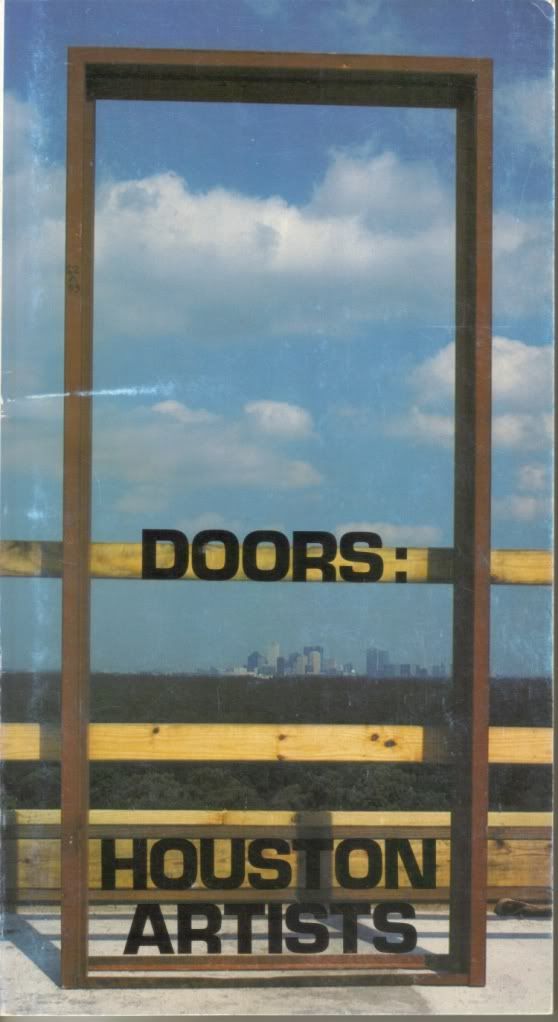
This was a show of Houston art that was put together in 1979. The theme of "doors" is rather contrived, but it does provide a snapshot of Houston art 30 years ago. Of the 54 artists, I recognized seven names--Mel Chin, Manual (Suzanne Bloom and Ed Hill), Gael Stack, Earl Staley, James Surls ... and Salle Werner-Vaughn. Here is her piece from the show:

Salle Werner-Vaughn, The Invisible Door, 1979
So I wonder if she was the sculptor of the two platonic solids in the yard on Blossom St.
Salle Werner Vaughn, an installation artist, has bought several small houses in the neighborhood, all of which have been carefully restored to their original state. A few years ago, Vaughn turned the inside of two Victorian homes into actual exhibits, including one that interpreted the Greek myth of the seasons, which revolves around the kidnapping of Zeus's daughter Persephone. ("Ain't That a Ditch", Brian Wallstin, The Houston Press, December 12, 2006)Then yesterday, I stumbled across this book:

This was a show of Houston art that was put together in 1979. The theme of "doors" is rather contrived, but it does provide a snapshot of Houston art 30 years ago. Of the 54 artists, I recognized seven names--Mel Chin, Manual (Suzanne Bloom and Ed Hill), Gael Stack, Earl Staley, James Surls ... and Salle Werner-Vaughn. Here is her piece from the show:

Salle Werner-Vaughn, The Invisible Door, 1979
So I wonder if she was the sculptor of the two platonic solids in the yard on Blossom St.
Saturday, September 5, 2009
Recent Acquisitions
Comics comics comics by three American masters...
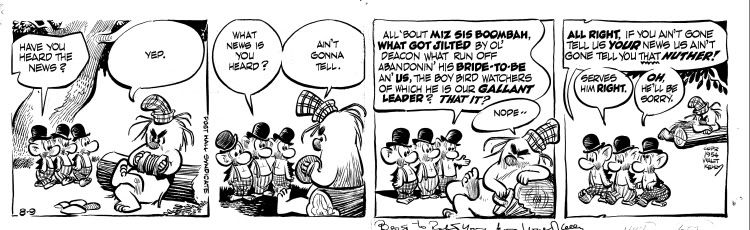
Walt Kelly, Pogo, 8-9-1954
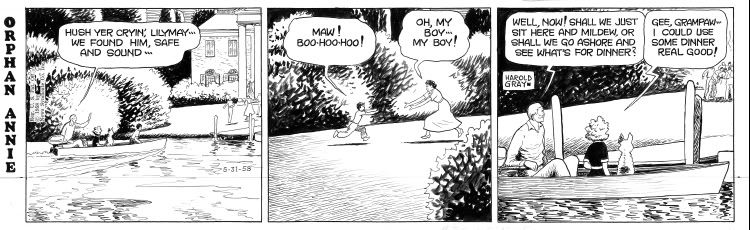
Harold Gray, Little Orphan Annie, 5-31-1958
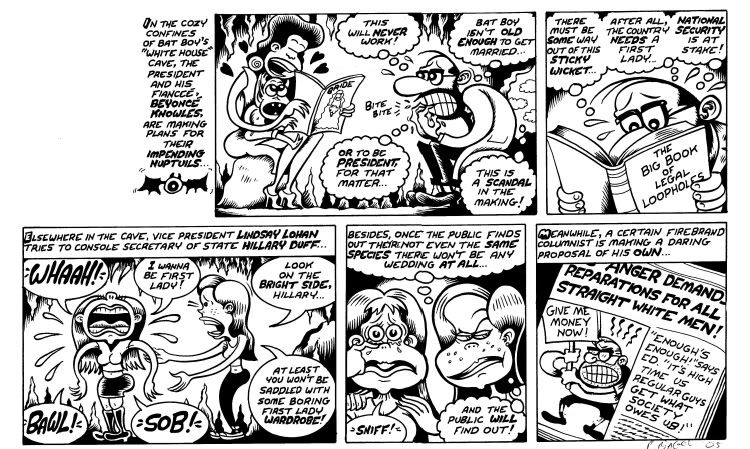
Peter Bagge, Bat Boy, 2005

Walt Kelly, Pogo, 8-9-1954

Harold Gray, Little Orphan Annie, 5-31-1958

Peter Bagge, Bat Boy, 2005
Thursday, September 3, 2009
Lawn Art
Last year in my other blog, I suggested that certain houses in Memorial that had huge front yards would benefit from some lawn sculpture. This weekend, I happened upon some lawn sculptures and had an inspiration--I would create a Google map of Houston lawn sculptures.
View Lawn Art in a larger map
As I discover new, interesting lawn art, I will add it to the map. Readers are free to make suggestions. I won't try to be exhaustive--only sculptures or objects that interest me will go on the map. And I will limit it to private residences. Art on public property or commercial property--however interesting--belongs on some other map.
So the first lawn art I saw Saturday was at the corner of Eberhard and West Pierce.

The sculpture is pretty unassuming. It's only about two feet high. And there is another one on the other side of the front walkway that I didn't photograph. Still, it's interesting to stumble onto a pair of Anthony Caro-like welded metal sculptures in someone's front yard. Anyone hove any idea who the sculptor is?
The second are two sculptures in someone's "back yard" (I use quotes because the house has a really weird orientation on the lot, and the back yard is off to its side). This is at 4618 Blossom, in the weird shaded enclave that seems so different from the rest of the neighborhood. This property is one of the reasons it seems so different.

That's one of the sculptures.

And here is the other sculpture. They are respectively a dodecahedron and an octohedron. They are two of the five platonic solids. (Here's an animated gif of a dodecahedron, included solely because I think it's cool.)

Now it's actually quite hard to see these sculptures. The owner of this proiperty has planted a rather dense privacy screen of shrubs and trees. The property seems rather spooky--it has a swampy, jungle-y vibe. Here's the main house.

You see that stuff hanging between the columns? It looks like the camouflage netting you see in Vietnam movies!
Intrigued, I looked the property up on HCAD. HCAD lists it as having one small house on the property.

But in fact, there are two houses here. One seems like it may have been moved to the property. Here is a photo of the north side of the second house.

Behind that enormous window is the bathroom. The window is obviously a modern addition, but the bathroom has old-style fixtures, including a freestanding tub. It suggests erotic fantasies of walking by on Fowler and noticing a beautiful woman reclining in her bubble bath before this huge window... Ahem.
Anyway, the reason I mention these two strange houses in addition to the sculptures is just to point out how decidedly odd the property is. The owner, Salle Werner Vaughn, lists his residence as being in River Oaks (according to HCAD). Salle Werner Vaughn, as far as I can tell, was (is?) some kind of art educator, as well as an author of at least one out-of-print book.
But enough about his houses and sculptures. Since this is the inaugural Lawn Art blog post, I want to state some principles.
1) Lawn art is a good thing
2) People should put sculptures or other artistic objects in their front yards
3) Other people should respect people's lawn art
Here are some pros and cons of lawn art.
Pros
1) It makes your house more interesting.
2) It distinguishes you from the neighbors.
3) It demonstrates that you have taste (obviously this depends on the art).
4) It gives your front yard a reason for existing (front yards are generally pretty useless in Houston--people do their recreating in the back yard).
5) It shows that you have money (again, this depends on the art itself).
6) It gives people a reason to notice your house and look at your house, which may make it less likely that you will be robbed.
Cons
1) It can be expensive to buy a sculpture.
2) Your art could be stolen.
3) Your art could be vandalized (especially by teenagers with spraycans).
4) Your neighbors/homeowners busybody group/zoning board (in some non-Houston neighborhoods) might disapprove.
5) Lawn art usually requires some maintenance (periodic repainting, rust removal, weeding around the bottom, etc.).
6) It may also require insurance.
View Lawn Art in a larger map
As I discover new, interesting lawn art, I will add it to the map. Readers are free to make suggestions. I won't try to be exhaustive--only sculptures or objects that interest me will go on the map. And I will limit it to private residences. Art on public property or commercial property--however interesting--belongs on some other map.
So the first lawn art I saw Saturday was at the corner of Eberhard and West Pierce.

The sculpture is pretty unassuming. It's only about two feet high. And there is another one on the other side of the front walkway that I didn't photograph. Still, it's interesting to stumble onto a pair of Anthony Caro-like welded metal sculptures in someone's front yard. Anyone hove any idea who the sculptor is?
The second are two sculptures in someone's "back yard" (I use quotes because the house has a really weird orientation on the lot, and the back yard is off to its side). This is at 4618 Blossom, in the weird shaded enclave that seems so different from the rest of the neighborhood. This property is one of the reasons it seems so different.

That's one of the sculptures.

And here is the other sculpture. They are respectively a dodecahedron and an octohedron. They are two of the five platonic solids. (Here's an animated gif of a dodecahedron, included solely because I think it's cool.)
Now it's actually quite hard to see these sculptures. The owner of this proiperty has planted a rather dense privacy screen of shrubs and trees. The property seems rather spooky--it has a swampy, jungle-y vibe. Here's the main house.

You see that stuff hanging between the columns? It looks like the camouflage netting you see in Vietnam movies!
Intrigued, I looked the property up on HCAD. HCAD lists it as having one small house on the property.

But in fact, there are two houses here. One seems like it may have been moved to the property. Here is a photo of the north side of the second house.

Behind that enormous window is the bathroom. The window is obviously a modern addition, but the bathroom has old-style fixtures, including a freestanding tub. It suggests erotic fantasies of walking by on Fowler and noticing a beautiful woman reclining in her bubble bath before this huge window... Ahem.
Anyway, the reason I mention these two strange houses in addition to the sculptures is just to point out how decidedly odd the property is. The owner, Salle Werner Vaughn, lists his residence as being in River Oaks (according to HCAD). Salle Werner Vaughn, as far as I can tell, was (is?) some kind of art educator, as well as an author of at least one out-of-print book.
But enough about his houses and sculptures. Since this is the inaugural Lawn Art blog post, I want to state some principles.
1) Lawn art is a good thing
2) People should put sculptures or other artistic objects in their front yards
3) Other people should respect people's lawn art
Here are some pros and cons of lawn art.
Pros
1) It makes your house more interesting.
2) It distinguishes you from the neighbors.
3) It demonstrates that you have taste (obviously this depends on the art).
4) It gives your front yard a reason for existing (front yards are generally pretty useless in Houston--people do their recreating in the back yard).
5) It shows that you have money (again, this depends on the art itself).
6) It gives people a reason to notice your house and look at your house, which may make it less likely that you will be robbed.
Cons
1) It can be expensive to buy a sculpture.
2) Your art could be stolen.
3) Your art could be vandalized (especially by teenagers with spraycans).
4) Your neighbors/homeowners busybody group/zoning board (in some non-Houston neighborhoods) might disapprove.
5) Lawn art usually requires some maintenance (periodic repainting, rust removal, weeding around the bottom, etc.).
6) It may also require insurance.
Subscribe to:
Posts (Atom)