Showing posts with label architecture. Show all posts
Showing posts with label architecture. Show all posts
Tuesday, April 20, 2010
Legos in the Expanded Field
I don't know anything about James May--he apparently does a show about toys in the U.K. But I loved this Lego house. It's funny that he has two real estate appraisers and an art expert give him values for the house. The real estate appraisers look at it exclusively as a "house" (quite absurd, really) and give ridiculously lowball estimates. The art expert sees it as a sculpture (a rational response, in my view) and gives it a very high estimate. (No one values it on the liquidation value of the Legos themselves, though.)
And here's a video made by one of the youthful volunteers who helped to build the house.
I would like to know who designed the house. Anyone know?
(Hat Tip to Jonathan Chait.)


Wednesday, April 14, 2010
Update on The Fountains Parking Garage

I have found out a little more about this mural, which I wrote about earlier this month. It is by an artist who specializes in murals named Eulogio Ortega. He commented on Swamplot, when they reported on the mural. Some (including myself) worried that the mural might fade (as so many around Houston do). Here's what Ortega wrote:
I used very high quality exterior paint; it’s guaranteed for 20 to 30 years, also it’s on the north side of the building which does not receive any direct sun all year long; that will add to it’s lifespan. This mural is meant to be seen from far away and near. I encourage anyone to look at it more closely once the project area is open to the public. You’ll be pleasantly surprised at the amount of detail and fuller effect that it gives up close. I tried to paint something beautiful and exceptional for the city of Houston to enjoy.
Friday, April 2, 2010
Beautiful Parking Garages
Can a parking garage be beautiful? Yeah, why not? But usually they are hideously ugly. Why? They are designed to be merely functional. Some architect busted her ass designing a building--and the developer paid a lot of money for it. And when she was done, the developer said to some engineer, oh yeah, put a 400 car parking garage next to this masterpiece I just commissioned.
Anyway, The Fountains at Memorial City is no masterpiece. They are condos under construction east of Memorial City Mall. They are being built right next to the recently completed Cemex headquarters. I drive by them on the freeway every morning, but this morning I saw this:

Here's a composite photo of the mural on the side of the garage. And you can see a larger version here.
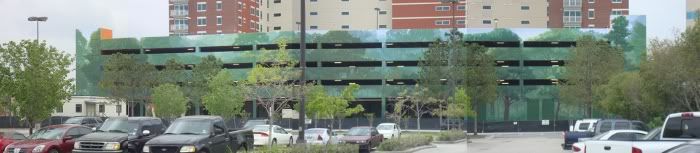
This mural on the side of the garage is nothing especially clever or innovative, but it looks nice and it's a lot more than most builders do for their parking garages. And it works well with the real trees in front of it.
Anyway, The Fountains at Memorial City is no masterpiece. They are condos under construction east of Memorial City Mall. They are being built right next to the recently completed Cemex headquarters. I drive by them on the freeway every morning, but this morning I saw this:
Here's a composite photo of the mural on the side of the garage. And you can see a larger version here.

This mural on the side of the garage is nothing especially clever or innovative, but it looks nice and it's a lot more than most builders do for their parking garages. And it works well with the real trees in front of it.
Tuesday, November 24, 2009
Mid-Century Modern, Houston Style

I want to make a brief mention of this book, which I read last week. It's modest (62 pages, discussing 11 houses designed by William Jenkins) but important for the cultural history of Houston. (Yes, I know--"cultural history" and "Houston" are words that don't seem to go together naturally.) These were modernist houses design by William R. Jenkins and built in Houston between 1951 and 1958. They were all built in the southwest part of town, near the Bellaire and Post Oak. Jenkins was an important Houston architect who eventually became dean of the U.H. architecture school during an important period of its expansion (when the Philip Johnson structure that houses the school was built).
This book goes through each house one by one, with plans, period photos, contemporary photos (when available--not all the houses are still around), and brief but informative descriptions of each house and how it came to be.
The publisher is an organization devoted to significant modernist buildings in Houston (from the modest, like these houses, to the huge, like the Astrodome). Houston Mod is doing great work in both raising awareness of Houston's architectural history and documenting it. (In some cases, Houston Mod members are buying and restoring mid-century modernist houses--and thus saving them from developers who would thoughtless scrape the lot and replace the houses with neo-Tuscan McMansions.)
(Now if only they could update their website with ordering info for this book. I got my copy at the MFAH bookstore.)
Friday, October 30, 2009
The Bizarre Classicism of La Luz del Mundo
If you drive up US 59 from the North Loop, you will soon pass a bizarre building on your right. After driving by it hundreds of times commuting to work, I finally had to stop. It is Iglesia La Luz del Mundo. This is it seen from the south:
 It basically consists of two buildings--a main building, which as a Greek temple-style front and a huge golden dome beside it, and then another, smaller greek temple-like building off to the southwest of the main building. This is the smaller structure.
 You can see that in front of the smaller temple is a circular colonnade.
 It is perhaps the most beautiful (and certainly the most mysterious) feature of the whole complex.
The main building is not only deep, but very wide as well, due to two curved wings in front.
 The building is fronted by very large marble columns (and is indeed made entirely of marble), topped with a pediment decorated with sculptural elements.
 So what is this remarkable complex? La Luz del Mundo is a Protestant Christian sect headquartered in Guadalajara, Mexico.
 When I was taking pictures, I got a chance to speak with the young watchman. He told me that the church took five years to build. He offered to let me see the interior, but I wasn't allowed to take pictures there. A shame, because as mindblowing as the outside is, the inside is even moreso.
Even though they clearly spent a fortune on this church, they really should have spent a little more on the sculptures.
 This pediment is inhabited by various Biblical figures, but unlike a Greek pediment, the figures don't have a visual or spatial relationship with each other or with the architecture of the pediment. One thing that so appeals about the finest Greek temples is the unity of compsition. Everything fits together wonderfully and naturally. Here, it is as if the various elements were sculpted separately and then stuck onto the pediment randomly, with no sense of composition.
The front gates feature similarly clumsy sculptures.
 La Luz del Mundo is not without controversies. And this building seems clumsy, grandiose, crass, and overpowering. Usually when one sees hispanic Protestant churches, one is struck by their modesty and humility. "Humility" is not a word that can be associated with La Luz del Mundo.
And yet, I like it. For two reasons I like it. First, it pays homage, in its own clunky way, to our classical heritage. And second, it is the attempt of a church to glorify God in the best way they know how. All church buildings used to be grand like this, and much of the greatest art ever made served the purpose of glory to God. Folks used to go to church every Sunday in their very best clothes. Nowadays you'll see people walking into church in t-shirts. I'm not a religious guy, but the idea of saving the very best for God has an ancient appeal. The Greeks did it with the Parthenon, and La Luz del Mundo have done it here.
 (Crossposted on Wha'Happen?)
The main building is not only deep, but very wide as well, due to two curved wings in front.
Even though they clearly spent a fortune on this church, they really should have spent a little more on the sculptures.
The front gates feature similarly clumsy sculptures.
And yet, I like it. For two reasons I like it. First, it pays homage, in its own clunky way, to our classical heritage. And second, it is the attempt of a church to glorify God in the best way they know how. All church buildings used to be grand like this, and much of the greatest art ever made served the purpose of glory to God. Folks used to go to church every Sunday in their very best clothes. Nowadays you'll see people walking into church in t-shirts. I'm not a religious guy, but the idea of saving the very best for God has an ancient appeal. The Greeks did it with the Parthenon, and La Luz del Mundo have done it here.
Subscribe to:
Posts (Atom)