Showing posts with label Susan Budge. Show all posts

Friday, October 22, 2021

Some Sculpture Month Highlights

 Robert Boyd

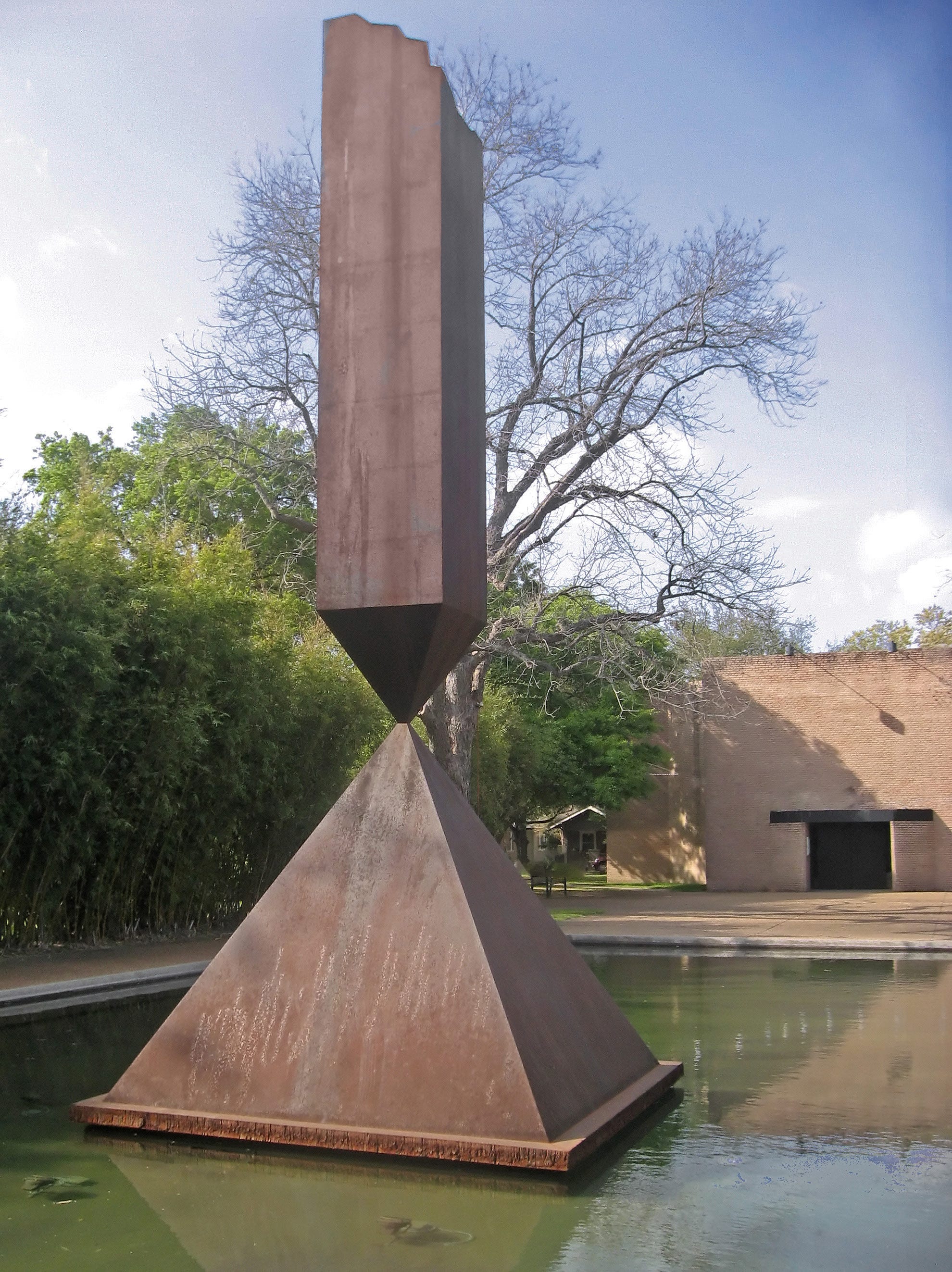
Sculpture in inconvenient. It takes up a lot of space and it therefore difficult to collect. There is a funny quote that is variously attributed to Barnett Newman and Ad Reinhardt: “Sculpture is something you bump into when you back up to look at a painting.” As far as I know, Reinhardt never made sculptures, but Newman did. You can see one of his, Broken Obelisk, in Houston in front of the Rothko Chapel. (And at the University of Washington, at Storm King and at the Museum of Modern Art.)
Admittedly, sculpture can be almost anything now, an idea put forth in the classic essay, “Sculpture in the Expanded Field” by Rosalind Krauss, 1979. The anythingness of sculpture was pushed even further in Thomas McEvilley’s book, Sculpture in the Age of Doubt.

Since 2016, every other year (except 2020) has had a “Sculpture Month” here in Houston featuring a month of sculpture exhibitions at multiple venues across Houston. I want to speak briefly about two of the venues and the sculpture within them. One is a venue I mentioned earlier this week where Nestor Topchy did his performanceThe Silos. Topchy’s performance was part of Sculpture Month (going with the almost infinitely malleable definition of sculpture). The rest of the silos were also used for a variety of site-specific sculptures.

The first one I came across after entering the space was by Shawn Smith called UnNatural Influence, made of plywood, ink, acrylic paint and silk flowers.
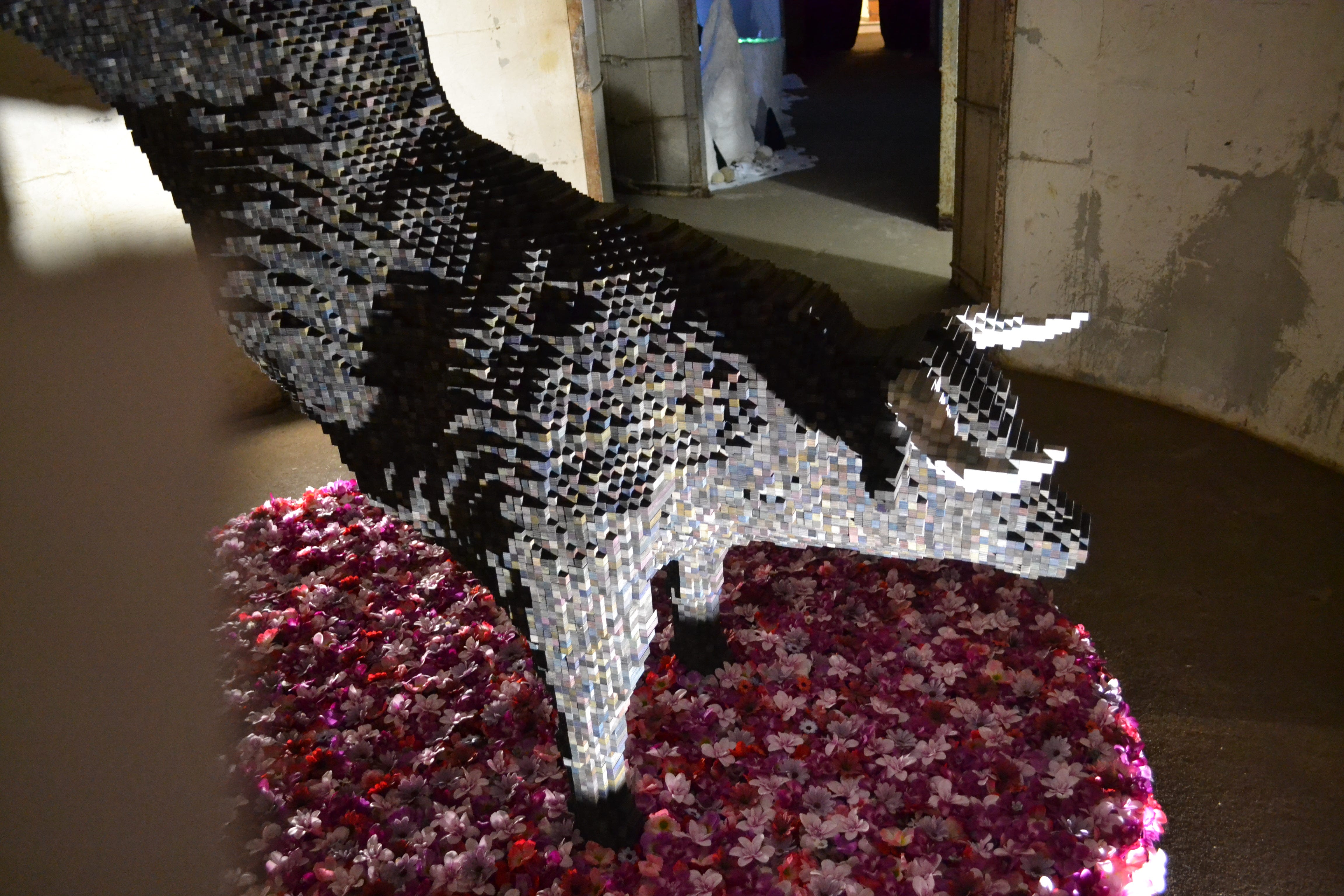
It is a classically Texas subject, a bucking bull, but made out of blocks of wood that imitates pixels. In some ways, this feels like a very traditional sculpture—a single, free-standing object meant to look like a specific thing. Praxiteles would recognize this sculpture, except maybe for the pixelation effect. He would have been most amazed by the artificial lighting effect, which combined with the cave-like interior of the Silos provides a dramatic shadow.
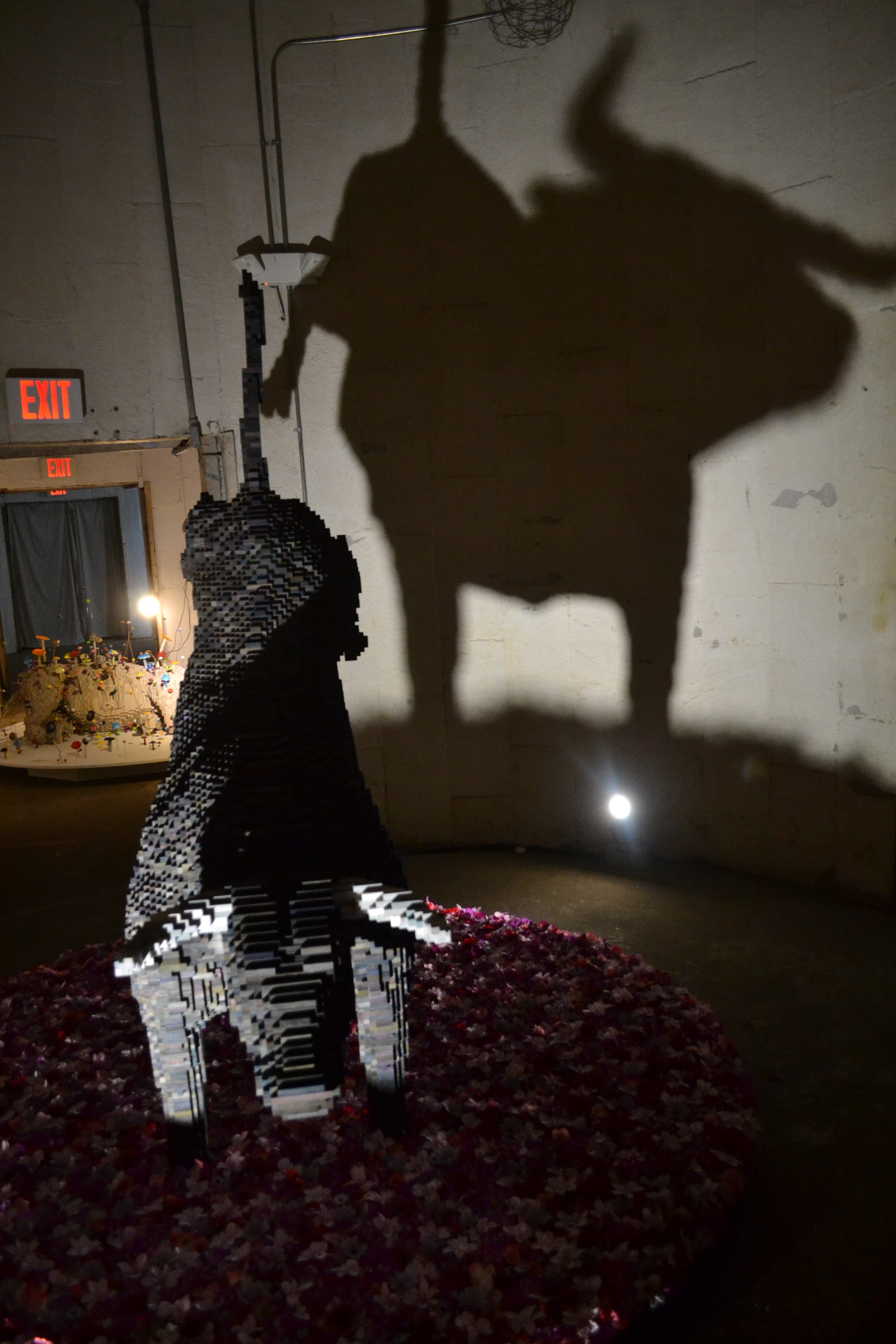
That shadow makes me think of neolithic hunters sitting around a fire in a cave, recounting their hunt for the wild auroch. Aurochs were wild cattle in Europe and Asia that went extinct around 1650. There are depictions of them in cave paintings, including four painted on the walls of the caves at Altamira in Spain. And Altamira is the name of this exhibit, perhaps in honor of cave-like interiors at the Silos.
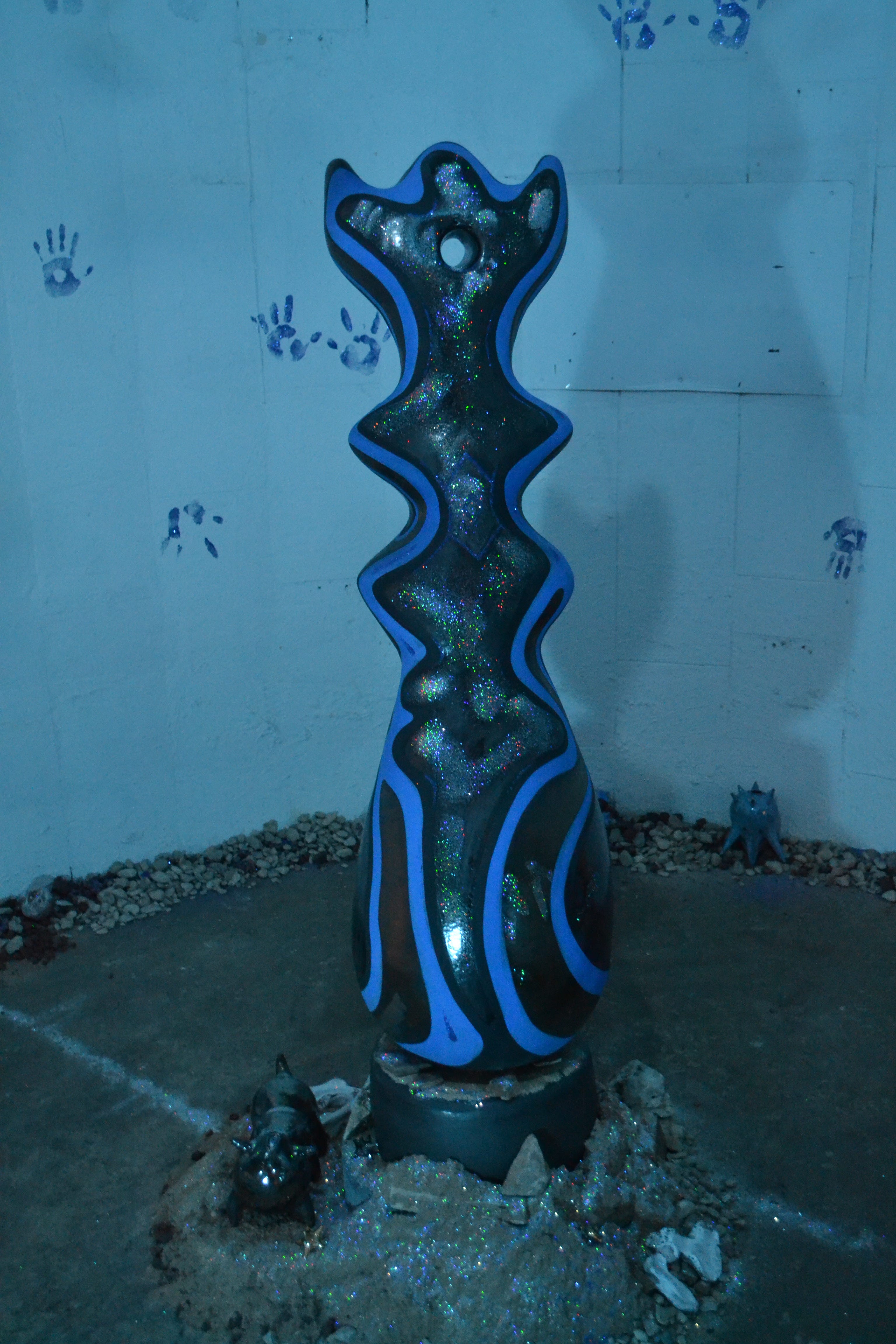
Susan Budge made an installation that made use of the entire silo she had. Stardust features a central object, surrounded by other objects. There is a small floor-level hole in the wall of the silo, into which Budge has placed several ceramic objects and lighted with a warm, incandescent light—in contrast to the dark, bluish light for the rest of the silo. It makes me think of a campfire. Above the central object are star-shaped ceramic figures.
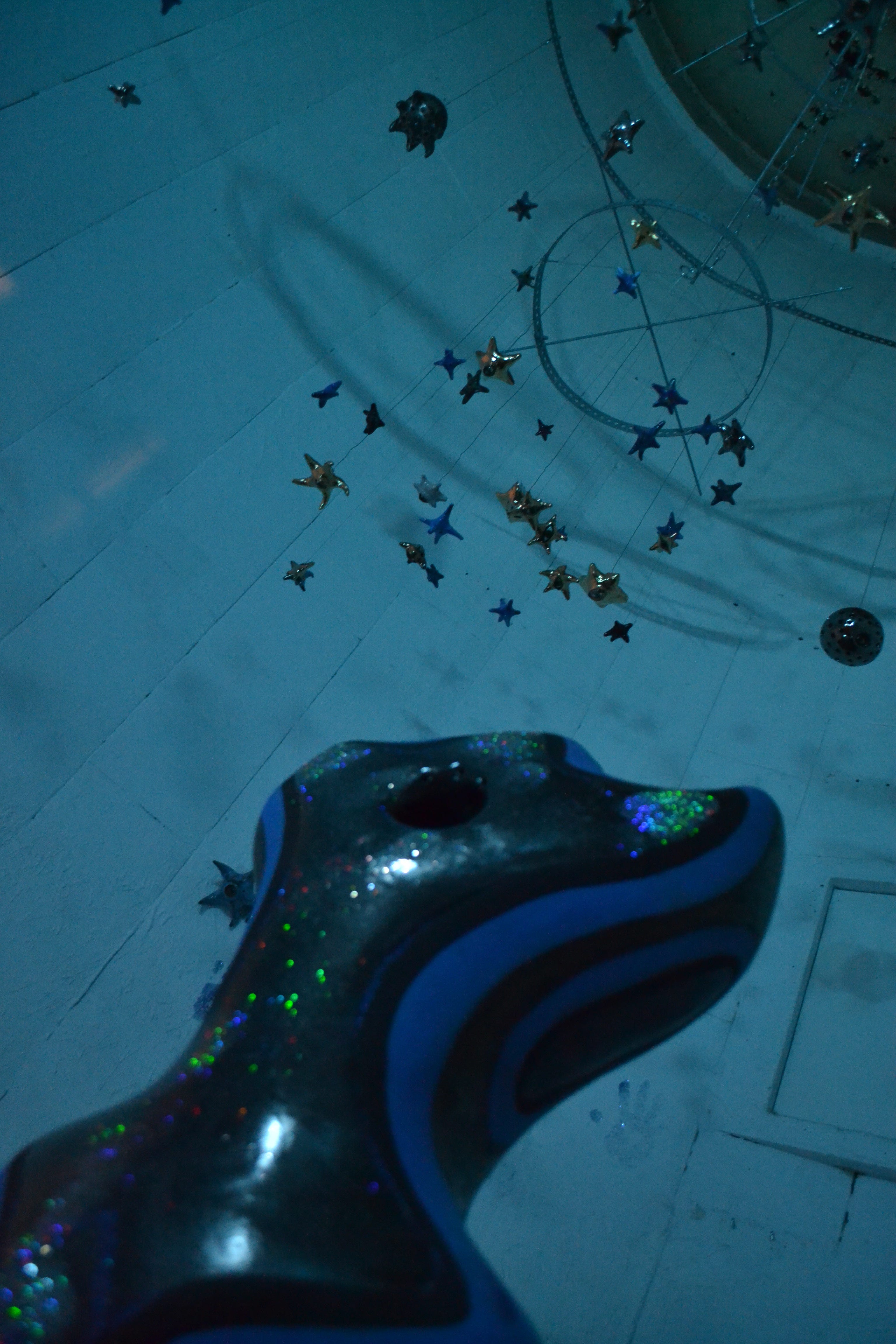
I took them as representing actual stars. In the center of the ceiling of the silo is a large ceramic eye, seemingly gazing down on the scene below. If the theme of the exhibit as a whole is based around our primal need to create as represented by the paintings on the cave wall at Altamira, then what Budge has created perhaps is a depiction of hunter-gatherer types sitting around a campfire with a totem under the stars.
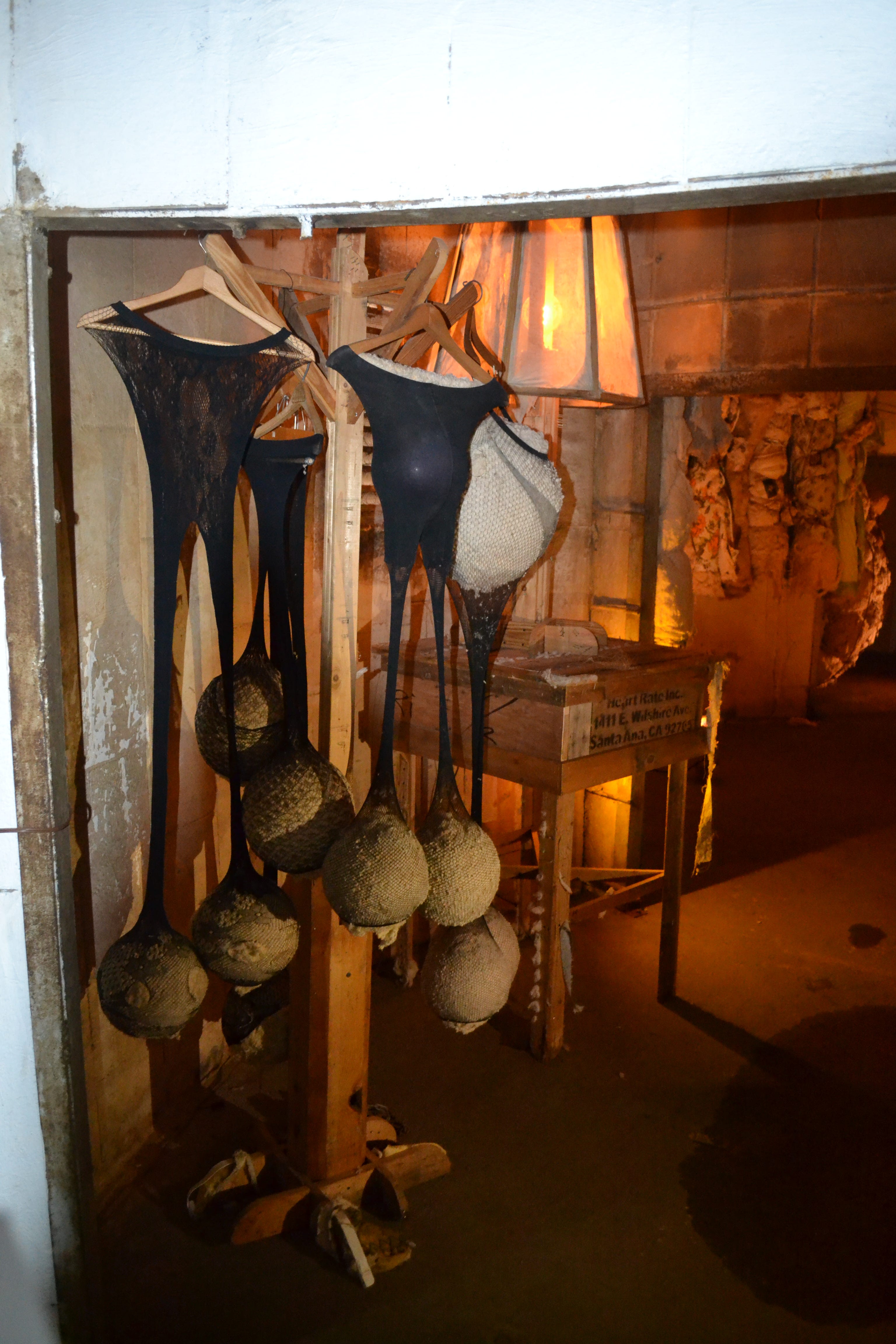
The largest piece was by Kathryn Kelley. Kelley is an artist I’ve written about frequently in the past. Her work always combined a fierce physicality and emotionality and an intellectual underpinning. This probably helps explain why she moved away from the Houston area to get a PhD in studio art. Since she moved, I haven’t seen any new work from her locally, which made me sad. But she’s back for Sculpture Month. This three-part installation is called Disproportionate Dream Fragments, and visually doesn’t seem all that distinct from her earlier work. Instead of using cut-up inner tubes as material, she has found new, grungy recycled material to work with. I always worry that I might catch tetanus from just looking at Kelley’s sculpture.
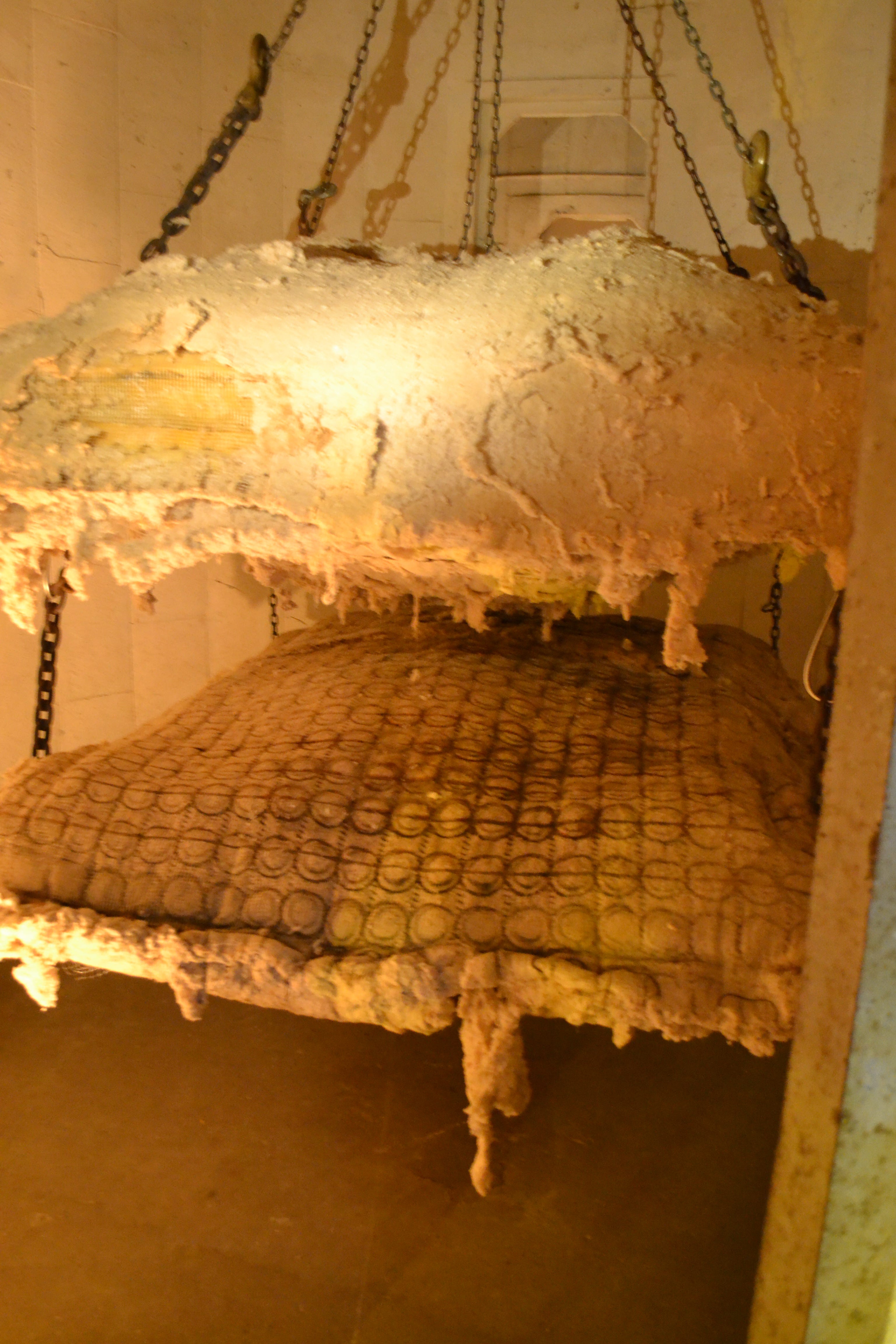
The rusty bedsprings, the loose nails, all adds up to a somewhat dangerous installation. I know that there are artists who have approached this level of pure grunge, especially assemblagists like Robert Raushenberg, Wallace Berman, Ed Kienholz, and George Herms (some of my favorite artists). And yet, none of those artists has ever given me a feeling of physical menace like Kelley does.
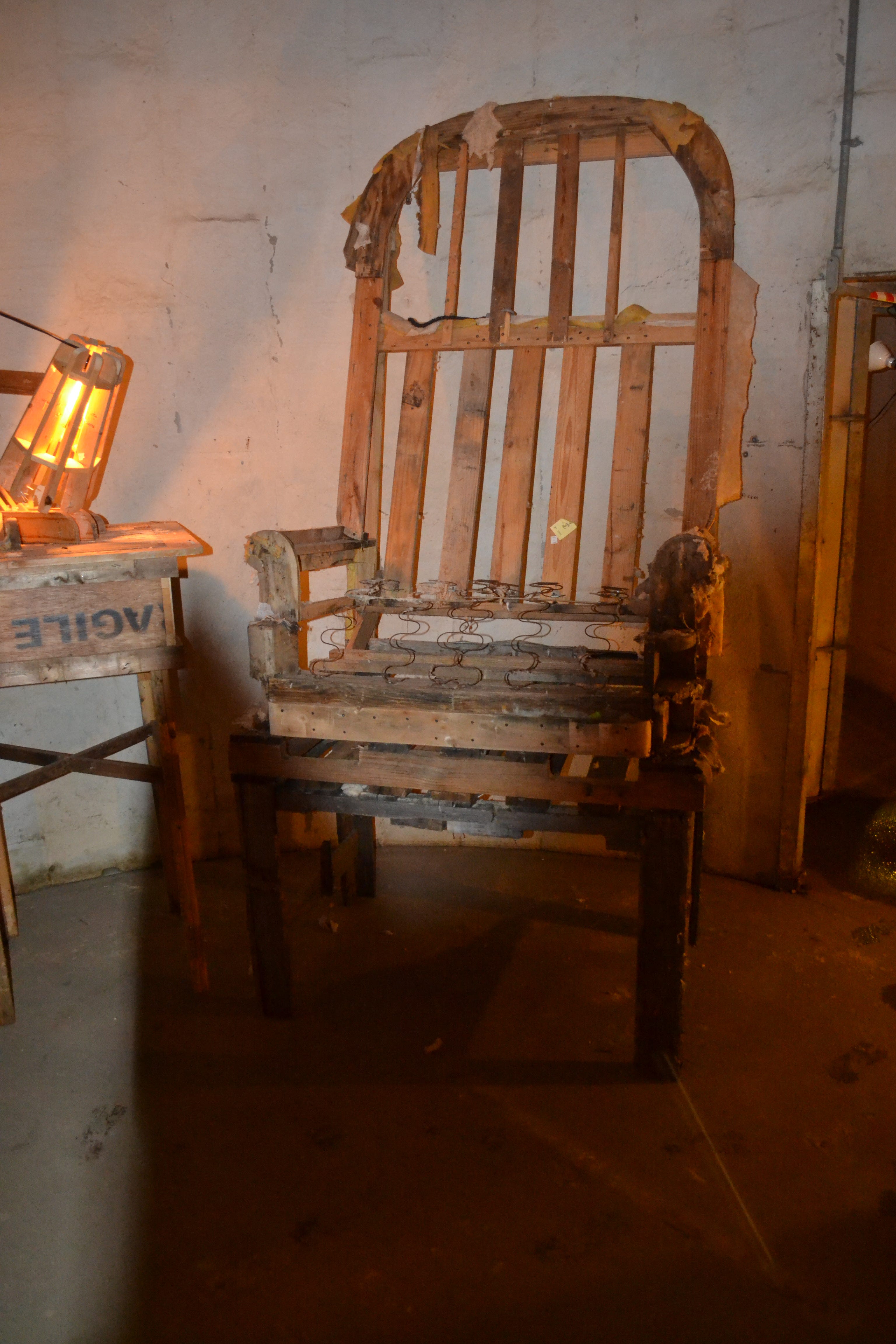
That chair could kill you.
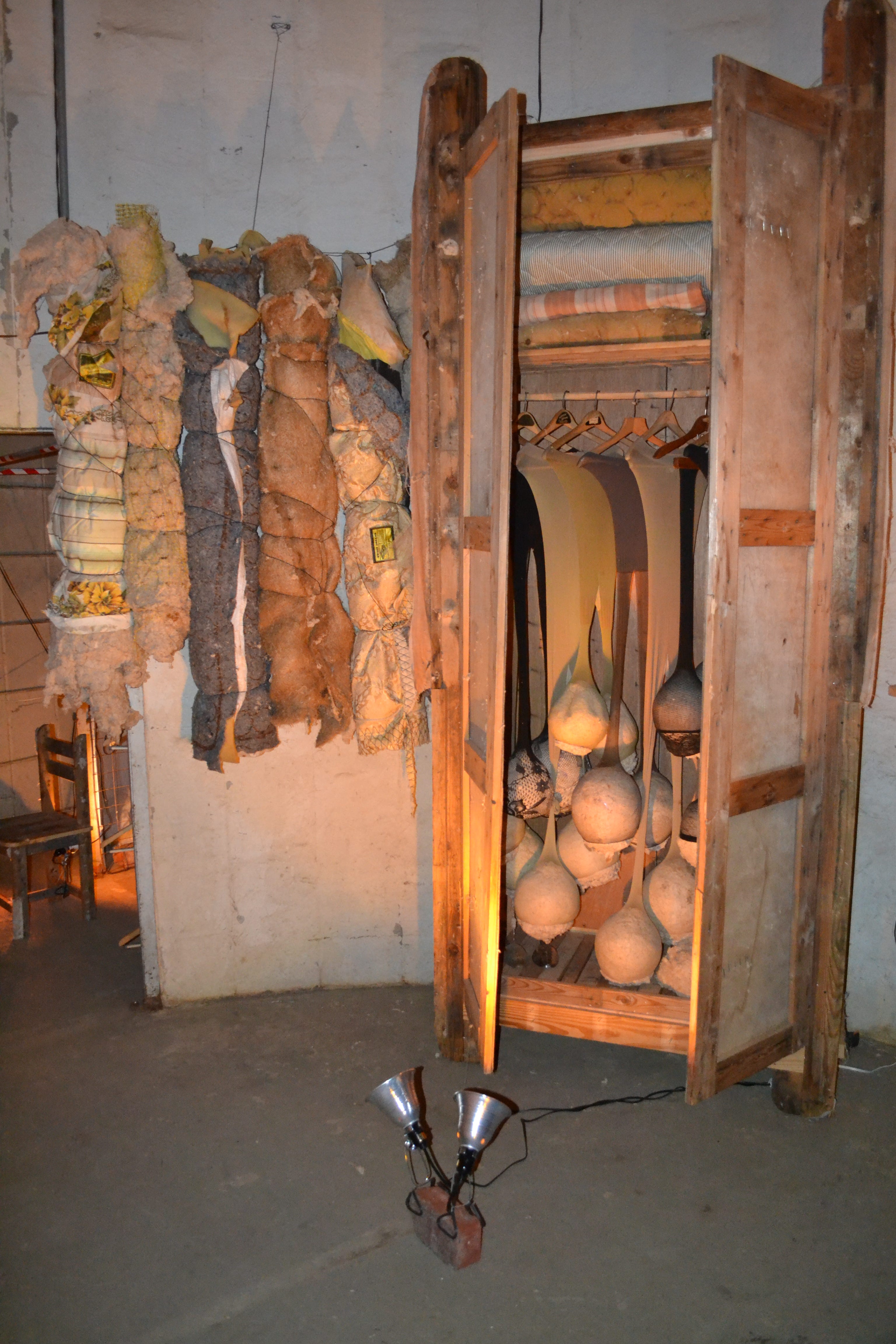
What these photographs utterly fail to convey is the clautrophobic sensation of being in these silos with the work. Kelley didn’t make it easy to breeeze through—you kind of have to squeeze past stuff to see everything. And I hardly need to say that photographing all the work in a given silo is next to impossible.

The installation seems to represent a homey, domestic interior made from scratch by a troglodytic family who only knew about things like beds, chairs, and wardrobes from television images. Their cargo cultic approximations of “home” are dangerous to use and not terribly functional.
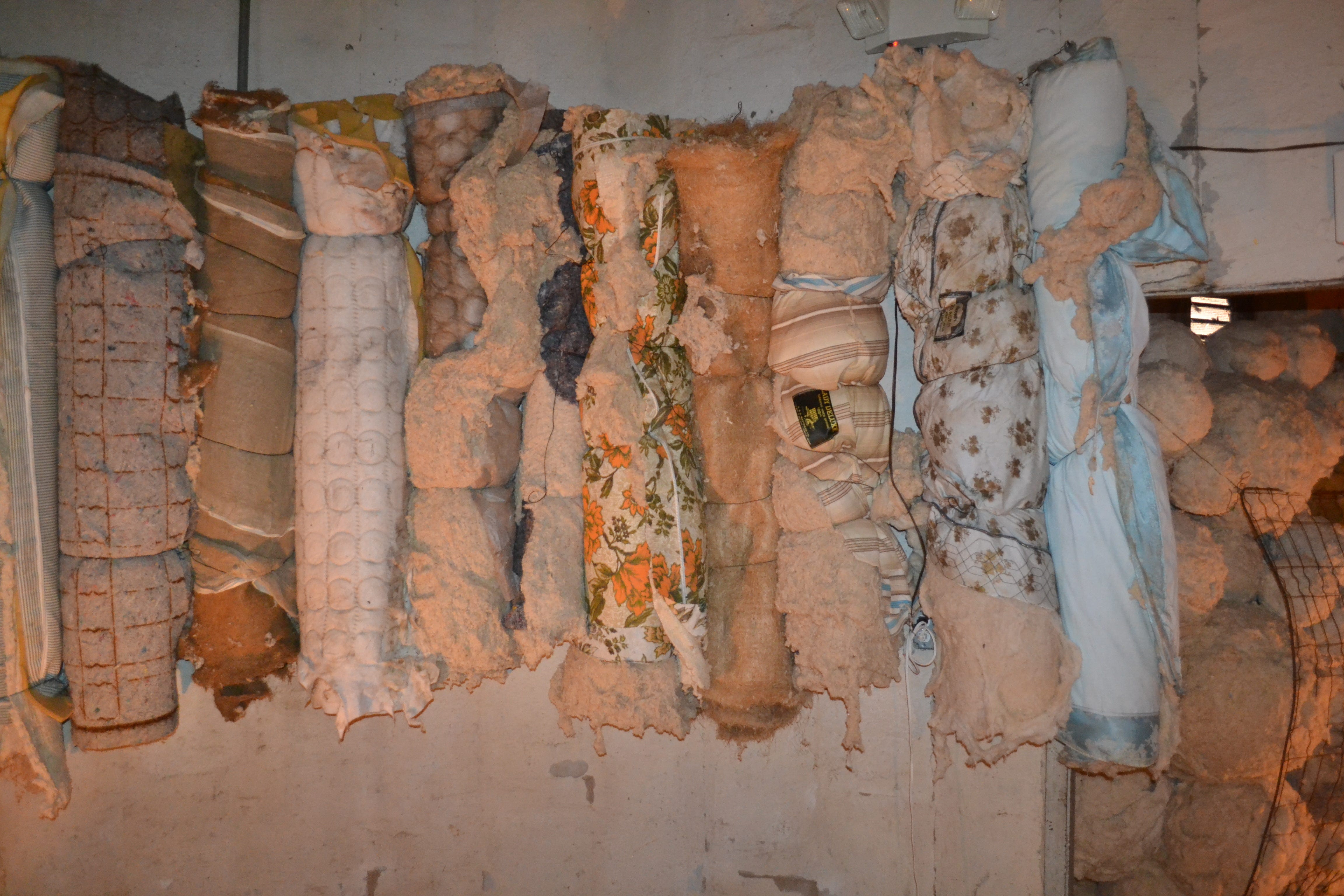
Having said this, I suspect that Kelley has a well-thought-out reason for everything, amply backed by theory and with a highly personal underpinning. This has frequently been the case with her earlier artwork. Kelley keeps a blog, but for the past few years, most of her posts have been about why an artist should write. It feels like a very solopsistic project, an artist writing about artists writing. Lots of quotations and excerpts. Her writing is dense and poetic. I was hoping there might be some clues about Disproportionate Dream Fragments there, but I didn’t see any—nothing obvious, anyway.

The other Sculpture Month show I wanted to touch on was also a group show held at the house of sculptor Michael Sean Kirby. I like house galleries and apartment galleries. I couldn’t imagine doing it myself—my tiny apartment is too cluttered. But Kirby’s house is kind of perfect for this, presumbly because he, unlike me, is capable of keeping it tidy. The show in his house was called “After Altamira” and featured six artists. I’m going to mention two, partly because of all the photos I took that night, they had the only ones that came out good. I do want ot give a shout-out to Ronald L. Jones’ unphotographable installation, Cavity. His work, mostly made of webs of yarn stretched over a space, is extremely difficult to photograph.
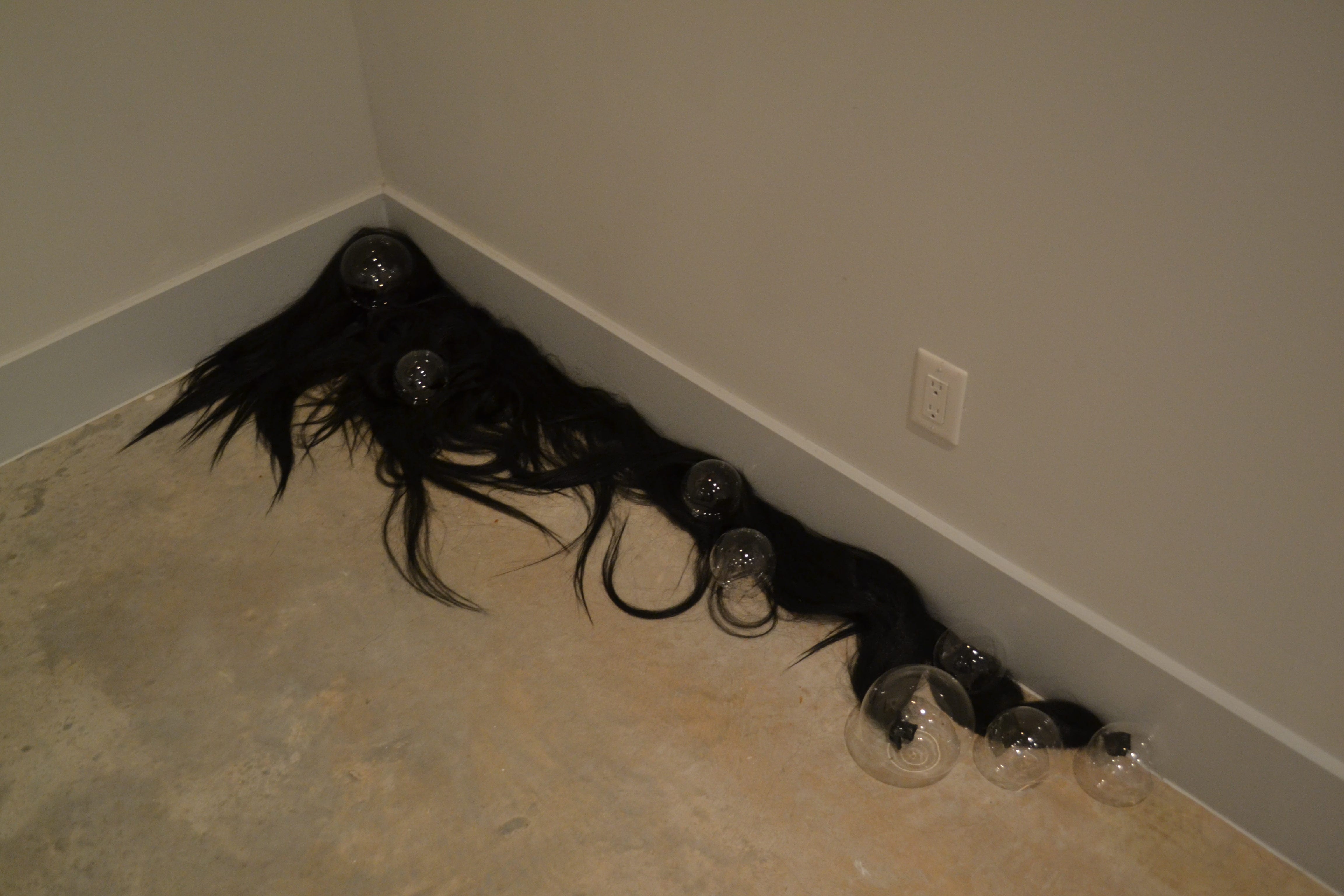
Kamila Szczesna is a Galveston artist who often works with spherical shapes wrapped in stretchy materials. But for this exhibit, the spheres came out of their wrappings. The piece above, interwoven, is made of mouth blown glass and hair. The glass spheres look so delicate, like soap bubbles.
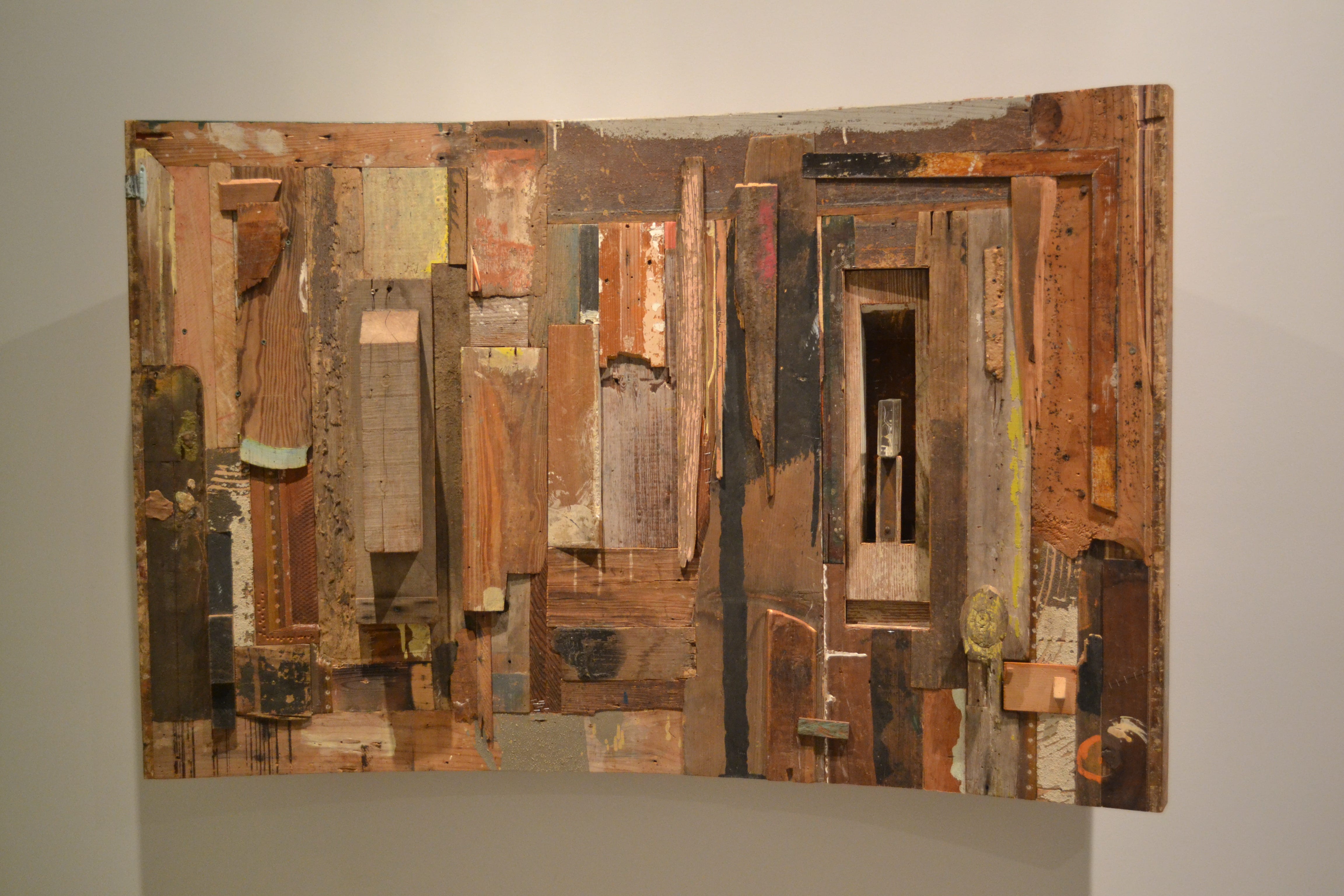
Patrick Renner is an artist I’ve followed for years, writing about his work on my blog and for other publications. His work is closer to the assemblagists I mentioned above than Kathryn Kelly art is—one can certainly see a little George Herms in introvert above. With Renner’s assemblage work, the component parts often have a personal meaning. In this case, they include “the only remaining side of a trick music box my paternal grandfather made when I was a kid” and a “bat house that used to be on my parents’ house.”

The spookiest detail was this tiny bat skeleton encased in acrylic.

Thursday, March 21, 2013

Pan Recommends for the week of March 21 to March 27

Robert Boyd

Do you want to see every art event this week? Sorry, you can't. This is one of the most crowded art weekends I've seen in Houston. In addition to the NCECA conference and the Bayou City Art Festival, there are, by my count, 37 art openings on Thursday, Friday, and Saturday! This list below only captures a small sampling. (And let me recommend Glasstire's listings if you want a more complete picture.) I'll be running around trying to see them all--so maybe I'll see you somewhere along the way!

THURSDAY THROUGH SATURDAY


A ceramic installation from the NCECA Conference website

The National Council on Education for the Ceramic Arts (NCECA) conference at the Brown Convention Center, today and Friday 8 am to 5 pm, Saturday 8:30 am to 11 am. NCECA actually started on Tuesday, and you may have noticed ceramics exhibits opening up in galleries and art spaces all over town in the past week or so. Attendance is a little pricey, but the exhibitors list alone looks worth it.


Miguel Ángel Rojas, Caquetá, 2007. Video, 7:38 minutes

Caquetá by Miguel Ángel Rojas at Sicardi Galleryruns through Saturday. A former Colombian soldier missing both hands cleans off the camouflage paint on his body. Part of Miguel Ángel Rojas' continued examination of the costs of the drug wars in Colombia.

THURSDAY


Image by Teri Frame

Skin Embellished featuring Teri Frame, Ryan Kelly, Linda Lopez, Matthew McConnell, Margaret Meehan, Julie Moon, and Lindsay Pichaske at Gallery 1724, 7 pm (runs through March 23, so catch it quick). This NCECA-related exhibit explores "skin." I don't know what to expect, but that Teri Frame image above freaks me out!


Nils Olav Bøe, Constructed Landscape 7, 2004. From the series Constructed Landscape

International Discoveries IV featuring Nils Olav Bøe, Kim Tae Dong, FLORA, Patrick Gries and Ian Teh at Fotofest, 7 pm (runs through May 4). If you are a little tired of ceramics, Fotofest has a new photography show going up.


The Bridge Club, their trailer, and Sam Houston (photo by Matt Weedman)

The Trailer by the Bridge Club at the Art League, 2 to 8 pm. The performance group's trailer will be at the Art League (which is opening four other shows, so expect a party).

FRIDAY THROUGH SATURDAY


Fired Up by Audrey Heller

The Bayou City Art Festival in Memorial Park, 10 am to 6 pm each day. I like strolling through this Festival and checking out the booths. I particularly like to see beautifully crafted wooden items, and always do a little early Christmas shopping there. The fact is, you never know what you'll see--for example, photographer Audrey Heller at Booth 287.

FRIDAY


I'm pretty sure this one is by Funk

Funk and Budge (Vernon Funk and Susan Budge) at Darke Gallery,  6 pm, up through April 20. I would see any exhibit (or Blaxploitation buddy movie) called "Funk and Budge," but in this case, they happen to be the artists' names. More ceramics from two accomplished practitioners.

SATURDAY


Randy Twaddle, Forager's Compass, 2013, charcoal on paper

New Work: Drawings, Collages, and Tiles by Randy Twaddle at Moody Gallery, 5 pm (through April 20). Every show by Randy Twaddle is a good one, and I expect this will be no exception.

 Share

Sunday, June 12, 2011

Drill Bit Totems by Susan Budge

by Robert Boyd

I was surprised when I walked into New Gallery to see these objects.


Susan Budge, Out of the Depths installation view, ceramic and steel, 2010-11

This sculpture group by Susan Budge, collectively called Out of the Depths, takes drill bits as its subject. Specifically, the drill bits are tri-cone rotary drill bits--the type that are used to drill for oil. 


Tri-cone rotary drill bits

The three cones crush up the rock while drilling mud is conveyed down the center of the drill pipe, exiting through a hole in the middle of the bit, where it carries the crashed up rock (known as cuttings) back to the surface on the outside of the drill pipe. (This is information that rarely comes up in art criticism, but it seems appropriate here.) Invented in 1934 by engineers at Hughes Tool Company, they are still in use today all over the world. For Houston, this is a very important piece of technology. I've often wondered why more artists here don't take this kind of thing as a subject or starting point for their work. Budge's interest is familial--her grandfather was a roughneck--an oil field worker--and her father was a petroleum geologist.


Susan Budge, Out of the Depths detail, ceramic and steel, 2010-11

Budge reverses the direction of the drill bits--they are coming out of the ground instead of going into it. She also puts them on undulating stands to bring them so just below eye-level. The zig-zig stands seem like 1980s new-wave decorative elements. I think these objects are meant to be totemic,  but they come off as somewhat unserious. (That said, they are beautifully crafted.)

On a similar theme are her ceramic representations of hard-hats.


Susan Budge, Tribute and Sacrifice installation, ceramic, 1999-2011

Hard hats are a loaded symbol. In the late 60s and 70s, "hard hat" was a metonym for the conservative working-class men who harbored a resentment towards hippies, African Americans, and other groups who were changing America in uncomfortable ways. (The hard-hats aged and became today's Tea Party.) But I think Budge's conception of hard hat wearers is far more positive, referencing earlier conceptions of working class men as the noble proletariat, the doers. Even though hard hats are worn by a variety of workers in a variety of circumstances, I associate these hard hats with oil and gas workers because of their proximity to the Out of the Depths sculptures and because of Budge's own family history. I also associate it with oil and gas production because I'm in that business myself; I see hard hats (and wear one) whenever I am on a worksite. I work in an office playing with spreadsheets, just like most of my co-workers, and yet every single one of us has at least one hard hat hanging on the wall.

Budge divides the hard hats into two series, Tribute and Sacrifice. Tribute seems straightforward--tributes to the roughnecks and roustabouts out in the oil patch. The Sacrifice hard hats, created in 2010-2011 are quite eerie. They each have a eye staring out from the top of the hard hat. The eye is realistically depicted and slightly uncanny because of it. While the Tribute hard hats are in a variety of fanciful colors. the Sacrifice hardhats are all white. It occurs to me that the Sacrifice hard hats may have been made in response to Deepwater Horizon disaster on April 20, 2010. Eleven workers were killed when the Deepwater Horizon exploded--all wearing hard hats, most likely. Of all the work in the show, I found the Tributes and Sacrifices to be the most moving.


Susan Budge, Sacrifice, ceramic, 2010-2011

Some of the other pieces in the show are identified as "Shalakos" and "Koshares."  Shalako, according to Wikipedia, is "a series of dances and ceremonies conducted by the Zuni people at the winter solstice, typically following the harvest." Wikipedia goes on to note that because Shalako is at least partly open to non-Zunis (unlike other ceremonies), it has achieved a certain popularity with the "New Age" crowd. And these mysterious totemic objects have something of a New Age feel to them.


Susan Budge, Shalako, ceramic, 2011


Susan Budge, Baby Shalako and Baby Koshare, ceramic, 2011

"Koshare" refers to a type of Hopi Kachina, specifically a representation of a clown or trickster figure.


Susan Budge, Koshare, ceramic, 2011

Budge makes reference to her spiritual beliefs in her statement, and my conclusion is that these beliefs are of the New Age variety.  While their eyes give them a bizarre quality, these statues feel fundamentally decorative. They don't strike one with the power of quasi-shamanic performances by Marina Abramowicz and Ulay or Joseph Beuys; or various disorienting surrealist masterpieces like Europe After the Rain by Max Ernst or the She Wolf by Jackson Pollock. These are probably unfair comparisons to make, but worth making if only because Budge's art seems to make big claims for itself. It wants to be spiritually serious. The thing is, one can see putting one of these handsome, well-crafted sculptures in one's garden or in a corner of the house, but one can't see leaving an offering to it. The possible exception to this are the deeply unsettling Sacrifice sculptures. The CEO of Transocean should hang one of these in his office and spend a few minutes every day with it, remembering by name the 11 who died on the Deepwater Horizon. That would be an appropriate offering.


Share