Thursday, March 24, 2011

The Invisible Curator - Home Furnishings

by Robert Boyd

As I was hitting various gallery shows in the past two or three weeks, the two pieces I'm going to discuss here got the attention of the Invisible Curator, who pointed out to me that they were both pieces of furniture (or a depiction of a piece of furniture). I said, Invisible curator, that is a pretty thin reed to hang an exhibit on, especially one with only two pieces in it. Still, I had to admit--they are two kick-ass pieces of art.

Photobucket
Camp Bosworth, La Vida Loca, carved wood, mirror, 50's vintage glasses. (Photo by Robert Boyd)

A giant carved wood pistol, balanced on the floor somehow. But wait! That's not all!

Photobucket
Camp Bosworth, La Vida Loca, carved wood, mirror, 50's vintage glasses. (Photo by Robert Boyd)

It's also a bar! This piece by Camp Bosworth is hilarious for its Tony Montana-style over-the-top garishness. I get the irony, but I also get that you can easily imagine a high-ranking member of the Zetas seeing it, laying down $30,000 (in cocaine-infused hundred dollar bills) and taking this bad boy home. One can even imagine a bloody last stand where the gangster's bullet-riddled body is sprawled over the shattered remains of La Vida Loca. I can hear the narcocorrido now. This piece is on display at Koelsch Gallery until April 23.

Photobucket
Geoff Hippenstiel, M.D., oil on linen, 2010. (photo by Robert Boyd)

Geoff Hippenstiel does work that skates back and forth over the edge of abstraction. This one, however, is firmly in the realm of representation. Somehow, his thick impasto and vigorous brushstrokes seem really right for this subject matter. It's very grungy. It's like a combination of Giorgio Morandi and Willem DeKooning.You can see this piece at PG Contemporary through April 2.

So two pieces of furniture in the Invisible Curator's show this week, both fit for a king--or at least a drug lord.


submit to reddit

Sunday, March 20, 2011

Time Travel at the Art League

I missed the opening of this exhibit of work by Patrick R. Turk at the Art League, but that was perhaps a blessing in disguise. This work is best experienced alone. You enter a darkened gallery with a large hexagonal column in the center. Each face of the column has a lighted part at about eye level. The six lighted parts are composed of circular lenses of varying sizes and varying levels of magnification. When you look through the lenses, you see a brightly lit collage behind them. The collage is three dimensional, and in some the pieces, there are moving elements. Each collage represents a time frame. For instance, one of the pieces represents 360,000,000 B.C. to 65,000,000 (the age of the dinosaurs). We also get more recent (and briefer) time spans, like 1804-1869, which starts with Lewis and Clark's expedition and ends with the completion of the transcontinental railroad. The collage images refer to the removal of the Native Americans who were in the way of America's westward expansion. Two of the pieces depict the future--including a technocratic age of robots and a ecological collapse that leads to a desperate bit of last-ditch genetic engineering.

These interpretations come from the accompanying catalog. The reality is that a viewer--this viewer at least--wouldn't have a real clue what he was seeing. I could see the dinosaurs and Native Americans, but without the catalog, I wouldn't have understood the intent. But that's OK. What is great about these six pieces is how great they look. The second you walk in the room, you are compelled to view the pieces. And viewing them may make you gasp in delight.


Patrick R. Turk, The Time Travel Research Institute, wood, LED lights, glass lenses, paper collage, 2010-2011


submit to reddit

Sunday, March 13, 2011

Emilie Duval's "Extremely Unlikely" at Darke Gallery

by Dean Liscum

On March 11th 2011,Emilie Duval's show "Extremely Unlikely" opened at Darke Gallery. The show is a mix of paintings, sculptures, and a video.

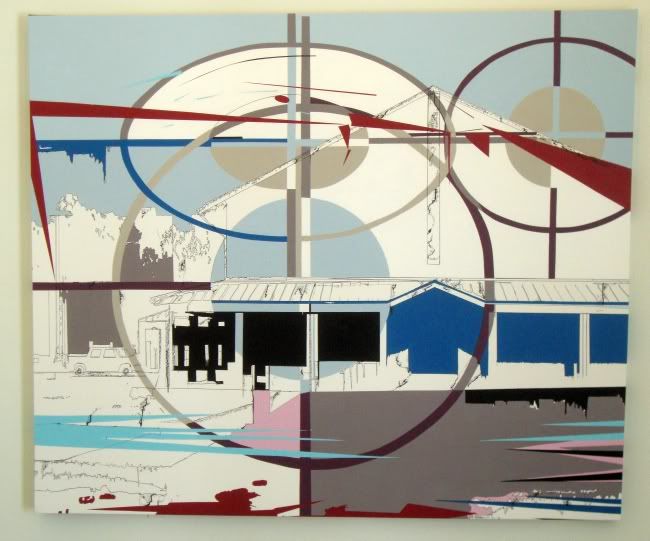
The paintings comprise silhouettes of moose and occasionally other fauna such as a deer, outlines of flora, and schematic depictions of gas stations, churches, and ambiguous architectural spaces. Geometric lines are super-imposed over the scenes to dissect or serve as visual guide-rails. Some works contain sweeping curves and arcs that are reminiscent of Stella or shipman's curves depending upon whether you approach these works from an art historian's perspective or a draftsman's. The colors are muted. Duval saturated them with gray-blue so that everything on the canvas feels cool (not hip but reticent and aloof).
Photobucket
Emilie Duval, Confusing Blast-0ff, Acrylic and in on canvas. (Photo by Robert Boyd)


Confusing Blast-off and Our Dangerous Growing Divide are representative of the canvases in this show. I interpret them as claiming that the world (in all its facets: social, political, religious, economic) is out of balance.

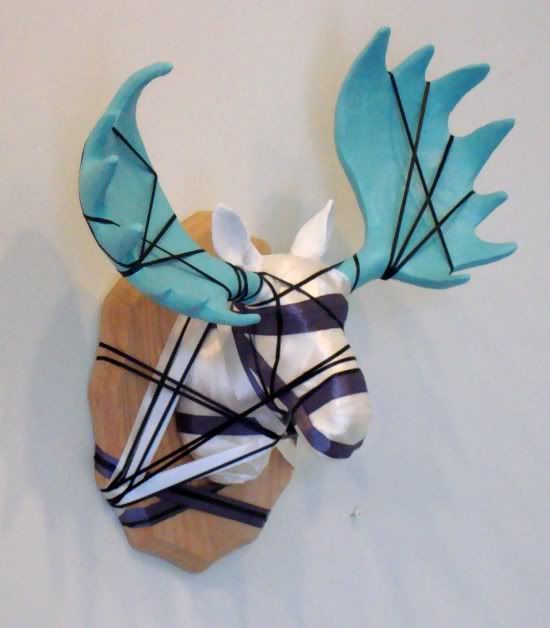
Duval's sculptures consist of several pre-fabricated wooden mounted mooseheads wrapped in pastel ribbons. They're soberly entitled "Thread of Ambiguity", "Appropriate Behavior", "First to Report", "Control Performance", and "Global Threads".

Photobucket
Emilie Duval, Appropriate Behavior, ribbons, wood sculpture. (Photo by Robert Boyd.)

Photobucket
Emilie Duval, Global Threads, ribbons, wood sculpture. (Photo by Dean Liscum.)
Photobucket
Emilie Duval, Threads of Ambiguity, ribbons, wood sculpture. (Photo by Robert Boyd.)

The symbolism is obvious enough: the wild (nature or your inner wild thing) in wraps. Yet, Duval's chosen materials and colors compromise its cogency. Instead of a powerful image, the shiny ribbons and mass produced wall mounts transform the experience into more of a pop fetish a la Rihanna's S&M music video than a powerful image of authentic repression, control, or discipline. An appropriate title for the series might be "Brownie troop XXX does Bullwinkle in Bondage". "Javelin", a two meter-long stick adorned with paint, rope, and tape seems both materially and curatorial-ly out of place. It leans in a corner looking more maintenance-like than menacing. Positioned differently I might have appreciated it differently.

The video, "Regulation 1.10", is ambiguously disturbing. There's a human-sized white bunny (think Donnie Darko) and pre-teenage boy in a large house. The bunny wanders the house through its daily routine. The boy follows and serves him. The relationship is obviously hierarchical but its nature is vague. It might be sexual, paternal, religious, financial, etc. Everything moves in slow motion as if you're in an evidentiary hearing and the projectionist has slowed down the video so that we can clearly see the violation. I hate to spoil the ending for you, but it never comes: neither the ending,nor the bunny, nor the boy. From the artist's website and speaking with her, I learned that the title Regulation 1.10 "refers to a proposal to limit the leverage in Forex to 1:10. The white bunny is the Speculator Guardian. The video is slow and the atmosphere heavy to emphasize the ferocious ambiguity between wealthiness and normal behavior regarding financial matters." As with the current financial situation, I don't see a lot of normal in this video, which may be the point.

Duval comes to art from the legal profession. This biographical detail is telling because her works approach their subjects very formally with a level of detachment that is associated with legal arguments or
intellectual discourse. If this is a warning cry, it's not a bang or even a pop, but a polite whimper prefaced by the phrase, "if it please the court." It's extremely unlikely to get the emotional reaction its subject needs.


submit to reddit

Please Welcome Dean Liscum

Photobucket
Dean Liscum at Box 13's fundraiser, The Empty Box. Photo by Robert Boyd

by Robert Boyd

A few weeks ago I asked readers if there were any of you who might be interested in contributing to The Great God Pan is Dead on an occasional basis. One writer answered the call--Dean Liscum. My hope is that between the two of us, we can cover Houston's art scene better than I could do solo (as well as covering any other art topics that interest us). I asked Dean to describe himself, and he wrote this:
Dean Liscum is an inveterate art observer. He's written about the Houston art scene online (http://dean4hire.blogspot.com) and in a number of Houston periodicals including ArtsHouston (now defunct) and Houston Free Press.
One thing I found striking about Dean is that he has something of a similarity to me in that we are both more-or-less middle-aged guys who live in the suburbs and really like art. We get in our cars and schlep into the inner Loop to see what's happening. For us, art is a hobby that we feel passionate about. For our peers, it might be golf or hunting or collecting baseball cards or classic automobiles or the Rockets. But we chose art for some reason.

But despite this similarity, I'm hoping that you'll find that Dean's opinions are not the same as mine. It was my goal in adding additional bloggers that I would be adding additional points of view.

There will be a few other changes on the blog. I have always been a bit fast and loose with the photo credits--obviously that will change. And each blog post will have a byline now. I hope readers enjoy Dean's contributions, and please remember that I am still interested in expanding the number of voices here. There's no money involved--this is purely a hobby, an amateur operation--and I can't even promise "exposure" since we have a pretty small readership (an average of 272 page views a day this year). So if you can get past that giant lack of incentive, we'd be interested in your voice and your opinions.


submit to reddit

Friday, March 11, 2011

Folk Art? Lawn Art? Whatever It Is, I Like It

Photobucket

Great catch from Swamplot today. Someone down in South Houston has taken a welding torch and turned his mailbox into a totem of the alien from Alien. I love lawn art in general, and this is an awesome example of someone turning a quotidian object into an idiosyncratic, highly-public piece of personal expression.


submit to reddit

More Art Advertising

A couple of weeks ago I blogged about the billboard for the Fourteen11 student show. I just saw another ad for an art exhibit in an unexpected place--on Facebook.

Photobucket

When you click on the add, it doesn't take you to Barbara Davis Gallery, it takes you to Todd Williamson's Facebook Page. A quick check at the Barbara Davis Gallery website doesn't say anything about this show (more than a month away), but Williamson was part of the group show that just ended there.

So why does this ad pop up when I'm on Facebook? It's the way Facebook allows advertisers to target their ads. You can specify a location (by country, state or city), demographics (age, gender, relationship status, language, education, workplace, , by interest (for instance, "art"), and finally a budget you are willing to pay (over the life of the campaign and/or daily). Every time someone clicks on that ad, you pay down a little of the budget. Presumably the ad stops running once you have hit the budget cap. (This is so easy, I might try it for The Great God Pan Is Dead. Call it an experiment. And if my number of "followers" increases, I'll call it a success.)

What is interesting here is that in both the Fourteen11 billboard and the Todd Williamson Facebook ad, it was the artists and not the galleries who took out the ad. Artists may not like the idea of self-promotion like this, but I suspect it's going to be a permanent part of the world of art from now on. The issue is how to keep from seeming totally crass (unless crassness is part of your artistic identity, like Mark Kostabi). It's all part of personal brand management, which is an irksome concept but one we all participate in every time we update the old resume or join Linkedin.


submit to reddit

Monday, March 7, 2011

High Volume on the Dream Market

Earlier today I idly wondered on Facebook how many dreams Man Bartlett had priced in his performance, #24hClerk. In a dexterous display of cross-social media communication, this was Bartlett's response:

Photobucket

Let's say it was 700. That means Bartlett was pricing, on average, one dream every 2 minutes and 3.4 seconds. Pretty fast pace!


submit to reddit