Showing posts with label art blogging. Show all posts

Thursday, June 28, 2012

You're Reading the "Best Arts Blog" in Houston

by Robert Boyd

Photobucket
Pan by Ron Regé

The Houston Press's readers have voted The Great God Pan Is Dead as the Best Arts Blog in Houston in the Houston Web Awards. I'm grateful for the honor, but it got me thinking about the "competition." It's funny to even use the word "competition." Bill Davenport, who writes the news for Glasstire, occasionally expresses mild disappointment when I scoop him on some bit of news (a rare event). But I never call Dean Liscum and Virginia Billeaud Anderson into the boardroom and say, "Crush Glasstire!" while pounding my fist on the conference table. I just don't see myself in competition with other arts writers and arts blogs in town. We're all colleagues.

Photobucket

In any case, I consider Glasstire to be a different beast than Pan. I see Glasstire as a full-fledged magazine that happens to live on the web. It has different departments--it has feature articles, reviews, columns (which they call blogs), news, classifieds, a calendar, etc. Very unlike a blog, which is highly linear--one post after another. Glasstire is not linear--like a print magazine, it is multidimensional. The reader can enter it at various points depending on her interest. And it has a fairly large stable of writers. And I have to add that Houston is really lucky to have Glasstire around. I know I depend on it.

Photobucket

What else is there? Well, there is The Silo by Raphael Rubenstein. This blog won a Creative Capital/Warhol Foundation Art Writers Grant in 2010. Rubenstein is a critical studies professor at U.H. and edited a book about art writing that I really like, Critical Mess. The Silo is " a personal, revisionist 'dictionary' of contemporary art. Its primary aims are to challenge existing exclusionary accounts of art since 1960 and to offer a fresh look at some canonical artists." And this is part of the problem--at least in terms of local popularity. Rubenstein isn't reviewing current exhibits. In fact, it is pretty much impossible to see many of the artists he writes about locally. The whole project--which I love--is about constructing an alternative, highly personal art history of the past few decades of art. Another problem with The Silo is that Rubenstein is not terribly prolific. Popular blogs get updated constantly. In short, The Silo is not the kind of blog that is likely to ever win a local popularity contest like the Houston Web Awards. But it is a great blog if you like diving deeply into the obscure corners of contemporary art--which I do.

Another local arts blogger is Theodore Bale. He writes a blog called Texas, A Concept which is hosted on ArtsJournal. Bale has a music background and writes primarily about music and dance. His writing is thoughtful and incisive. But as a blogger, he has the same problem as Rubenstein--he is not very prolific. Or, to put it another way, he is not a prolific blogger. As a freelancer, he writes quite a lot for other publications, especially CultureMap. I think it's hard to be a professional freelance writer and a blogger. A freelancer needs to be continually seeking out paying work--the best paying work he can get at any given time.

There are local art blogs that are really personal blogs which have a heavy art component. One of these is Neon Poisoning by Robert Kimberly. The value of such a blog is that it has no agenda, and because of this, it can surprise you in delightful ways. For instance, this post noting the relationship between the work of Miina Äkkijyrkkä and Daniel Anguilu.

Photobucket

Lots of local artists have their own blogs. I've linked to Professor Art, Earl Staley's blog, many times. I like it because he frequently takes the reader through his creative process on his paintings, showing us works in progress. Brian Piana's blog, Art Falls Out, is primarily images (lucky for me he saves his writing for Pan). Some of the images are his own work, and some of it work he likes. This is a good approach for artists--showing images of work that is meaningful to them, whether their own or other people's work. But you don't need a "blog" to do this--a Pinterest board or a Tumblr work just as well. There are tons of Tumblrs that show nothing but jpegs and gifs that their author finds interesting. Another local artist, Alexandre Rosa, does this kind of thing on his blog Fiery Laundry. But the champion artist-blogger is Stephanie Toppin, who essentially has five simultaneous blogs, including Art Keeps Me Poor, fabric+lines, Obey Crochet, Hello Very Much, and Very Dead Toys. Each one more-or-less focuses on a different interest of Toppin's.

I don't know much about local blogs dealing with theater or dance or art music. I'm a visual arts guy. If you blog about art or music or dance or theater, leave your link in the comments. I'd love to read your blog.


Share

Saturday, January 7, 2012

Ring in the New Links

by Robert Boyd

Progeny of the Tush Hog
Buster Graybill, Progeny of the Tush Hog, mixed media. My nephews are arranging the Tush Hogs into an impromptu football field in this photo. This show was on Salvador Castillo's "best of" list. (Photo by Sarah Boyd)

The Best of 2011, Austin Edition: Salvador Castillo put up an entry in his all-to-infrequently updated blog 'Bout What I Sees with his list of 19 shows that he really liked. I only saw one of them--Recovering Beauty at the Blanton (resolution--more trips to Austin in 2012). Castillo's list included such Houston favorites such as El Anatsui, Claire Falkenberg and Barry Stone. If reviews are the first draft of art history, "best of lists" are the second draft. (Now who has a "best of list" for Dallas/Fort Worth or San Antonio?)

Best of 2011, Britt-Darby Edition: Devon Britt-Darby also came up with a top 10 list with no particular geographic focus (although most of the shows were naturally from his former base in Houston). He limits his list to museum shows. Included are Donald Moffett: The Extravagant Vein at the CAMH, Upside Down: Arctic Realities at the Menil, and Andrei Molodkin: Crude at the Station Museum. [Reliable Narratives]

Paloma
 Paloma from Budapest at the Rita Ackermann at the Ludwig Múzeum.

I don't go to galleries and museums just for the art: Checking out the beautiful, fashionable women is a big motivator, too. For hetero men (and lesbians, I suppose), this is one of the key pleasures of going to openings, etc. Now at last there is a website that acknowledges this unspoken truth: Babes at the Museum. Of course, I added it to my RSS feed instantly. [hat-tip to Hyperallergic]

Francisco Solano Lopez
Argentine comics great Francisco Solano López at 28 in 1956

One we lost in 2011, Francisco Solano López: Solano López was one of the key artists in the history of Argentine comics. If you can find it, get a copy of Deep City (1986, Catalan Communications). I had the honor to edit his work in the early 90s, and I even wrote a short story for him to draw, "Buoy 77," that appeared in Dark Horse Presents. He was one of the greats, and seeing this photo reminded me how much I missed him. Solano was the same age as my dad, which may have something to do with my feelings about him... [The Crib Sheet]


Share


Friday, December 2, 2011

Seven Blogs that Are $30,000 Richer Today Than They Were Yesterday

by Robert Boyd

These blogs' windfalls are because they received 2011 Arts Writers Grants from the Warhol Foundation/Creative Capital. I applied for this grant last year (and I'll try again this year). So if I say anything against any of the winners, it's probably my jealousy talking.

Carol Deihl's Art Vent is a highly personal art blog. She writes about art a lot, but also about things happening in her own life (a life that revolves around art, since she is artist and a contributing editor for Art in America). I like the casual style she uses. It sometimes feels diary-like, but her discussions of art show that this is a critic writing. She occasionally shows her own work on the blog. Here are a couple of pieces that I liked.


Carol Diehl, Gloria, oil on panel, 2007


Carol Diehl, Isla de Encanta II, oil on panel, 2007

Jason Farago's blog Art in Common is supposed to be a blog about public art in New York and how it relates to the city. Sounds great except that it doesn't exist. I think this is kind of bullshit. I can see how someone writing a book would need a grant to survive during the period the writing is taking place, but blogs have no barriers to entry and exist in the now. Nothing against Farago--he followed the rules and presumably submitted a kick-ass blog proposal. But if I were running Arts Writers, I would make the grant for existing blogs only (or blogs that existed but had to be suspended for some reason--see Claudia La Rocco below). Show that you have some sweat equity in this thing, and we'll help you grow. Anyway, keep your eye out for Art in Common--coming soon to an internet near you.

Claudia La Rocco's blog The Performance Club also doesn't currently exist, although it once did. She wrote it when she was the cultural critic for WNYC, which hosted the blog. (WNYC currently hosts the blog Gallerina.) It looks like it was a good blog, and I'm glad Arts Writers is helping her revive it.

Sohrab Mohebbi's proposed blog Presence Documents "will consist of daily entries, each focusing on a video or image posted online on the same day by citizen reporters and indigenous journalists. Mohebbi will also relate these images of the present to performance art’s experiments with documentation." There are lots of blogs that troll the internet for images that appeal to the bloggers, which they then just pop up, without comment. I wonder if adding commentary to such images will be any better. Especially if these are news images--it strikes me that trying to relate them to performance art will trivialize the real experiences the images document. Once again, this seems like the kind of blog that would cost nothing to start, therefore I wonder why he hasn't done so. Why did he wait for the grant?

Valerie Soe's blog beyondasiaphilia is a blog primarily about Asian film in all its forms. It looks quite good. It's not a topic I have a special interest in (although I occasionally watch Asian films, of course), so it's hard for me to comment about the blog. If Asian film an area of interest for you, I suggest you check it out. But one thing I liked about it is that while she has a primary area of interest, she will also write about art exhibits, political happenings in Oakland, and other things that interest her.

Meredith Temple's proposed blog is Art and Shadows. She will deal with art in light of current theories of mind and consciousness. That sounds a bit high-level to me, but if she is approaching it in terms of psychology and neuroscience (as opposed to philosophy), it could be interesting. I've long contended that the intellectual frameworks with which we approach thinking about art are too narrow. But again, I wish she'd just started writing the blog instead of waiting around for Arts Writers to give her a grant.

James Urban, R.L. Tilman and Amze Emmons have a blog called Printeresting. Urban teaches print-making at U.T., so this is the only Texas blog to win a grant. I would have definitely given them the grant if I had been on the grant committee--this blog is totally fun and just loves its subject, printing in all its diffeent forms and aspects. For instance, one post begins, "This guest post by Josh Dannin, a talented print artist, who has been traveling around the continent visiting printshops and paper mills." Josh Dannin is clearly a fanatic, and Printeresting clearly loves his fanaticism. (Confession--I once visited the Strathmore paper mill in Massachusetts because I was interested in seeing how they made the paper that most comics artists used.) They also have a great logo.


So what can I learn from these blogs? Well, it helps to be from New York. Four of the seven winners are from New York. It helps to no already have a blog--four of the seven blogs don't currently exist. So that's two strikes against me. It helps to be accomplished in the art world outside your blogging--to be a curator or an art writer in other publications for example. Other than that, the existing blogs that got grants are not all that different from The Great God Pan Is Dead in terms of content. But they all had one thing in common with each other that Pan doesn't have--they have clean designs with white backgrounds. Maybe that's the secret to success!


Share

Sunday, May 8, 2011

Report from Austin part 2: A Buncha Art Critics, Sittin' Around Talkin'

The reason I was invited up to Austin for the Hybrid Arts Summit was to represent bloggers in one of a series of critical roundtables. There were three in all. The first one featured Wendy Vogel, Core Fellow and editor of ..might be good, and Jeanne Claire Van Ryzin, arts critic and reporter for the Austin-American Statesman. They spoke a great deal about the mechanics of their respective gigs--circulation, who reads their work, how assignments work, the business of the publications, etc. I was astonished to learn that ...might be good had 8000 subscribers. Subscribing is free, admittedly, but the subject matter of the web magazine is fairly narrow--mostly contemporary art in Texas or somehow related to Texas. Of those 8000 subscribers, only 16% of them are from Texas. One can only speculate who the non-Texan readers are and why they subscribe. Perhaps it says something about the uncentered nature of the art world that interested parties feel they have to subscribe to a critical web magazine from Texas.

This is a subject that I find interesting--who reads criticism (and art news) and why? To me, this is one of the defining issues for a publication. It should be a key part of one's publishing mission--to fulfill the needs of those readers. Van Ryzin described the mission of the Statesman as to provide information to its readers. And no doubt its readers depend on it for information. But readers keep coming back to it because they are interested in what it has to say. Providing information is a part of, but not the entirety of, retaining reader interest. (This is why good writing--writing with real style--counts. If it was all about information, writing-qua-writing would be irrelevant.)

I was curious about whether Vogel and Van Ryzin felt a need to sell their publications. Van Ryzin spoke about a wall separating the editorial from the advertising departments, and said she never thought about "selling" the paper. She said that the editors told them that "Good news sells papers." (By this, I took her meaning to be high-quality news.) It's a nice, idealistic point of view, and true to an extent, no doubt. But if that's the whole of your editorial ideology, I think you're abdicating your responsibility to keep your readers interested. There is something beyond "high quality news" that brings people in. I'm not accusing Van Ryzin of being boring, but she did express repeatedly that the Statesman was about providing information to readers. As a mission, I find that kind of barren and puritanical. I just read an interview with Harold Bloom in which he said:
I don’t see any point to literary criticism or literary editing unless it’s as personal as poetry, or some varieties of the novel, the story or drama. Literary criticism is either part of literature or shouldn’t exist. I teach, think, read and write personally. What else could I be? What are we all here for? Objectivity is a farce. It’s a myth. It’s shallow. Deep subjectivity is not easy—it’s very difficult—it’s what you try to educate people into. ("The Anatomy of Influence," Boston Review, 4/28/2011)
Substitute "art" for "literary," and you have my feeling about art criticism and art writing in general. It's not merely information we're providing. Indeed, a good critic has style, and you feel you know her when you've read a number of her pieces. A good critic is not, therefore, a slave to Strunk & White, the A.P. Stylebook, or the MLA Handbook. Nor does a good critic stand aloof, with Olympian disinterest--instead, she is passionately involved in the work under question.

But that still leaves aside the question of audience. While Samuel Johnson's famous line "No man but a blockhead ever wrote, except for money" is proven true every time I put up a new post (for which I get paid nothing), I nonetheless think hard about my readership. I have the least possible reason to pander and am beholden to no one. And yet, my thoughts return again and again to the readers. I do this--write this blog--for me but also for them. My ego wants to keep them involved. That is the strongest motivating force I have, and that's why I write. But I also recognize in myself a desire to nurture the art world. Wendy Vogel addressed that:
If [...might be good] writing about a show gets more people in the door...I think that that's a success. If somebody writing about a show at ...might be good helps the artists sell more, whether I like the work or not, I that's a success because I think one thing criticism should do is help stimulate an entire art world and art economy.
I sort of agree with this, but not totally. Sometimes, to paraphrase William F. Buckley, our job as critics is to stand athwart some artist's career and yell "Stop!" Vogel's idea of criticism (and, if I may expand it, art writing generally) stimulating the art economy can lead to a dangerous practice: cheerleading. This came up a bit in the first talk. (I commented that only writing good reviews was like being a sportswriter and only reporting when the home team won.) But it was a far bigger issue in the second panel, which featured photographer Barry Stone, Chris Cowden of Women and Their Work gallery, and Charissa Terranova.
Photobucket
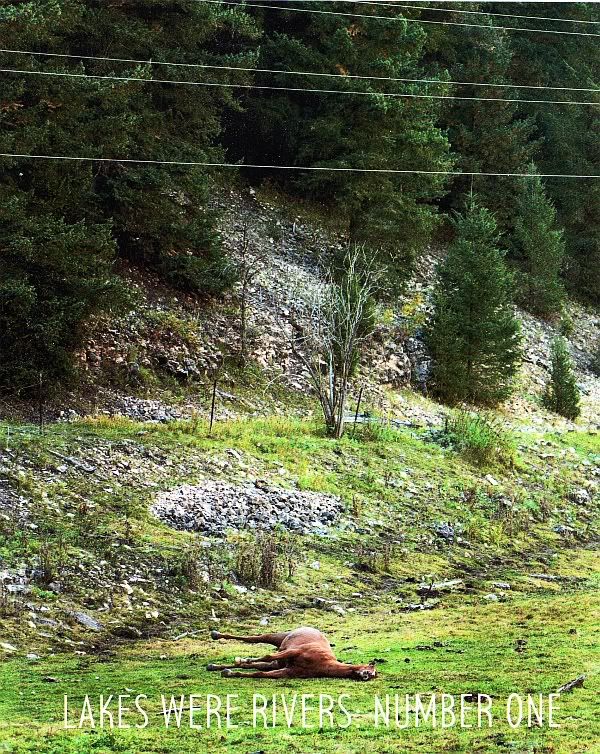
 Lakes Were River #1, a publication of the photographer's collective Lakes Were Rivers

This was a very different group. Except for Terranova, none of them were critics per se. Stone runs a semi-informal crit group--photographers critiquing other photographer's work. (He is also the founder of the photographers' collective Lakes Were Rivers. I don't know what relationship Lakes Were Rivers has with the crit group, though.) Cowden publishes handsome trifold catalogs for her exhibits and hires freelance art writers to write essays for them. Only Terranova, a professor at U.T. Dallas, is also an art writer. Her position as a critic is ideal--as a professor, she doesn't need to hustle writing jobs and can afford to burn bridges if necessary. Indeed, she stopped writing for a daily paper when they edited her work too heavily (she said the straw that broke the camel's back was when they asked her to remove the word "trope," because it might be too jargony or difficult for their readers). But she said she never writes bad reviews. Her reason? She just doesn't like doing it.
Photobucket
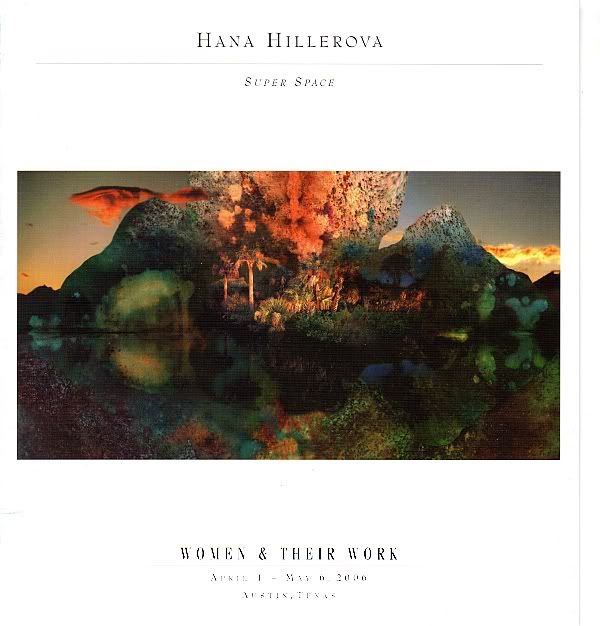
catalog for Hana Hillerova: Super Space from Women & Their Work, with an essay by Charrissa Terranova

I mentioned this (in disbelief) to a friend of mine, and she came back not exactly agreeing with Terranova, but saying that for many people, writing negative reviews or harsh criticism within a local community could be politically difficult. That got my back up a bit, so here's my response:
There are lots of reasons for "cheerleading":
1) A critic might feel he or she is representing art in the face of a hostile or at best indifferent public, therefore would want to give art--especially contemporary art, which is often hard for the uninitiated-but-curious public to understand--as much of a boost as possible
2) Desire not to burn bridges. Critics (especially local critics) live in work among the persons and institutions they write about. These critics will need to continue their relationships with artists/institutions into the future for the purpose of their work. So if instead of a bad review, a critic writes no review, important relationships are preserved without any sacrifice of integrity on the part of the critic.
3) Desire not write about art one doesn't like. Writing a bad review or a highly critical editorial or think-piece might not be much fun. I know a lot of writers who just don't like to do it. Why do something you hate doing?
4) Desire not to hurt people's feelings. I don't like hurting people's feelings, and excluding bullies and sadists, I think most people don't like it. Not writing bad reviews, negative editorials, etc., is one way not to hurt people's feelings.

All of these are legit. I personally have wrestled with each one. But I think cheerleading lowers the quality of publications (whether that publication is a newspaper, a magazine, a web-magazine or a blog). Readers like a certain amount of drama. In art writing, drama comes in the form of good reviews followed by bad reviews, as well as by scandals, fiery manifestos, gossipy punditry, bitter denunciations, unabashed love letters, snarky put-downs, heartfelt celebrations, etc. In short, the full range of human response. There's a reason people like sports pages. Wide World of Sports famous cliche line--"The thrill of victory, the agony of defeat"--is well-remembered because it's so true.  The problem with the cheerleading mode is that you end up with a bland publication that has one flavor, one tone, which is celebratory. You only get the "thrill of victory," and that gets boring after a while for readers. So for me, I think cheerleading is a grave disservice to readers, who want to be entertained by what they are reading (even if they are reading something dry and difficult like October).

My other problem is for the critic, never writing a bad review means--possibly--that one's critical facilities will atrophy (not to mention one's writing abilities). One ends up like the gym rat who only exercises his upper-body muscles. He might have great abs and delts and whatnot, but they rest on two chicken-leg pillars. I think it's important for critics to exercise all of their critical and writerly facilities.
I would add a third problem with a "no negative criticism" policy, which is in a way weaker than the other two. Artists (and curators and gallerists) need to be held to account. Their friends are all going to tell them they're great--they need someone to say "You suck!" if they suck. And they need to be discouraged from doing the things that suck.

But what about reason two--desire not to burn bridges? For me, if someone criticizes what I do, an shrug it off as well as I can. But I'm not an artist or curator who depends on a certain amount of good will for my professional survival. I have rarely gotten really negative feedback, but it occasionally happens. And I would expect critics who are more aggressive than me get it even more--either to their faces or behind their backs. Maybe you have to be a gruff character like Donald Judd to write bad review after bad review and remain a force in the art world. Locally, Michael Bise seems to be a fearlessly honest critic, despite his connection with the local scene as an artist. I think the benefits for a regional art scene of having fearlessly honest critics outweighs the negatives for the critics. At least I hope so. If not, then there need to be more critics who, like me, have nothing to lose.

The final panel was the one I was on. I think the idea was to give new media people a say. We had Duncan MacKenzie from Bad at Sports and Richard Serrano from Art This Week. (I should also mention that Salvador Castillo moderated all of these panels.) I was the odd man out--these guys were producing respectively podcasts and videos. I was the only one who wrote stuff. (This is not totally fair--Bad At Sports, which is a veritable empire, has a blog portion.) Mackenzie had a very specific notion of his intended audience--other artists, working in their studios. Bad at Sports was something they could listen to while they worked. That makes perfect sense and explains away one obvious weakness of any art podcast--the lack of images. In this respect, both Pan and Art This Week are superior to Bad at Sports--we can show in addition to telling. But one problem I personally have with video is that it demands you pay attention to it right now. Writing you can always walk away from and return to later. But this is a minor objection--a good short video interview or walk-through can be really entertaining and enlightening. Art This Week is a fairly young endeavor, but one could see it growing into real importance in Texas. Serrano also expressed an interest into expanding into art-education videos, which strikes me as a great way to make a little money doing something you love.

But the thing about both these enterprises is that they are not criticism. And maybe that's the future. We think of writing about art (or video or interviews or whatever) as being criticism; that the phrases "art criticism" and "art writing" are synonyms. I think this old way of thinking is collapsing. As Nancy Princenthal wrote:
On one hand, there is no self-evident reason to make the linkages between art and theory that have been argued over the past twenty years, productive and often fascinating though they have been. Semiotics, Lacanian psychoanalysis, Marxist economic theory, structural anthropology--these are all fascinating fields, but they have no more compelling claims as explanatory systems for art criticism than do theology, mathematics, or the physics of color (to name a few heuristic precedents). ["Art Criticism, Bound to Fail," Art In America, 2006]
But I would go even further. I don't think art criticism is inherently the best way to talk about art. Or rather, I don't think it should be privileged over other kinds of writing about art. I think, for example, writing about the economics of auctions by Noah Horowitz or Don Thompson will tell us as much about the art of Damien Hirst or Jeff Koons as any criticism will. Art writing (and video, etc.) needs to embrace all approaches.

I think the Hybrid Arts Summit barely scratched the surface. I would like to see more events or get-togethers like this. I don't know if the art world cares too much about this stuff--I personally feel pretty irrelevant to the goings on in the local art scene. But for me, thinking about these issues, and discussing them with colleagues,  is useful.


Share


Sunday, March 13, 2011

Please Welcome Dean Liscum

Photobucket
Dean Liscum at Box 13's fundraiser, The Empty Box. Photo by Robert Boyd

by Robert Boyd

A few weeks ago I asked readers if there were any of you who might be interested in contributing to The Great God Pan is Dead on an occasional basis. One writer answered the call--Dean Liscum. My hope is that between the two of us, we can cover Houston's art scene better than I could do solo (as well as covering any other art topics that interest us). I asked Dean to describe himself, and he wrote this:
Dean Liscum is an inveterate art observer. He's written about the Houston art scene online (http://dean4hire.blogspot.com) and in a number of Houston periodicals including ArtsHouston (now defunct) and Houston Free Press.
One thing I found striking about Dean is that he has something of a similarity to me in that we are both more-or-less middle-aged guys who live in the suburbs and really like art. We get in our cars and schlep into the inner Loop to see what's happening. For us, art is a hobby that we feel passionate about. For our peers, it might be golf or hunting or collecting baseball cards or classic automobiles or the Rockets. But we chose art for some reason.

But despite this similarity, I'm hoping that you'll find that Dean's opinions are not the same as mine. It was my goal in adding additional bloggers that I would be adding additional points of view.

There will be a few other changes on the blog. I have always been a bit fast and loose with the photo credits--obviously that will change. And each blog post will have a byline now. I hope readers enjoy Dean's contributions, and please remember that I am still interested in expanding the number of voices here. There's no money involved--this is purely a hobby, an amateur operation--and I can't even promise "exposure" since we have a pretty small readership (an average of 272 page views a day this year). So if you can get past that giant lack of incentive, we'd be interested in your voice and your opinions.


submit to reddit

Monday, March 7, 2011

WINNER!

I just had to quote this from Earl Staley's blog.
Friday is breakfast with my friends. They were all there. Bill is going to Paris next week to do the Picabia thing. I enjoy talking with him about the BAD Picabia’s that never make the history books. Remindes me of my bad years. First I was a “Bad Painter” and then I was a bad artist and today I am enjoying the fruit of those years. To quote Charley Sheen, " WINNER!"
Staley then goes on to casually dismiss Jim Nolan's show at Art Palace, Heimir Björgúlfsson's show at CTRL, and the Heyd Fontenot show at Inman, before he praises a show I somehow didn't even hear about--Sfumati Nudi by George Krause. The photos from the show look really good! I may disagree with some of his brusque opinions (we disagree about Jim Nolan's show, obviously), and I wish he'd name names when he slags off an artist's work, but damn if he isn't an important voice locally. Put Staley's blog, Professor Art, in your RSS Feed.

Photobucket
George Krause installation with Earl Staley (not sure who the photographer is!)


submit to reddit

Sunday, March 21, 2010

Pan is on Facebook

 http://photos-e.ak.fbcdn.net/hphotos-ak-snc3/hs470.snc3/25779_362223008315_289926968315_3743385_6857027_n.jpg
This is just a reminder--if you are on Facebook and would like to be updated about new posts here, please become a fan of Pan.
http://hphotos-snc3.fbcdn.net/hs470.snc3/25779_358511408315_289926968315_3733297_6995708_n.jpg

Thursday, March 18, 2010

Look at Me!

Me with a Stephanie Toppin
Noted Houston blogger standing next to a Stephanie Toppin painting

They love me! They really love me!

Well, they like me at the Houston Press at least. They very graciously included me in a list of 10 notable Houston bloggers. I guess it's because I'm about the only active art blogger in town (who isn't an artist mainly dealing with his or her own work). B.S. Houston is mostly moribund (although he writes for the Free Press).

I am already a devoted reader of Off the Kuff, Swamplot (the best blog in Houston in my opinion) and Houston Calling.The Bloggess looks pretty good. Texans Chick doesn't interest me--not because it's bad, but because I am just not interested in the Texans or sports in general. Ditto the two food blogs, Blue Jean Gourmet and H-Town Chow Down--I'm not enough of a foodie to get full value from these blogs. Defending People is interesting but a bit too technical for me--it really is aimed at other lawyers. And the mommy blog, Blog con Queso, is totally impressive but again not really aimed at me.

There are actually lots of other interesting Houston bloggers, but the problem is that they have lives. And when you have a life, it's hard to post very often. Right now I think my favorite infrequent blogger is Slampo. I don't always agree with him, but I like the way he says what he says.

The piece that Cathy Matusow wrote about Pan portrays me as a total fanboy. That's fair. My blog is too uncritical. I've avoided doing bad reviews not out of a desire to avoid hurt feelings (although I don't relish hurting anyone's feelings) or a sense of boosterism. It's because I have a limited amount of time to write and would prefer to write about things I like. But this makes my blog a bit bland, and makes me a lazy art writer. I should follow the example of Albert Nurick of H-Town Chow Down and fearlessly pan what deserves to be panned. Because writing a bad review--not a gruesome slam, as entertaining as those can be to read, but one where I force myself to articulate clearly what I don't like and engage the work seriously--will help my writing in general. It will help me focus on what is good and what is not. There's a way to do it without being needlessly cruel or pointlessly dismissive. So that's my resolution--tougher criticism.

(One last note--every single one of the other bloggers (except for the coy Gus from Swamplot) is significantly better looking than me. It's not fair.)

Friday, November 6, 2009

The 20 Least Powerful People in the Art World

Here.

Unfortunately, they forgot regional art-bloggers. We are surely less powerful than almost anyone on their list...

http://photos1.blogger.com/blogger/1391/1082/320/gagosian%20upset%20bunny.jpg