Darryl Lauster, The Inaccessibility of Various Things, 2014, cast paper, steel, period Victor Victrola, Tommy Dorsey music and electronic components, 47 x 31 x 19 inches
A plane circles an antique Victrola as a big band plays. One might remember at that moment that something like 50% of British air crews died in World War II. Dead airmen is one theme in Ought Not No One by Darryl Lauster, on view through December 20 at Devin Borden Gallery. He writes letters to pilots who died in Vietnam.

Darryl Lauster, The Newburgh Papers (letter to Sgt. Carter), 2013m ink on handmade paper, 22 x 15 each
Six are displayed, including this one to Sergeant Carter. "Thank you for giving your life in service to our country." Why is he doing this? The end of the letter, which is chatty and refers to his grandfather's own military service, explains: "A favorite poet of mine talks about writing letters to the dead. I guess I write you as a way of asking questions about myself. If only you could share the knowledge you have gained with me, I'd have more answers."
Writing these letters and displaying them publicly feels somewhat calculated. It seems that they should be private. The Darryl Lauster who wrote them comes of as a character invented by the real Darryl Lauster. Except he writes about crying as he writes them. There is a tension here between sincerity and artifice. The work won't let me decide how I feel about it.

Darryl Lauster, Self-Portrait as a Loadmaster, 2014, digital media on archival paper, 78 1/2 x 36 inches
Lauster poses in a flight suit that belonged to his grandfather, who served in World War II and Vietnam. On his website, Lauster writes, "This self-portrait is an attempt on my part to bear witness to his service, knowing that, in the same way I cannot quite fit into his uniform, I cannot quite live up to his legacy." What stuck in my head after seeing this image the first time was Lauster's resplendent mullet. I had seen a similarly leonine nape drape recently.

Eugene Porter from The Walking Dead
At the risk of spoilers, Eugene Porter (played by actor Jack McDermitt) is a character from The Walking Dead television series who pretends to be a scientist with a cure to the zombie plague in order to get protection from fellow survivors. He needs this protection because he is such a wimp that he is to afraid to fight the zombies himself. It's coincidental (I assume) that Lauster and Porter so resemble one another. In addition to their two magnificent Tennessee top hats, they are both faking it--putting on the costume of a person they know they can't live up to. The difference is that Lauster never pretends otherwise.

Darryl Lauster, Spar and Compliant Tower, 2013, steel, aluminum, brass, plastic and hand blown custom glass bottle with cork, reconfigurable hickory base, 50 x 21 1/2 x 8 1/4 inches each
I saw a work related to Spar and Compliant in a group show at Devin Borden in 2012. Lauster's sculptures of off-shore oil-producing platforms are simplified forms--they don't depict these structures in detail. He is recalling the classic ship in a bottle model with these two pieces. For model makers, the ship in a bottle is a kind of bravura stunt, a "how'd he do it?" But with these wide-necked custom-made bottles that Lauster uses, there is no such mystery.

Darryl Lauster, Compliant Tower, 2013, steel, aluminum, brass, plastic and hand blown custom glass bottle with cork, reconfigurable hickory base, 50 x 21 1/2 x 8 1/4 inches
One can think of relatively recent artworks that are similar, like Mike Kelley's Kandors (Kandor is a city from Superman's home planet of Krypton that has been reduced and placed in a bottle by Braniac) or the delicate sculptures made of human bone under bell jars by Charles LeDray. But by placing his bottles in a horizontal position, Lauster is not recalling a bell jar (which suggests a scientific display) but the ship-in-a-bottle model, which is more sentimental and decorative.

Darryl Lauster, Compliant Tower, (detail), 2013, steel, aluminum, brass, plastic and hand blown custom glass bottle with cork, reconfigurable hickory base, 50 x 21 1/2 x 8 1/4 inches

Darryl Lauster, Spar, 2013, steel, aluminum, brass, plastic and hand blown custom glass bottle with cork, reconfigurable hickory base, 50 x 21 1/2 x 8 1/4 inches
When I see these, I wonder who they are for. Are they destined to decorate the offices of executives from Transocean or Nabors? After all, they are works of art but they are also merchandise for sale. But it's tricky--if you visit the offices of companies that do offshore work of any kind, you often will see elaborate scale models of the ships or platforms they operate. They are a kind of corporate marketing, something to show the clients. Are they art? Would a client be able to distinguish between one of those models and Lauster's versions? If Spar and one of these corporate lobby models were in the same room, is one art and the other not art?

Darryl Lauster, Spar (detail), 2013, steel, aluminum, brass, plastic and hand blown custom glass bottle with cork, reconfigurable hickory base, 50 x 21 1/2 x 8 1/4 inches
I don't pretend to have an easy answer for that. And it's something I think about all the time. (I have some weird obsessions, I know.)
Darryl Lauster, In Case of Fire, 2013, neon, wood/iron, 16 x 23 x 15 inches
Lauster writes about this piece, too: "In Case of Fire is a reflection on our nation’s various legacies, and the ways in which changes often come about only through great trial and hardship. More significantly, we are be reminded of how easily those changes can be eradicated if we do not remain vigilant." I like that Lauster writes in clear English, but it seems he is being a little vague on purpose. The legacy that's in danger here is the legacy of FDR--Social Security, vast government built and operated infrastructure, government work programs for the unemployed, etc. The neon is bright but fragile, and there is a giant hammer right next to it. He did this piece in 2013, several years after George W. Bush's attempt to privatize Social Security went down in flames. But this most recent election renews that danger. While the works discussed above were marked by sadness or even nostalgia, In Case of Fire marks a turn towards an angry political stance.

Darryl Lauster, Draft, 2014, ink on hemp, fig and mulberry papers, 18 x 139 inches
That stance is amplified in the next two works, which seem freakishly appropriate to our current political moment. Draft and Vessel are bitter works. Draft in particular seems particularly angry. Lauster writes, "This collaged text-based work, titled Draft, is a disjunctive narrative of four protagonists that is excerpted from a novel in progress. It is meant to conjure individual struggles with bigotry, identity, isolation and psychological disorders. The character’s voices are bitter, resolute and very familiar."
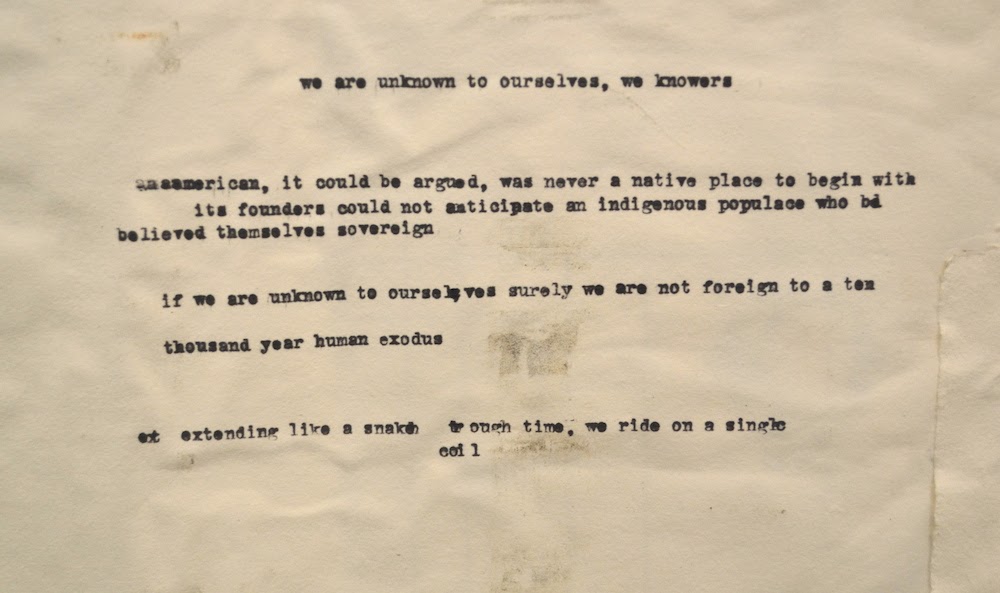
Darryl Lauster, Draft (detail), 2014, ink on hemp, fig and mulberry papers, 18 x 139 inches
The displacement and genocide of native populations of America are mentioned. These are forceful voices.

Darryl Lauster, Draft (detail), 2014, ink on hemp, fig and mulberry papers, 18 x 139 inches
The characters are faced with the choice of violence and self-annihilation through inebriation. This was powerful when I read it last week, but now as the news juxtaposes the art world's orgy of consumerism in Miami on one hand and the riots in the streets over the no-billing of police officers who killed Eric Garner and Michael Brown, the choice seems all the more stark and relevant.

Darryl Lauster, Vessel, 2014, Antebellum Proslavery text, paper, plaster, steel and reconfigurable wood base, 54 x 41 x 9 inches
Vessel deals with more historical horror and crime. It's another model, a boat made of papier-mâché. There are no sales, but it appears to be the hull of a sailing ship. There are also no decks. It's a crudely made hull on a metal stand.

Darryl Lauster, Vessel (detail), 2014, Antebellum Proslavery text, paper, plaster, steel and reconfigurable wood base, 54 x 41 x 9 inches
And the paper from which Vessel is constructed is from an Antebellum pro-slavery text. It's vile and sickening, and it tells you what kind of ship you are looking at, and the wretched cargo of human beings it carried. The work in this show reels you in--the Tommy Dorsey music, the jocose photo of Lauster in the tight flight suit with his outrageous hockey hair, the cute little oil platforms in bottles--and then submerges you in war, slavery and death. Maybe this tactic is what it takes to convince us, passengers on a Ship of Fools, to face uncomfortable truths.