Wednesday, March 26, 2008

Suzanne Anker

Suzanne Anker's art is based on psychology and biology. In this wall drawing, she takes a familiar Rorschach test image and gives it a spooky feeling of volume and aliveness.

The image “http://www.we-make-money-not-art.com/wow/0endoinkblott.jpg” cannot be displayed, because it contains errors.
The Sum of All Fears, 2002 (?)

She has also turned Rorschach blot images into mysterious sculptural objects which combine a kind of sun-bleached classicism with Antonio Gaudi-like organic shapes. They could almost be the carefully preserved bones of species of animals related to those painted by Jim Woodring.

The image “http://images.artnet.com/artwork_images_424505875_277713_suzanne-anker.jpg” cannot be displayed, because it contains errors.
Bear, 2005

The image “http://images.artnet.com/artwork_images_424505875_277716_suzanne-anker.jpg” cannot be displayed, because it contains errors.
Gossipers, 2005

The image “http://images.artnet.com/artwork_images_424505875_277714_suzanne-anker.jpg” cannot be displayed, because it contains errors.
Crab, 2005

I think the combination of strangeness and delicacy draws me to these pieces just as it does with so much of Jim Woodring's art. These sculptures are small (apparently they come in two sizes, 14" x 14" or 5.5" x 5.5"). Imagine having one hanging on your wall, across from your bed--it would encourage interesting dreams.

I was alerted to Suzanne Anker's work by We Make Money Not Art, which discovered her work as part of an exhibit called Brainwave at Exit Art in New York City.

(According to Artnet, these sculptures are available from the Deborah Colton Gallery right here in Houston. I mention in case someone wants to get me one as a graduation present. Just sayin...)


Sunday, March 16, 2008

Marcel Dzama

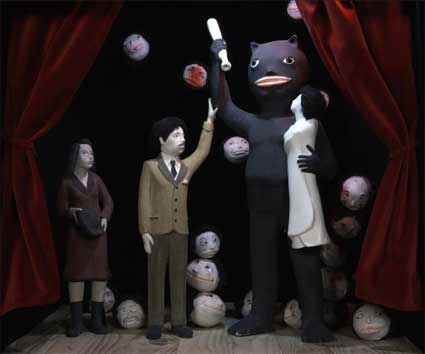
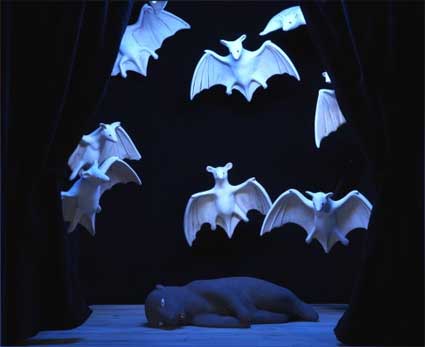
I have never really warmed up to Marcel Dzama's drawings, but these three dimensi0onal installations from his latest gallery show are really cool.

The image “http://www.we-make-money-not-art.com/wow/0aafirtborn.jpg” cannot be displayed, because it contains errors.

The image “http://www.we-make-money-not-art.com/wow/0apipistrell.jpg” cannot be displayed, because it contains errors.

The show is at Gallery David Zwimmer in NYC. Hat-tip to We Make Money Not Art.

Wednesday, March 5, 2008

I love these sculptures


They're by Jennifer Maestre. Hat-tip to a best truth.

Thursday, February 21, 2008

Ed Kienholz

Did you know that before I studied finance and risk management, before I edited, marketed, and published comics, before all that, that I was an art history major?

One of my favorite artists is Ed Kienholz (1927-1994). He came to campus once for a a pair of shows at the Rice Museum and at the CAM in 1985. So I got to met him, and he and his wife/collaborator Nancy Reddin were really open and friendly to us students. He was having a good experience in Houston. CAM in particular was a very flexible space for him to build his huge tableaus. He complained bitterly about a museum in Seattle that failed to accommodate him adequately. (I later got to be friends with Larry Reid, then the director of that "museum," who had bad memories of Kienholz and his difficult demands.)

Kieholz's work is seering, brutal, unbelievably powerful. I don't know why, but today he and his work popped into my mind.

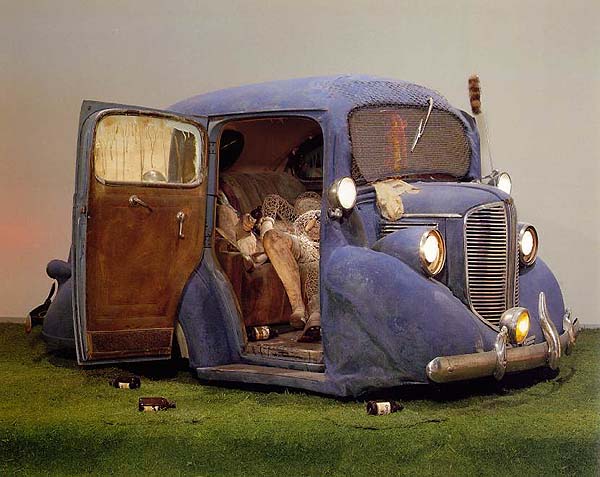
The image “http://www.beatmuseum.org/kienholz/images/dodge.jpg” cannot be displayed, because it contains errors.
Back Seat Dodge '38, mixed media, 1964.

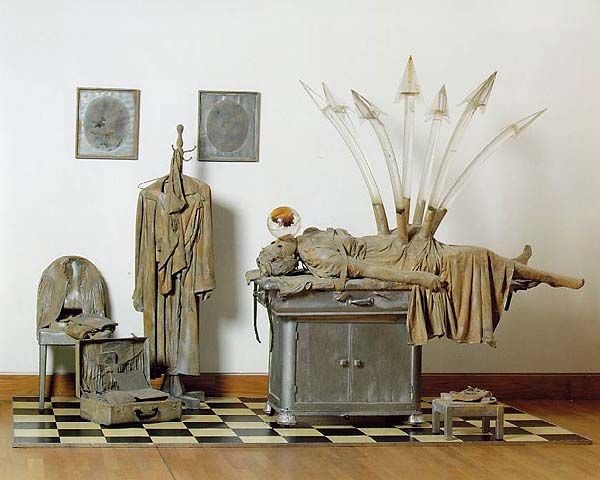
The image “http://www.3dlit.org/practice/Kienholz/images/kienholz8.jpg” cannot be displayed, because it contains errors.
The State Hospital, mixed media, 1966

From a review of a Kienholz show in The Guardian, 2005:
When Ed Keinholz died, he was buried in his 1940 Packard, a deck of cards and a dollar in his pocket, a bottle of 1930 Italian red wine beside him, the cremated remains of his dog (who died a few days before him) on the back seat. His burial arrangements sound like one of his own works. It also gives something of the measure of the man, a farmer's boy of Swiss ancestry from Washington State, self-taught, immensely self-reliant, an individualist westerner who dodged the draft for the Korean war and made a living as an odd-job man in the 1950s (he had a truck advertising his services with the words "Kienholz - Expert" on the side). He decorated bars in Las Vegas, worked in a Spokane speakeasy, and opened a shortlived but successful LA gallery with the curator Walter Hopps in the late 1950s, a place that, by all accounts, had much in common with today's "alternative spaces". Kienholz was a hard-nosed guy who loved to hunt (he once took the Swiss artist Jean Tinguely on a duck shoot), loved cars, dogs and horses and the outdoors, and eyed New York with suspicion, always going his own way.Kienholz made installations before there really was such a thing, and conceptual works before the term became a movement. In the 1960s, he swapped watercolour "Barter" works, whose washy grounds bore only the rubberstamped name of the thing he wanted, for the goods themselves: a set of screwdrivers, a fur coat, a portable saw, a car.


The image “http://www.beatmuseum.org/kienholz/images/birthday.jpg” cannot be displayed, because it contains errors.
The Birthday, mixed media, 1964

Monday, February 11, 2008

What is a Painting Worth

The image “http://graphics8.nytimes.com/images/2008/02/11/arts/11painting5-650.jpg” cannot be displayed, because it contains errors.

One hears about daring art thefts, mainly in Europe, with alarming frequently. Unlike Hollywood heist movies, they tend to be low-tech affairs. For example, there were two multi-million dollar art thefts in Switzerland in the past week.
Three men wearing ski masks walked into a private museum here in daylight, grabbed four 19th-century masterpieces, tossed them into a van and sped off, pulling off one of the largest and most audacious art robberies of all time. It was the second multimillion-dollar art heist in Switzerland in less than a week.

What's amazing is how easy the most recent of these thefts was.

According to the local police and officials at the Bührle Collection, one of the top private museums for Impressionist and Post-Impressionist art in Europe, three men wearing ski masks entered the museum barely a half hour before the 5 p.m. closing time on Sunday.

One of the thieves pulled a handgun and ordered terrified staff members and visitors to lie down on the floor, as the other two men pulled the paintings off the wall. The police said paintings appeared to be sticking out of the back of the white van the men used to make their getaway.


The image “http://graphics8.nytimes.com/images/2008/02/11/arts/11painting3-450.jpg” cannot be displayed, because it contains errors.


The paintings they took, a Cézanne, a Degas, a van Gogh and a Monet, were collectively worth an estimated $163 million. The thieves were not connoisseurs, though. These were not the most valuable paintings--just the easiest to grab (they all hung next to each other in a single room). The big question is, what did the thieves hope to gain?

[The paintings] stolen in Zurich are considered major works and so widely known as to be “unsalable,” said Richard Kendall, a prominent scholar of late-19th-century French art and a curator at large at the Clark Art Institute in Williamstown, Mass.

For the police and the public, the looming questions were not only who committed the crimes but, given the near impossibility of selling the paintings, why.

A common myth, popularized in the movies, of a theft to order carried out at the behest of a private collector, “is really to be considered a fiction,” said Karl-Heinz Kind, team leader of the works of art unit at Interpol.

The fact that there are no buyers lined up helps account for the recovery of famous works, he said, like the Munch paintings [stolen in Norway several years ago], which were recovered in 2006. “The thieves have difficulty finding someone to take them,” he said. “They are obliged to multiply their contacts and proposals. That increases the chances for police.”

Now this made me think about valuations for art. Assets are valued not just on what someone is willing to pay for something, but also on how many people are willing to pay and how frequently and easily they would do so. In other words, liquidity is important. When they price artworks, they base it on auction prices of similar artworks. (Which adds an extra layer of complexity--when you price a share of stock or an oil future, you have a bunch of identical assets to compare it with that are constantly being traded. But each painting is unique.) But there are few legitimate channels to buy art. When I say "legitimate," I don't mean "regulated." The art market is pretty unregulated--some countries have national heritage laws, that makes it impossible or difficult to export certain artworks; there are applicable tax laws, of course; as well as laws regarding the receiving of stolen property. But legitimate in this case means that you know the artwork's provenance. You know it wasn't stolen or looted. And if the seller can't provide provenance, you will have a hard time getting an auction house to carry it (especially for expensive works) and buyers will demand a deep discount, because they will be at risk of buying stolen goods.

So when they estimate the value at $163 million, there are two things to consider. Because of the relative lack of liquidity in the art market, the prices are likely to be lower than the best auction price at any given moment, and are also likely to be volatile. Calculating an estimated price would somehow have to take into account this volatility. The second point is that the value of the art to the thieves will inherently be much lower than $163 million because they are cut off from selling through legitimate channels to legitimate customers. The customers for stolen artwork have the power to set much lower prices.

My final question is, were these artworks insured? Can you even really insure paintings worth $163 million? I wonder especially because the security was so lax.

The museum’s director, Lukas Gloor, said the museum generally did not check visitors’ bags and had no metal detectors, which he said the entry hall of the building was too narrow to accommodate.

Given this, I wouldn't insure these artworks. Would you?

Sunday, December 30, 2007

People Who Died

This time of year newspapers publish lists of notable deaths. It might be morbid, but I do like to reflect on the lives of people I admired. So this is my own brief list of people who died in 2007 and what they meant to me. Let's raise a glass to them, shall we?


Molly Ivins
The image “http://www.texasobserver.org/images/molly_cover.jpg” cannot be displayed, because it contains errors.
(cover of The Texas Observer memorial issue)

I loved her books and her attitude. There aren't many notable liberal Texas writers--and unlike Jim Hightower, Ivins always seemed very authentic and personal. She grew up in Houston, and worked in Dallas and Austin. Her editorship of The Texas Observer really energized that little magazine, which usually seems--at best--to putter along. She was at her best, in my opinion, when writing about Texas politics, especially about the permanently corrupt and risible state legislature (or, as she called it, "the Lege"). She worked hard to remind people that their state reps and senators were a bunch of fools, boobs, thieves, and fanatics. In this regard, her best successor that I've found is the owner of Pink Dome. She's not quite Molly yet, but I hope she gets there. Because we really need Molly Ivins.

Sol Lewitt
The image “http://www.crownpoint.com/artists/lewitt/modules_large.gif” cannot be displayed, because it contains errors.
( CUBE STRUCTURES BASED ON FIVE MODULES, 1971-74, painted wood)
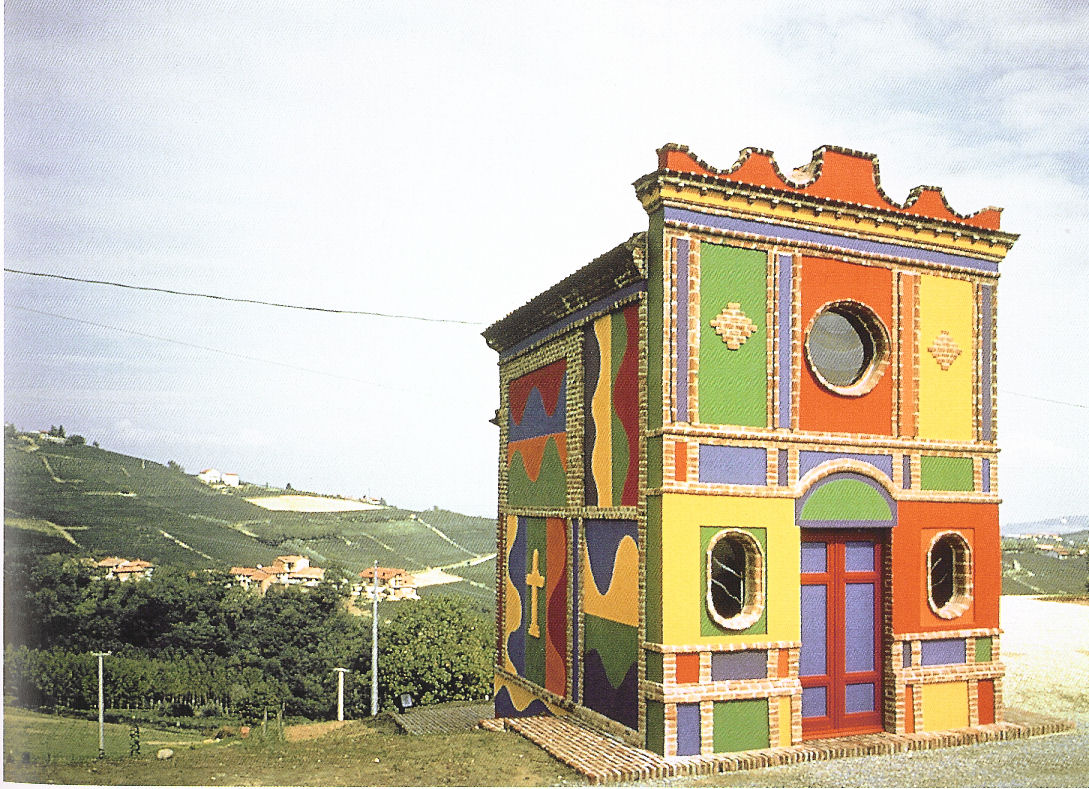
The image “http://academics.triton.edu/faculty/fheitzman/sol%20lewitt%20barolo%20chapel%201999.jpg” cannot be displayed, because it contains errors.
(Barolo Chapel, somewhere in Italy, year unknown)

The image “http://hirshhorn.si.edu/images/collection/img_high/03.11.jpg” cannot be displayed, because it contains errors.
Wall Drawing #1113 On a wall, a triangle within a rectangle, each with broken bands of color, 2003 (hirshhorn, washington)

Sol LeWitt was one of the big conceptual artists. There's virtually nothing as boring as conceptual art, but LeWitt's work always looked great. Often his "work" was in the form of instructions on what to paint on a wall, or what to build out of wood. That sounds like a recipe for artistic chaos, but as the pieces above show, the results were often--usually even--beautiful. I love his work.

Elizabeth Murray

The image “http://www.artcritical.com/DavidCohen/sun_images_october/elizabeth-murray.jpg” cannot be displayed, because it contains errors.
Elizabeth Murray The Sun and the Moon 2005
oil on canvas on wood,

The image “http://time-blog.com/looking_around/82153001.jpg” cannot be displayed, because it contains errors.
Dis Pair, 1989-90 — The Museum of Modern Art © 2007 Elizabeth Murray

Elizabeth Murray was one of the artists who became hot in the '80s as a "neo-expressionist," a phrase that obviously didn't work for her. I always thought she was quite young, so I was surprised to learn that she was 66 when she died this year. Her work is often cited for its cartoony feel, and indeed, to me her work is like Phillip Guston without the angst, or Jim Nutt without the anxiety about women. Her bright colors are quite beautiful, and I always loved her shaped canvases.

Madeleine L'Engle
The image “http://www.fanboy.com/images/a-wrinkle-in-time.jpg” cannot be displayed, because it contains errors.

She wrote A Wrinkle in Time and A Wind in the Door. Her books were a mixture of science fiction and fantasy, and I think they helped me love the genre as a child. They were scary but mind-expanding. I treasure these books; they are among my favorite books from childhood.

Saturday, December 16, 2006

Cy Twombly

I’ve never been a fan of Cy Twombly, an artist who almost dares you to like his work. Some of his paintings are not unlike the bored scribbles of a manager trapped in a very dull meeting. I mean, except for the scale and the media, there is no difference. I just couldn’t see this as meaningful expression—I couldn’t see the intelligence behind it.
So I avoided the Menil’s Twombly gallery for years until today. And I was surprised. While there were plenty of perplexing scribble paintings, there were some that had real presence.
One was an untitled suite of nine paintings, mostly green, black, grey and white. He would tend to put the green and black in one area and the grey and white beneath it and to the side. The effect was an illusionistic effect (unintentional?) of dense greenery coming right up to the edge of a lake on an overcast day. I was filled with emotion seeing this. There had been a piece on Monet’s letters in NPR the other day, which made me think about Monet, which made me think about Giverny and the water lily paintings. One thing about these paintings was how rich in color they were. Twombly creates something similar with a far more limited palette.
Then I thought of Theft by Peter Carey. Carey has Butcher Bones describe his new paintings as abstract with slabs of super-rich pthalo green, and seeing these Twombly paintings made that image return. It’s as if Carey had seen them and used their memory to create Bones’ paintings.
I wish I could find an image of one of these paintings to post. I can't though--you'll just have to visit the gallery.