Wednesday, January 11, 2012

Performance Art in Houston, Past and Future (NSFW)

by Robert Boyd

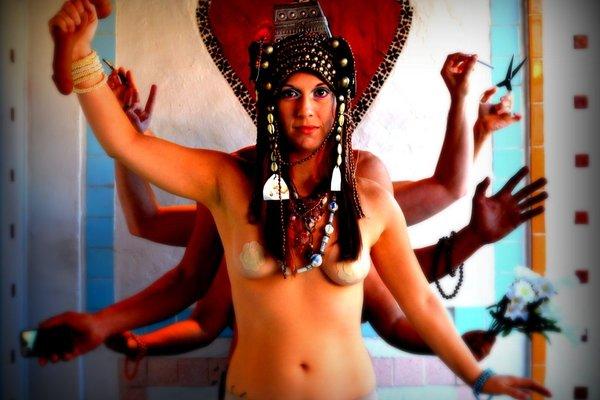
Julia Wallace and Jonatan Lopez are the artists behind Continuum, a performance art group that have done a variety of events since starting up in 2011. They put together a retrospective video of some of their 2011 activities. As that it includes several boobs, asses and dicks, it is quite possibly NSFW where you work.


Continuum, 2011 Highlights from Continuum PerformanceArt on Vimeo.


If this is the kind of performance art you're looking for, they have a new performance called KALI at The Orange Show coming up in February. In case you're thinking of bringing the kids, they warn that it is "FOR MATURE AUDIENCES ONLY." You can help support this show on their Indiegogo page.


Constructed Chaos sculpture group
KALI

 But that's not all. There's an upcoming event called the Lone Star Performance Explosion that bills itself as the "Houston International Performance Art Biennale 2012." It lists the following performers:

Fantastic Nobodies (New York)
Myk Henry (New York / Ireland)
Arianne Foks (France)
Ville-Karel Viirelaid & Remo Randver (Estonia)
Jim Pirtle (Houston)
The Art Guys (Houston)
Nestor Topchy (Houston)
Elia Arce (California)
Jenny Schlief (Houston)
Jill Pangallo (Austin)
Nyugen Smith (New Jersey)
Emily Sloan (Houston)
Johnny Amore (Germany)
Elena Nestorova (Finland)
Natali Leduc (Canada/Houston)
Nancy Douthey (Houston)
Julie Wallace (Houston)
Daniel Adame (Houston)
Marcus Vincentes (Brazil)
Kim Ceol (Korea)

This looked so interesting that I linked to it on Pan's Facebook page. And here was Julia Wallace's reply, "It does sound awesome, I would love to perform, but I have never heard of it despite being listed as one of the performers!" A closer look at the otherwise excellent website listed no one in charge, no contact information, nothing! Very mysterious (and pretty damn presumptuous to list a performer who hadn't yet been invited). 


But the Lone Star Performance Explosion does have a Facebook page, so I posted a query there asking what the story was. I was surprised to get a response from Kelly Alison, a painter who I have never associated with performance art before. She wrote, "Robert, The Festival is being directed by Nestor Topchy nestortopcy@yahoo.com and Myk Henry. It is non-profit. I am acting as administrator and event coordinator. me@kellyalison.com."

So there you have it! Nestor and Myk, I suggest you contact Julia Wallace and nicely ask her if she would like to participate. I think she might be game. And it would be cool if you put a little more information on your website (for example, contact info, ticket info, etc.) But aside from this, it looks great! Assuming all the performers you have listed are actually performing, this could end up being the FotoFest of performance--and that'd be a damn good thing to be!


Share


Tuesday, January 10, 2012

Forrest Bess on Antiques Roadshow

by Robert Boyd

On Antiques Roadshow last night (January 9, 2012), a owner of a Forrest Bess was flabbergasted to learn how valuable his painting was. The appraiser is Debra J. Force and the owner is from Tulsa, apparently. Maybe Robert Gober can contact him to include this piece in his mini-Forrest Bess exhibit that is going to be part of the Whitney Biennial this year. (Hat-tip to Scott Gilbert.)

(To read a first-person account of Bess, see this post by his last apprentice/assistant,Michael Senna.)


Share

Monday, January 9, 2012

Studio Visit: Earl Staley

by Robert Boyd

Earl Staley in his studio

Earl Staley has a studio above Art Supply on Main, and I spent an afternoon there shortly before Christmas. I first encountered Staley's work in 1985 at the Fresh Paint show. I moved away from Houston a few years later, and Staley also moved away, and I didn't hear much about him until recently, when I stumbled across his enjoyable but infrequently-updated blog, Professor Art.

Staley's story is interesting and, while unique, it says quite a lot to me about Houston and the art scene here. Staley moved to Houston in the 60s and taught at Rice. This was before the Menil contingent moved en masse from St. Thomas to Rice (a key event in the art history of Houston). At the time, he was having friction with his boss at Rice, so when Menil uprooted her art department at St. Thomas and took them to Rice (bringing along William Camfield, who stayed at Rice for decades and taught me a couple of very interesting classes), there was a vacuum at St. Thomas which Staley moved in to fill. This was in 1969.

Shortly after this, his career blossomed. He was getting regular solo shows at various galleries in Houston and in New York. His work had been noticed by Marcia Tucker, who included it in her influential exhibit "Bad" Painting at the New Museum in 1978,  alongside work by Neil Jenney, William Copley and Joan Brown, as well as including his work in the American Pavilion at the 1984 Venice Biennale. that same year, he had a retrospective that started at the CAMH and went to the the New Museum. But, to quote Bessie Smith:
Once I lived the life of a millionaire,
Spent all my money, I just did not care.
Took all my friends out for a good time,
Bought bootleg whiskey, champagne and wine.

Then I began to fall so low,
Lost all my good friends, I did not have nowhere to go.

It's mighty strange, without a doubt
Nobody knows you when you down and out
I mean when you down and out ["Nobody Loves You When You're Down and Out," Jimmy Cox]

He had a bad divorce, he made what in retrospect was an unwise decision to move to Santa Fe, and his art style fell out of favor. (His greatest champion, Marcia Tucker, died in 2006.) So now he's back in Houston, no gallery (although he has an upcoming watercolor show at PG Contemporary), teaching at Lonestar Community College (the local community college systems are a life raft for many a Houston artist), living on the East Side on the weekends and in Tomball near the school during the week, and spending long hours in Midtown at this beautiful studio.


This is the quintessential studio that you could live in. It's roomy, filled with natural light, and downright homey. Staley painted the interiors bright colors (he never shies away from bright colors), so the joint has a festive feel. And it has permitted him to be prolific, especially with watercolors.

some of the many watercolors Staley has been producing in his new space

Another current practice involves recycling old work. I don't mean this in a conceptual sense of, say, revisiting old subject matter. He is literally taking old paintings, cutting them up, and pasting them back together, then painting on top of them. He has a very unprecious view of his older work. Here's what he wrote on his blog about this practice:

In 1981 before the Professor went to Rome he painted this picture. It is called The Awakening. It has been rolled up for many years. When he painted it he thought he was the new Picasso. His ego was rather large. He knows better now. The picture has been rolled up for years. He has recycled it. [Professor Art, November 2, 2011]

Earl Staley, History Lesson, acrylic collage, 2010

The question then is, are these pieces of old paintings formal elements in the new paintings, or is there some sense of autobiography in their use? I think the title of History Lesson suggests the latter.

Earl Staley, Recuerdos, acrylic collage, 2011

The autobiographical aspect is even more pronounced in Recuerdos (Spanish for "memories"). He typically paints over the old pieces of canvas to a certain extent, but it is notable that he didn't paint over the image of the house in the bottom center of Recuerdos.

Earl Staley, Recuerdos detail, acrylic collage, 2011

This was Staley's home/studio in the Heights. It is a memory that he apparently does not wish to obliterate with paint. On the other hand, it's still hanging in his studio--he could change his mind and cover it with one of his dot storms. For the moment, however, it still seems important to keep this particular recuerdo intact.

Staley's collage work is quite different from other, older work.

Earl Staley, Big Rock Candy Mountain, acrylic, 2009

But his work over all is not exactly self-similar. It's a little hard to reconcile Big Rock Candy Mountain, with its unnaturally intense colors, with the more naturalistic colors of Entrance to the basin , Big Bend, N.P.  Texas from 10 years earlier.

Earl Staley, Entrance to the basin , Big Bend, N.P.  Texas, acrylic, 2009

But the use of bright neon colors is more characteristic and has been since at least the mid-70s. He's no Giorgio Mirandi. It may be that this combination of extremely strong colors, his pointillism (which seems like a relatively recent addition to his basket of techniques--at least it wasn't present in his 70s/early 80s paintings), and his use of collaged canvases leads to paintings that struggle to resolve themselves. But even so, we can observe that here is an artist in his 70s who is still evolving. How often does that happen?


Share

Sunday, January 8, 2012

The Art Guys-Devon Britt-Darby Saga Continues

by Robert Boyd

Commeorative Cake Topper
The Art Guys, The Art Guys Marry a Plant Cake Topper, painted porcelain wedding toppers, model tree (plastic), model makers' grass, brass plaque, glass bell jar with wood base, edition of 12, 2009

That headline is a little misleading--nothing has really happened since Britt-Darby left town and the tree was vandalized. But new details came to light in a piece, "This Month in Art-Killing Nonsense," by Buffalo Sean in the Free Press Houston. (The piece is not online.) Sean succinctly details the whole story (and does so without being boring, which is amazing given how much this story has been repeated). But Sean adds some details I hadn't heard before.
The morning of the 'attack' on the artwork a police report was filed after an altercation between [Art Guys] Massing, Galbreth and gallerist Hiram Butler in front of his gallery. The Huffington Post reports "They [The Art Guys] called him [Butler] 'a coward and an evil fuck' and accused him of being an 'unhappy homosexual.'"
And Sean puts his finger on one important upshot to this. "[The] Chronicle has no art critic and will not get one for the foreseeable future." I heard that they were interviewing shortly after Britt-Darby left, but I haven't heard anything since. The art coverage has been very spotty, but there was a nice feature on the Seeing Stars exhibit (which is freaking great, by the way) in last Sunday's Zest. (That piece aside, Zest has to be the weakest Sunday culture magazine imaginable.)

In the end, I think Sean overstates the importance of all this. "[The Art Guys] have alienated many people with their callous actions and set the Houston artworld back from from recognizing conceptual artwork as valid for years to come. Accusations of homophobia, witch-hunting and professional incompetence are seeping out of the controversy which will inevitably leave a stain on Houston's already soiled reputation. [...] There is no beauty to be found in the Art Guys' works or Britt's social sculpture web videos, only the pain of destroying art in a misguided run towards celebrity." I think the art scene will suffer for not having a regular art critic at the Chron, Toby Kamps may be spanked by the Menil brass ("Dude, why did you bring this tsuris on us?"), and the Art Guys' reputation will suffer. Who knows where Britt-Darby will end up out of this. But that's about it. The rest of us will just continue on, making art, looking at art, writing about art, etc.

That said, I can't close without commenting on one last statement Sean wrote: "Boyd is the only art critic left in Houston." I might be the most prolific, but there are other good art writers in Houston. Still--we need more. All you would-be art writers--contact me at robertwboyd2020@yahoo.com


Share

The Houston Art Gallery Two-Step

by Robert Boyd

There's a new gallery in town, Heights Art Gallery (no website yet, but you can visit them at 3202 White Oak), and I went to their opening party last night. It was quite a scene.

Heights Gallery

Heights Gallery

Heights Gallery

Heights Gallery

E-L Wire suit

I would say that Heights Gallery is positioning itself to be the La Luz de Jesus of Houston. (In fact, I would suggest that Heights Gallery try to establish a cooperative relationship with La Luz, which has 25 years of success in Los Angeles behind it. Maybe the two galleries could share Solomon Kane!) It is going for a somewhat less highbrow style than, say, Wade Wilson Gallery. It's the opposite of the "white cube." Its esthetic is more informed by the Art Car esthetic.

Noah Edmundson and Tracy Pierce
Noah Edmundson, director of the Art Car Museum, and Tracy Pierce, director of the Heights Art Gallery

Now me, I love the white cube gallery. I just bought a Linda Post video sculpture at Art Palace, which is a white wall gallery cubed. And when I described it to a friend of mine at the Heights Gallery fiesta, he said, "These guys will never sell a TV in a sock." True! But I think Houston needs some funky people's art, too.

Speaking of white cubes, one of Houston's blue chips is moving. It's been known for a while that Sicardi Gallery was moving from their Richmond space (next to McClain Gallery) to a new custom-built space on Alabama. I was over there yesterday and took a picture of the new gallery under construction.

Sicardi Gallery Construction
The Sicardi Gallery under construction

It looks like it will be huge! Considering how modest their current gallery is, that will be a big change. And sitting across from the Menil parking lot and the Houston Center for Photography will likely increase walk-in traffic (not that they sell artworks to many walk-in customers, I'm sure). In fact, I'd say that the stretch of Alabama between Mandel and Graustark is a great place for galleries. People could park at the Menil, go check out the scene there, swing by the HCP, and then check out Sicardi and whatever other gallery moves in. It's not like this stretch of Alabama is already dense with businesses or residences--there's even a very large empty lot along the north side of the street.

But what about Sicardi's current space? The word on the street is that Thom Andriola's New Gallery will be moving there from its current Colquitt location. One could make a lot of speculations about the pluses and minuses  of such a move, but let's stick to facts. And one fact is that it is a move from a huge space to a substantially smaller space.

So what about New Gallery's Colquitt space? More word on the street is that Scott Peveto, formerly director of McClain Gallery, will be starting his own gallery in that space. Previously it had been rumored that his new space would be on Milam next to PG Contemporary, in the space where we mounted the Pan y Circos show. But Colquitt is probably a safer choice, given all the galleries already there. (Scott Peveto is perhaps best known for closing down Walter's on Washington--but I'm not sure that's the same "Scott Peveto.") I don't know what the timeline for all this is, but pretty soon, given the state of the new Sicardi building.

Meanwhile, while it is a disappointment for PG Contmporary that Peveto is not opening his gallery next door (because two galleries is more of a "destination" than one gallery), they are still forging ahead by moving next door to their current location into a space that is easily twice as large. It will, in fact, allow PG Contemporary to put up two shows at once if they want to. The new space will be open next week for their David Lozano show.

Is this an indicator of Houston's economy improving? Two new galleries in the early part of 2012? (Two and a half, if you count the PG Contempory expansion.) The economist in me says that art gallery openings and closings are probably a trailing indicator of economic prosperity. Some real economist should do a study of this.


Share

Saturday, January 7, 2012

Ring in the New Links

by Robert Boyd

Progeny of the Tush Hog
Buster Graybill, Progeny of the Tush Hog, mixed media. My nephews are arranging the Tush Hogs into an impromptu football field in this photo. This show was on Salvador Castillo's "best of" list. (Photo by Sarah Boyd)

The Best of 2011, Austin Edition: Salvador Castillo put up an entry in his all-to-infrequently updated blog 'Bout What I Sees with his list of 19 shows that he really liked. I only saw one of them--Recovering Beauty at the Blanton (resolution--more trips to Austin in 2012). Castillo's list included such Houston favorites such as El Anatsui, Claire Falkenberg and Barry Stone. If reviews are the first draft of art history, "best of lists" are the second draft. (Now who has a "best of list" for Dallas/Fort Worth or San Antonio?)

Best of 2011, Britt-Darby Edition: Devon Britt-Darby also came up with a top 10 list with no particular geographic focus (although most of the shows were naturally from his former base in Houston). He limits his list to museum shows. Included are Donald Moffett: The Extravagant Vein at the CAMH, Upside Down: Arctic Realities at the Menil, and Andrei Molodkin: Crude at the Station Museum. [Reliable Narratives]

Paloma
 Paloma from Budapest at the Rita Ackermann at the Ludwig Múzeum.

I don't go to galleries and museums just for the art: Checking out the beautiful, fashionable women is a big motivator, too. For hetero men (and lesbians, I suppose), this is one of the key pleasures of going to openings, etc. Now at last there is a website that acknowledges this unspoken truth: Babes at the Museum. Of course, I added it to my RSS feed instantly. [hat-tip to Hyperallergic]

Francisco Solano Lopez
Argentine comics great Francisco Solano López at 28 in 1956

One we lost in 2011, Francisco Solano López: Solano López was one of the key artists in the history of Argentine comics. If you can find it, get a copy of Deep City (1986, Catalan Communications). I had the honor to edit his work in the early 90s, and I even wrote a short story for him to draw, "Buoy 77," that appeared in Dark Horse Presents. He was one of the greats, and seeing this photo reminded me how much I missed him. Solano was the same age as my dad, which may have something to do with my feelings about him... [The Crib Sheet]


Share


Thursday, January 5, 2012

Donald Barthelme on Conceptual Art

Photobucket
Joseph Kosuth, One and Three Chairs, 1965

BARTHELME: Conceptual art isn't something I'm overly fond of. It seems to me entirely too easy...
RUAS: Why would you say it's easy?
BARTHELME: Well, because it is easy.
RUAS: To be able to delineate concepts and have people understand the concept?
BARTHELME: Yes. I think as art it is entirely too easy.

...

BARTHELME: Had I decided to go into the conceptual-art business I could turn out railroad cars full of that stuff every day. My younger brother, who is a writer, Frederick Barthelme, was very interested in conceptual art at one time, and was as a matter of fact in a Museum of Modern Art conceptual art show, and he was friendly with Joseph Kosuth, who was sort of the papa of conceptual art. So I've listened to endless conversations about conceptual art, more than I wanted to hear about it, until my brother--who did it very well--finally stopped doing it and turned to prose on the grounds that there was not enough intellectual excitement in conceptual art. [from an interview with Charles Ruas and Judith Sherman, 1976, reprinted in Not-Knowing: The Essays and Interviews the Essays and Interviews by Donald Barthelme]
 
Share