Monday, October 18, 2021

Nestor Topchy at the Silos

 Robert Boyd

On October 16, Nestor Topchy did a performance at the Silos, perhaps the strangest and most awkward visual art venue in Houston. The Silos are actual grain silos, defunct artifacts of industrial agriculture. The Silos has 34 disused silos that it uses to display art. The spaces are a real challenge for artists. They are round, for one thing. Topchy’s performance made use of the round space. Topchy told me the performance did not have a name because at the last second before the performance, he changed what he planned to do.

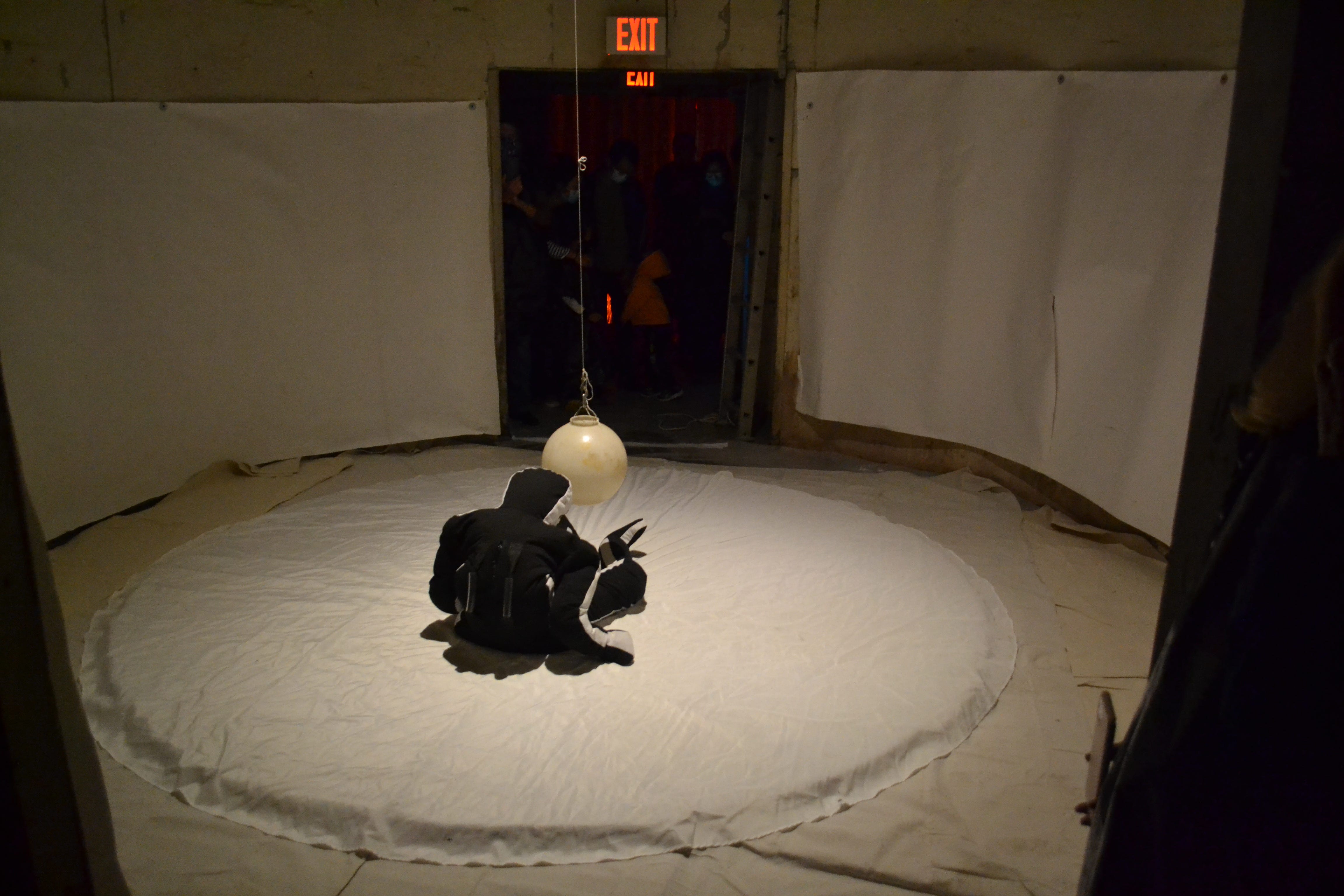
The silo space he was in had a large round platform a couple of inches high, covered by a circular piece of unprimed canvas. The walls were covered with paper. In the center of the canvas was a dummy covered in black and white fabric. Hanging from the center of the ceiling was a sphere. It appeared to be a light covering.
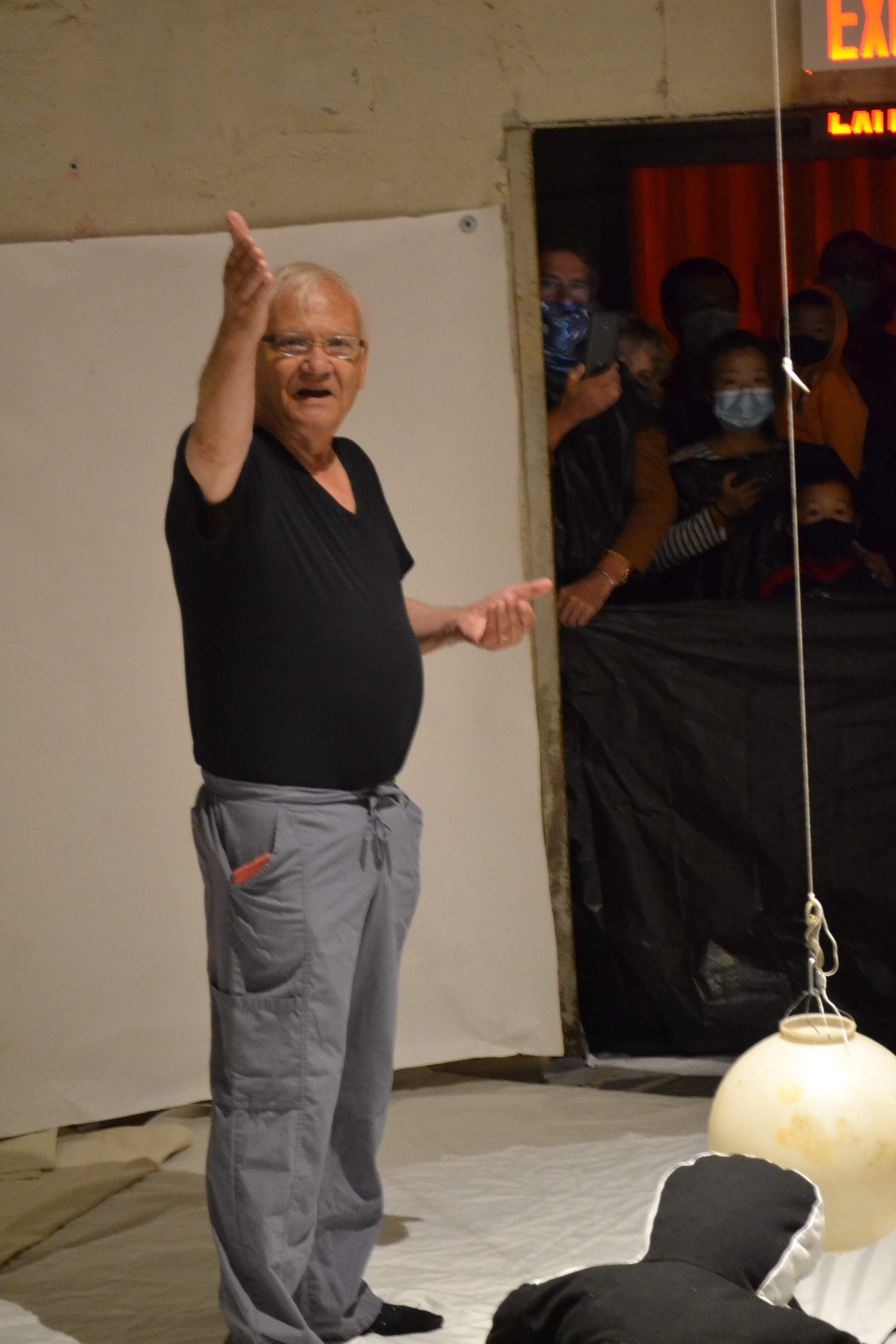
Before Topchy came out, Volker Eisele, one of the founders of Sculpture Month Houston, came out to talk about the performance. He discussed Topchy’s connection with artist Yves Klein and in particular about International Klein Blue, the pigment that Klein invented and that Topchy has used frequently in the past in his sculptures and performances. But this must have been one of the last minute changes—Topchy did not use IKB.
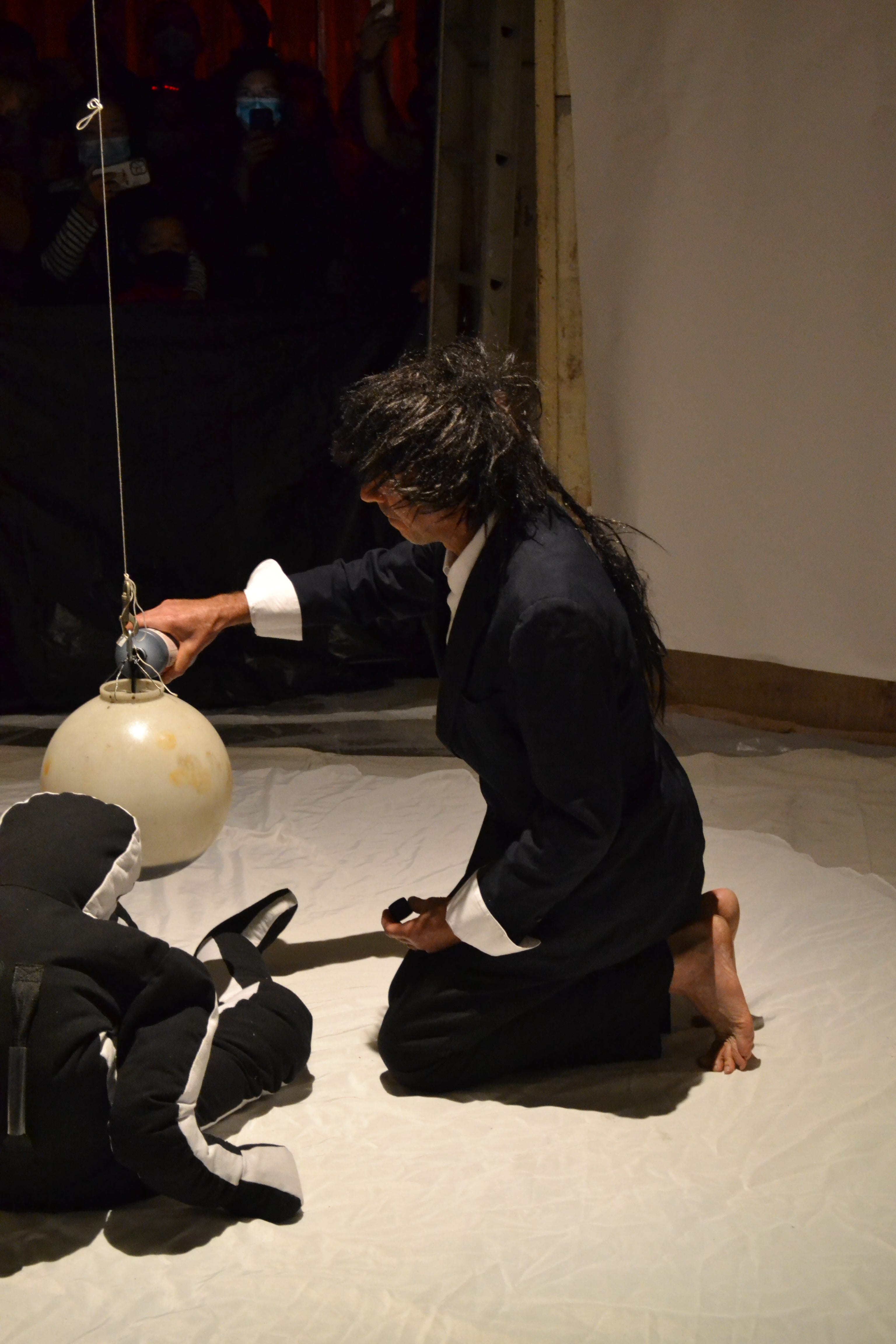
He used sumi ink in the performance. He mentioned to me beforehand that he was going to use sumi ink. I asked him if he was going to grind it in person. Ordinarily, sumi ink comes in a compressed, solid block that the artist grinds on a suzuri stone, mixing it with water to get the density of black desired. But it turns out you can buy sumi ink in a bottle, and Topchy had two bottles of the stuff that he poured into the sphere.
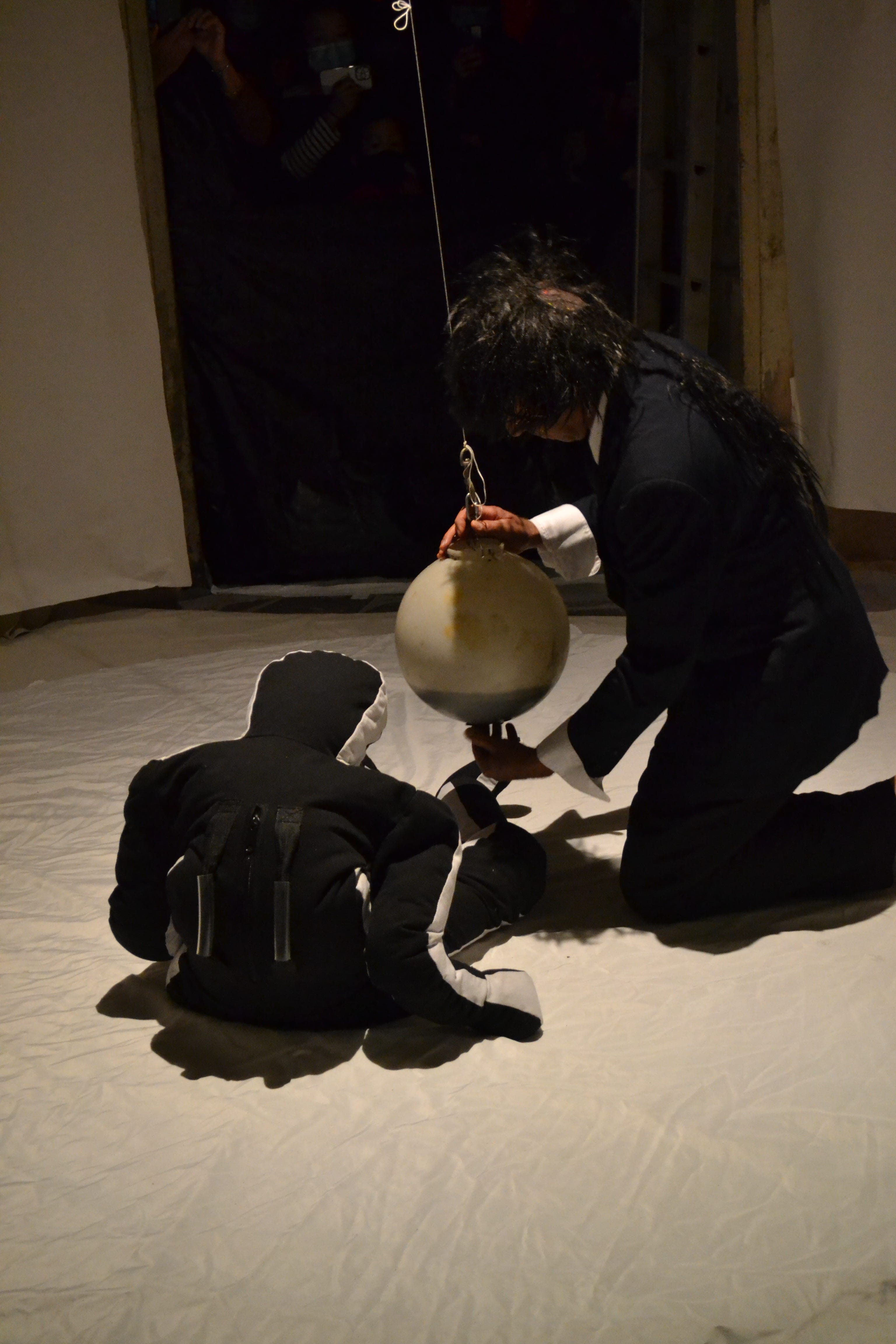
Once the sphere was full, Topchy pulled a plug from the bottom of the sphere to let the ink leak out. He then set the sphere swinging in a circle.
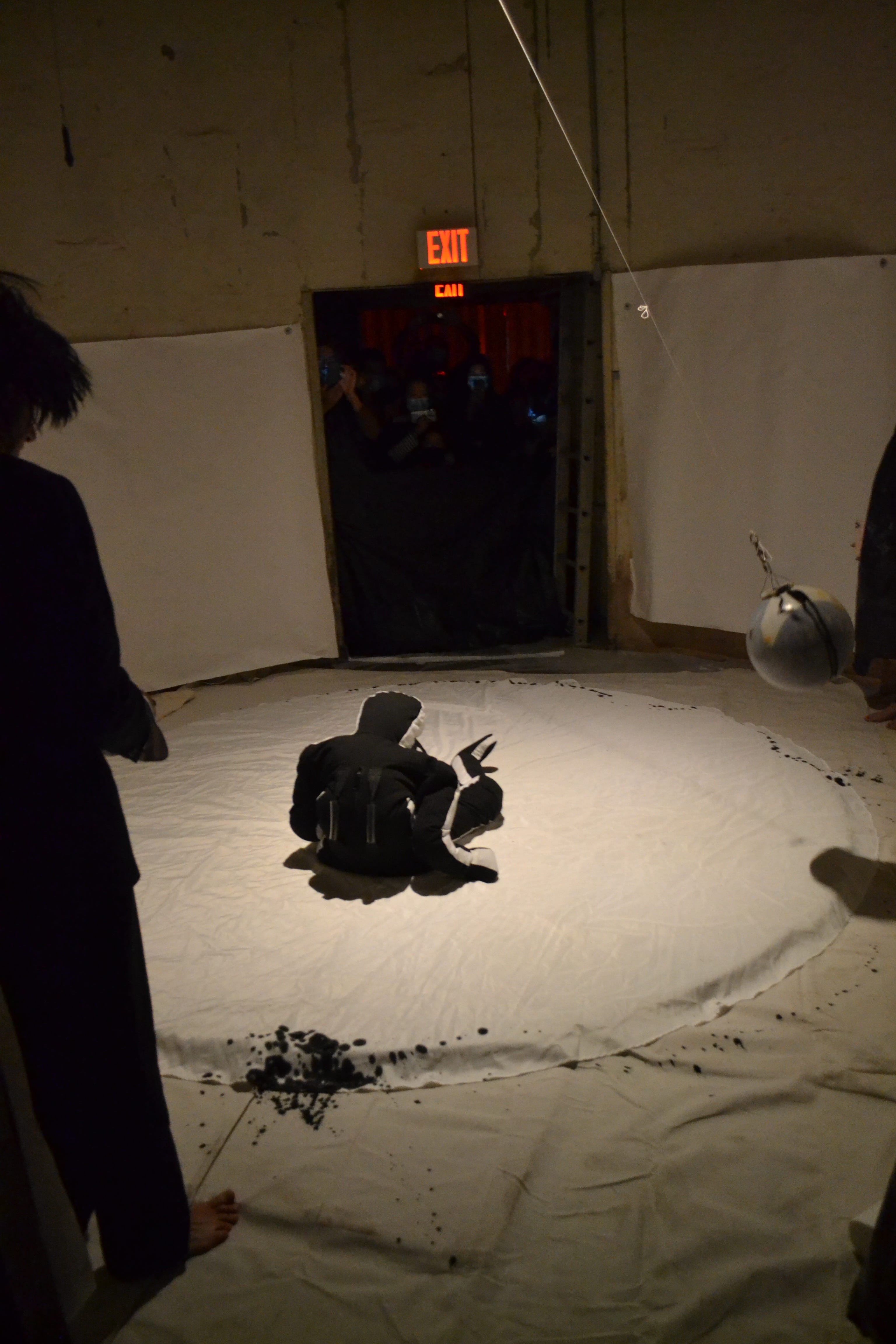
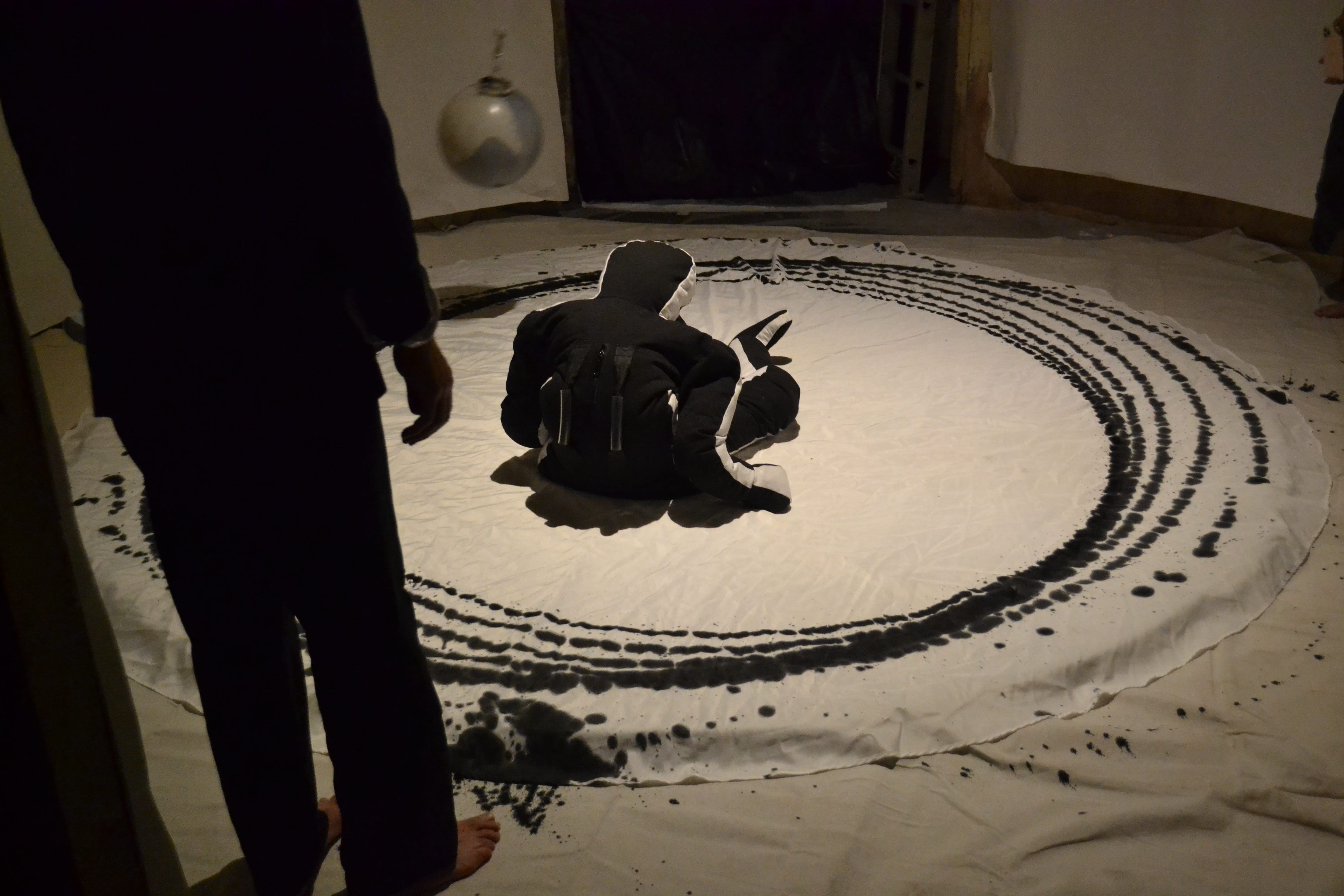
As it spun around, it produced a fuzzy ink line on the canvas. At first the line was pretty distinct, but as the watery ink soaked into the unprimed canvas, it the line started to fill in.

Topchy knocked the dummy over so it was laying face up. He took off his jacket and let the ink pour directly onto the dummy’s face.
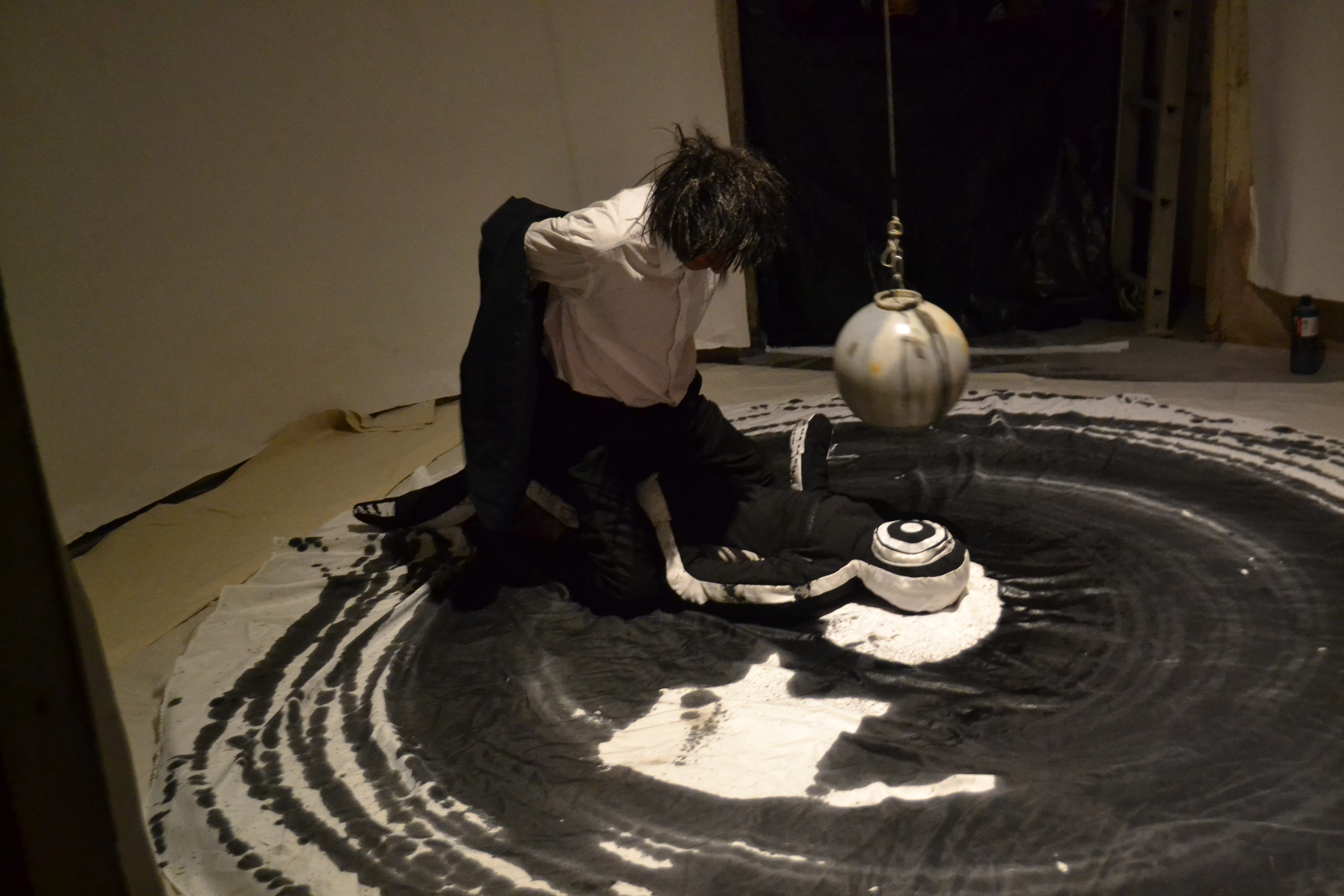
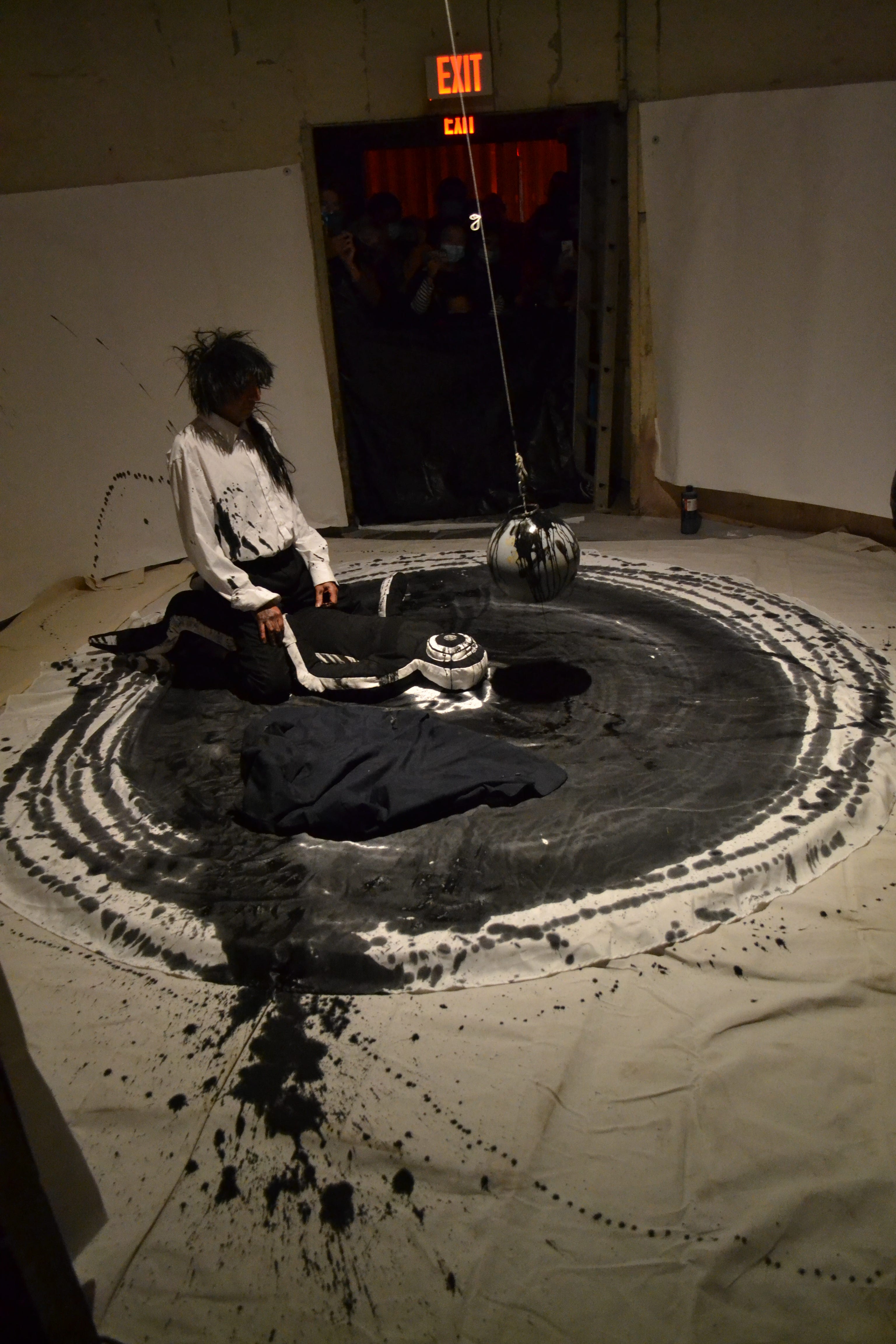
He wrestles the dummy, which appeared to be pretty heavy, and mashed its ink-covered face into the wall. Then he lay down directly under the sphere.
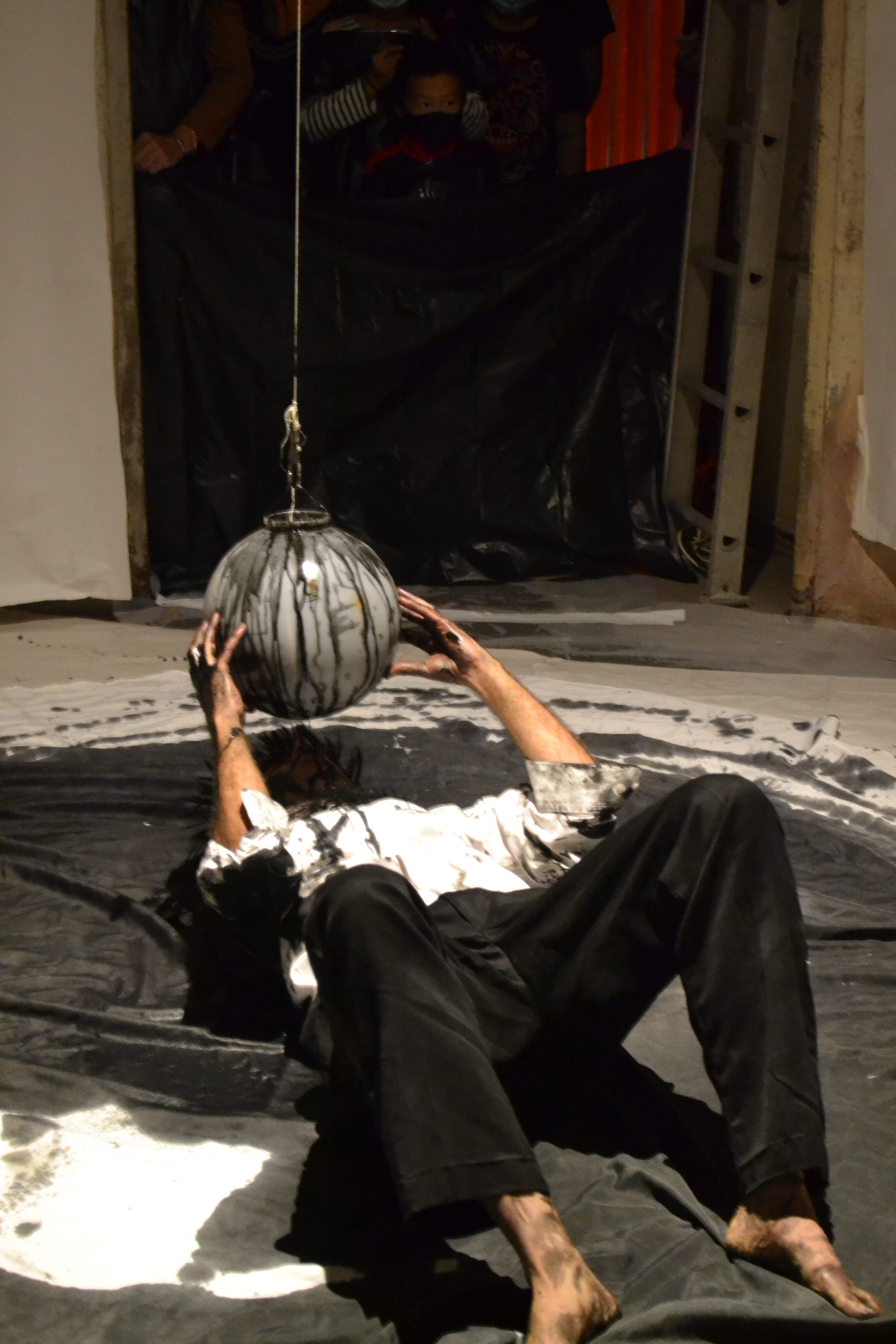
He let it drip ink into his mouth. Then he did something on the side of the silo which I couldn’t see from the angle from where I stood. The silos are not really conducive for audiences to view performances within.

He bowed to the audience.
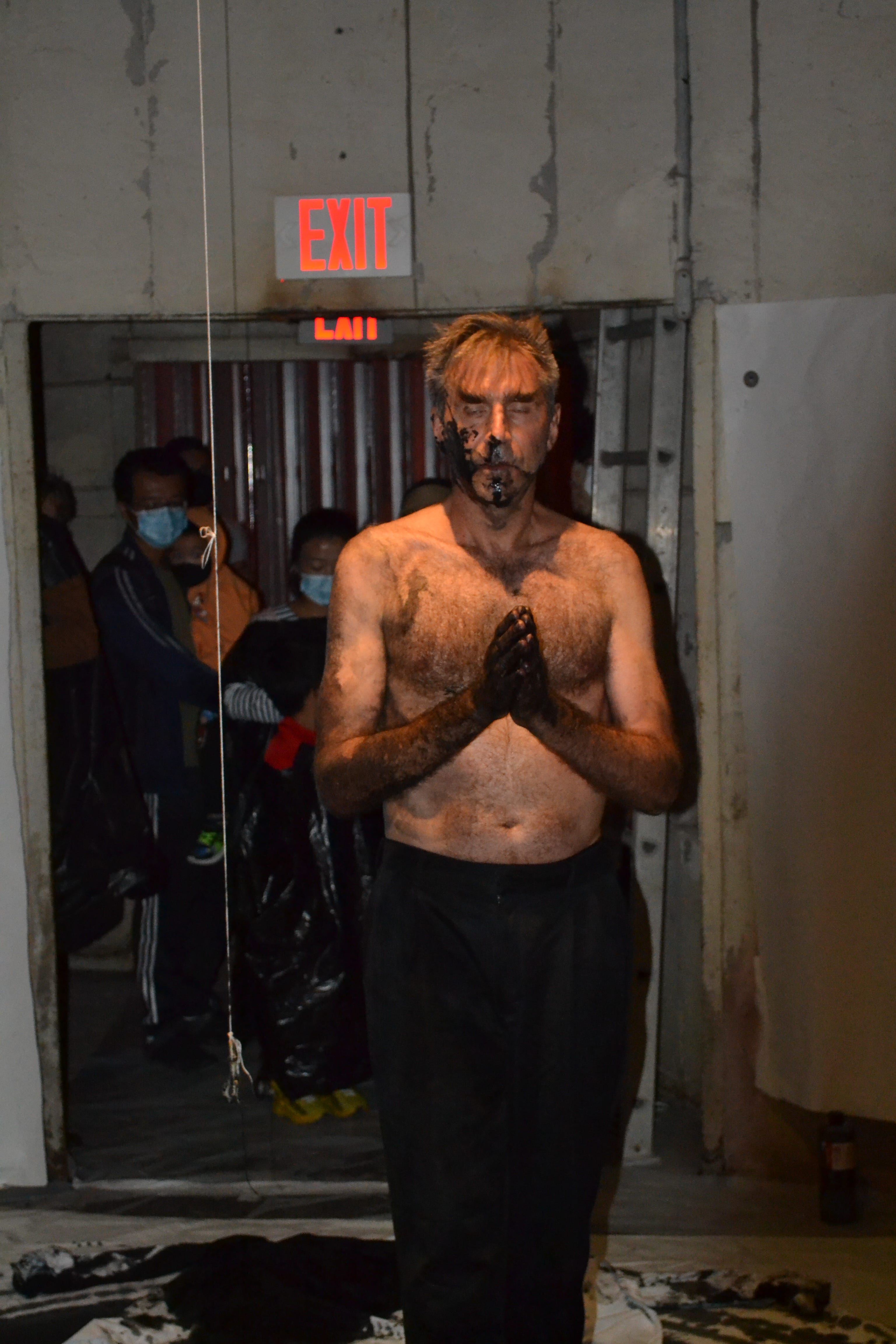
And the performance was over.
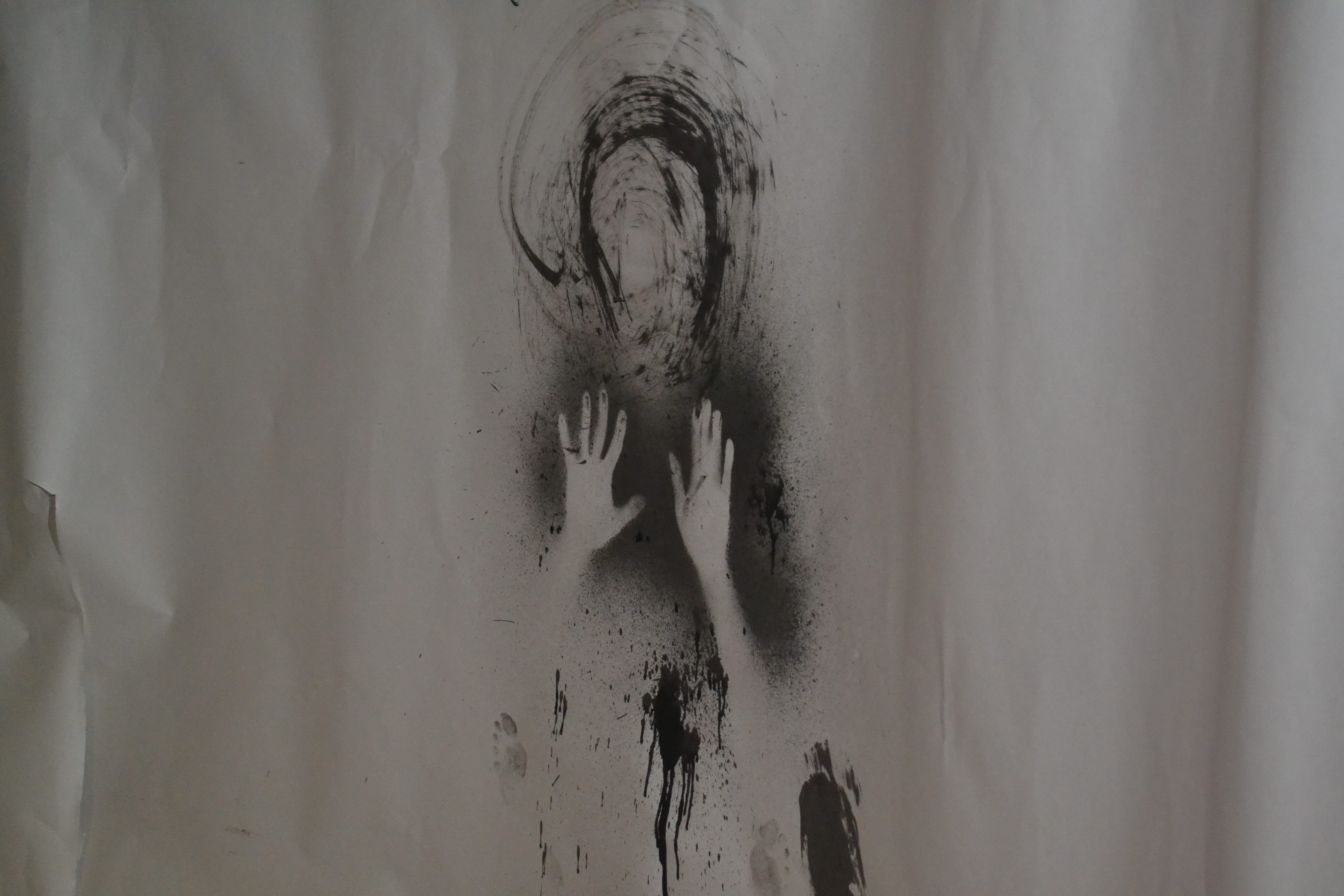
Once it was done, one could enter the silo and see what he was doing on the wall. He sprayed the ink from his mouth over his hands to create a negative impression of them.
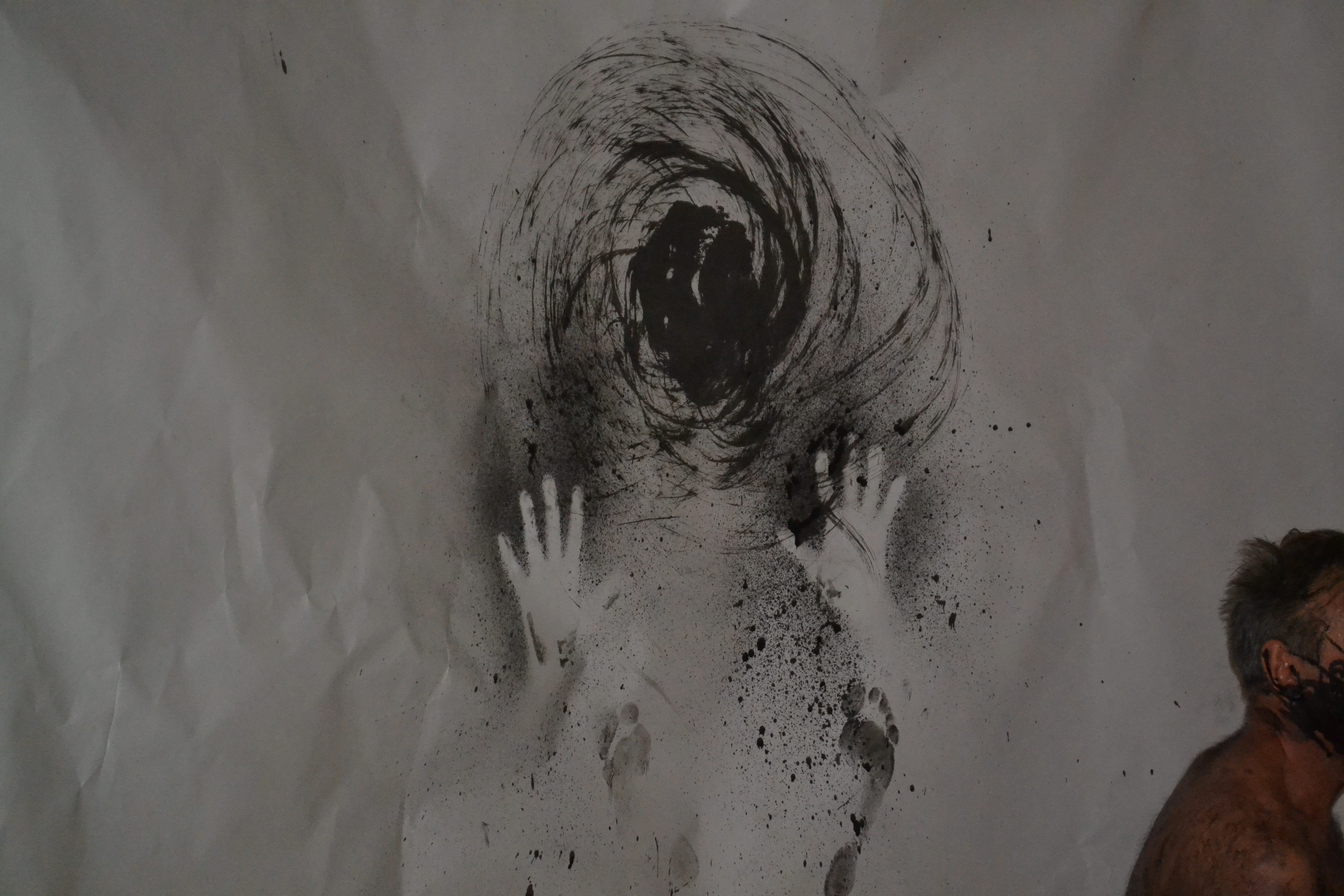
This form of negative hand stencils is one of humanity's earliest forms of art, found in cave paintings all over the world.
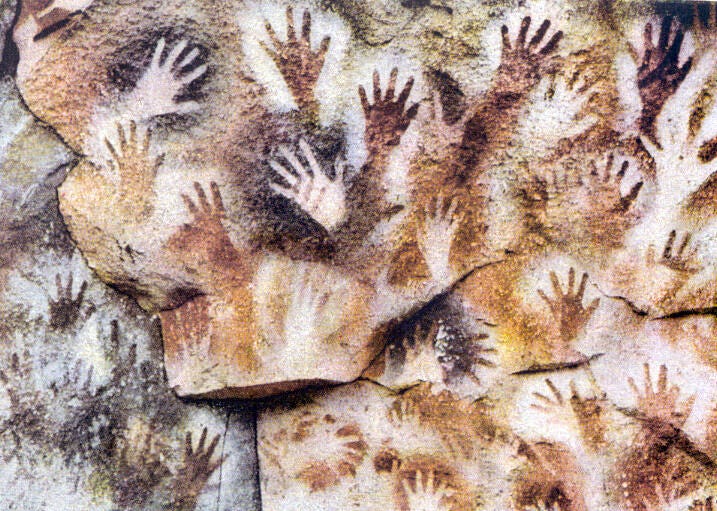
This is from Cueva de las Manos in Argentina. They are estimated to be between 13,000 and 9,500 years old.

Thursday, October 14, 2021

It's Emily Peacock Season

 Robert Boyd

Sometimes an artist shows up in multiple venues at one time. Right now, one can see Beth Secor at UH Downtown and at Inman Gallery. And Emily Peacock has a show at Lawndale and Jonathan Hopson Gallery. I wrote about die laughing at Lawndale and just want to mention lightweight, on view through December 5 at Jonathan Hopson Gallery. I just want to mention two pieces.

Peacock is a photographer, although her artistic practice has evolved into multiple streams—the creation of objects, films, videos, paintings, etc. But she returns to photography here with a series called Bayou Behemoths.

 Emily Peacock, Bayou Behemoth, photograph, 2021

These photos of kudzu were taken on purple film. They look ominous, like the setting for a horror film or science fiction film on an alien world.

Emily Peacock, Bayou Behemoth, photograph, 2021

And this one is like a giant, fuzzy dick protruding from the bayou.

Emily Peacock, Bayou Behemoth, photograph, 2021

The low angles on these make them loom over the viewer. The Bayou Behemoths are wonderfully creepy.

Then there is this piece, which on first glance feels like an inexplicable found object.

Emily Peacock, Flavin Skates: August 4th, 2021

A pair of brightly colored rollerskates on a chrome-plates serving tray. What can they mean?

Emily Peacock, Flavin Skates: August 4th, 2021

There is a story behind them which the artist told me herself at the opening. But she told me that for a certain reason that anyone would understand, “I am not advertising it if you know what I mean.” So I got to hear the story, but you don’t. If you run into Peacock at an opening or just socially, ask her yourself. The story behind the skates is bonkers.

Tuesday, October 5, 2021

The Artist is an Illegitimate Cosmonaut

 by Robert Boyd

Today I reviewed Ilya Kabakov: The Man Who Flew to Space from his Apartment, a short book by Russian art critic Boris Groys. It's a short book--only 60 pages (many of which are full-page illustrations). It's basically an essay on a single piece of art, The Man Who Flew into Space from his Apartment. Ilya Kabakov is one of my favorite artists. He was an "official artist" in the Soviet Union, which  means he was a member of the Artists' Union and did work for the state--in his case, for state publishing houses, because he was a children's book illustrator. But he had other things he wanted to express, and developed a double art practice--one official, and one unofficial. But even in his unofficial art, he used the skills he had gained as a book illustrator. This narrative underpinning to his otherwise highly conceptual art is something that Groys reiterates in his book, along with the idea expressed in the title of this post, which is a quote from Groys' text (Kabakov the unofficial artist was a little like a fictional character trying to become a cosmonaut in his own apartment) and the idea of "Cosmism," a Russian philosophical movement with its roots in the 19th century. "Cosmism" is a topic that fascinate Groys--he published a book about it in 2018, and it is the subject of an interesting lecture he gave that can be found on YouTube.

Monday, October 4, 2021

How High the Moon

 by Robert Boyd

The 8th Continent is the title of a new artwork by Brazilian artist Clarissa Tossin now on view in the Brochstein Pavilion at Rice University. Some followers of the Houston art scene may recall that Tossin was a Core Fellow from 2010 to 2012. During her time in Houston, she was in two Core Exhibits at the old Glassell school (one of which I wrote about), and in exhibits at Sicardi Gallery and the Houston Center for Photography.

Clarissa Tossin, The 8th Continent, three tapestries with metallic thread, 2021

The 8th Continent are a series of tapestries produced with metallic thread on a jacquard machine, a type of loom invented in the 19th century that used punch cards to communicate the design to the machine--it was a precursor in a way to the computing machines of the next century. But the large tapestries are meant to recall those produced during medieval and Renaissance times. These were Veblen goods--they signified the wealth and power of their owners (although they did have a practical purpose--buildings then were drafty and poorly insulated, which tapestries helped). The metallic thread in The 8th Continent also are design to recall the ostentatious wealth display of ancient tapestries. 

Clarissa Tossin, The 8th Continent center tapestry, tapestry with metallic thread, 2021

The 8th Continent was produced with the cooperation of Rice’s Space Institute and Houston’s Lunar and Planetary Institute. They depict areas on the poles of the moon that are possible sites for future moon missions. It is thought that in some of the shadows of some crater--shadows that are never exposed to the sun--there may be water ice. 

Clarissa Tossin, The 8th Continent right tapestry, tapestry with metallic thread, 2021

Tossin used high-contrast photos as her source material, which make the shadows seem even darker than they might otherwise. The black in the tapestry is especially black, presumably because the sewn surface traps light very well. 

So why should these lunar locations be the subject of this modern tapestry? The idea is that because of a 2015 treaty, the Artemis Accords, the USA might be able to mine the moon, particularly to extract water from these dark craters to make rocket fuel from. Why go to the moon to get the water? After all, we have plenty on Earth. But the problem is that it takes a lot of energy to lift rocket fuel away from Earth. A lot of what we're doing when a rocket lifts off is lifting the fuel itself. So if we want to go further than the moon, it would be useful to produce the rocket fuel on the moon and lift off from there. Earth's gravity would still be a drag, but much less so if we were leaving from the moon. So think of these tapestries as trophies of a future colonial possession.

Clarissa Tossin, The 8th Continent left tapestry, tapestry with metallic thread, 2021

(As an aside, they fact that we would even consider going to the Moon to get water shows how absurd it is that science fiction films posit aliens coming to Earth to get our water, as in Oblivion (2013). Why would they drop into our gravity well when water is plentiful in the solar system--on the moon, on various other moons like Europa and Ganymede, and in comets.)

I saw this exhibit on September 24, when it was officially installed. The artist was present. I met her and said, "Parabéns," which is Portuguese for "Congratulations." She spoke Portuguese back to me and I was immediately lost--I know it a little, but not enough to converse.

Clarissa Tossin in the Brochstein Pavilion

Looking at her CV, it seems that in her most recent works, she is looking at science fiction themes. She has always been interested in Modernity, and what is science fiction but Modernity persisting? (Except for the more dystopian branch of the genre.) But linking this futuristic notion--lunar colonization--with the past--medieval tapestries--places this work is a postmodern space, if I may be allowed to use a term that already is starting to feel antique. Colonizing the Moon won't have the huge cost borne by colonized populations, but there could be conflicts. The Artemis Accord is supposed to prevent that--it defines how far apart different nations' outposts must be from one another. But people are good at finding reasons to fight. 

The location of The 8th Continent is interesting. Brochstein Pavilion is not an art gallery, as should be obvious from the photo above. It's a small cafe with spaces for student to get some coffee and study. 

The Brochstein Pavilion

It was built in 2007 (long after my student days here in the early '80s), and architects, Thomas Phifer + Partners, made no effort to fit it in with the original Mediterranean design style of Ralph Adams Cram. Trying to contextualize buildings into Cram's original vision is something that Rice has done sporadically since the founding of the university over a century ago, and the result is a mish-mash of architectural styles. The Brochstein Pavillion seems perfect for its purpose, and students seem to enjoy hanging out there. And I suspect that The 8th Continent is just the sort of artwork that will appeal to the nerds of Rice University.

Thursday, September 30, 2021

Funny Ha-ha AND Funny Strange

 Robert Boyd

I want to write a brief note on Emily Peacock's new exhibit which is up at Lawndale Art & Performance Center through January 15, 2022. The name of the show is die laughing

I've been following Peacock's work for a long time. The first time I saw her work and was aware of it was in 2011 when she was part of the MFA exhibit at U.H. That was a great class--Francis Giampietro, Britt Ragsdale and Jeremy Deprez were three of the class of 2011, along with Peacock. I've written about Peacock and her work several times over the years, but more than that, I've acquired work by Peacock, supported her film project, had her exhibit in the Pan Art Fair (a satellite to the Texas Contemporary Art Fair in 2012), published her work in the single issue of EXU that I published (still available from from the Pan store), and become friends with the artist. Because of this long-time relationship, I am reluctant to try a full-on piece of criticism about die laughing. But I do want to show off some of the works and maybe comment briefly about some of them.


Fast Burning Type, double-sided video, "every rock my son has ever handed me," nylon fibers, 2021

I love that the list of materials includes "every rock my son has ever handed me." I like that it suggests that the first time that happened, Peacock decided, "I'm going to keep this." And between the time I met her, when she was a student, and now, she has a son! Family has always been a major factor in Peacock's work, and the death of her mother was the catalyst for some powerful work

My Very Own OOF, spray paint on canvas, 2021

Peacock is a funny artist and a funny person. I've heard her do stand-up and she's not bad. She never shies away from humor in her work--she is never afraid that it might make her seem unserious. And Peacock's OOF does directly refer to Ed Ruscha's painting OOF. Another artist who was not afraid to be funny. 

Helluva Performance, archival inkjet print mounted to aluminum, 2021

The after years of making photos of the previous and current generation of Peacocks, I guess it's time for the next generation to get some lens time. 

Tastes Funny, trophy, fruit roll-up, fruit by the foot and aluminum pedestal. 2021

Somehow I doubt that Tastes Funny is archival. 

Tastes Funny detail, trophy, fruit roll-up, fruit by the foot and aluminum pedestal. 2021

Funny Bone: I Don't Feel Til It Hurts, plaster cast of the artist's elbow, 2021


 Funny Bone: I Don't Feel Til It Hurts detail, plaster cast of the artist's elbow, 2021


 Increase the Contrast, Plexiglas, vinyl & two lawn chairs, 2021

When I first encountered Peacock's work, she was strictly a photographer. For some artists, mastery of one medium is at least part of their goal as an artist. But for some, what they want to express requires a certain flexibility. I wonder if specialization is a product the progress--as human knowledge increased, it became more and more difficult to be good at everything. That makes sense in the sciences and in knowledge fields, but I wonder why the arts were dragged along in this movement towards ever-increasing specialization. Peacock may have gotten  a degree in photography, but her work, while always including photos, has moved beyond the simple statement: "Emily Peacock is a photographer." Emily Peacock is an artist.


Monday, September 27, 2021

Liminal States/Silver #2

 by Robert Boyd

 
Jim Nolan, Liminal States/Silver #2, mixed media, 2019

I am a material boy. I love to own things, especially if those things were created by artists. But because I was laid off shortly after COVID started, I haven't been spending money on art. (If you're hiring, call me!) But a few days ago, I got a new piece of art, which you can see above, hanging in my grimy apartment. It is a work by Jim Nolan, an old artist friend of mine. 

I think I met him when he was giving a brief talk about his work in a Lawndale Big Show about 11 years ago. His work was distinguished then by it's somewhat rough-hewn, craft-less approach. I wish I had a recording of his talk, but I remember that he concluded with a statement like this: "If you keep working on a thing, does it get better?" I'm paraphrasing from memory. It seemed like a strong statement against craft. But nowadays, he is still creating artworks that veer into the conceptual, but he is also doing work as a potter. It seems that he has embraced craft.

 
Jim Nolan, Liminal States/Silver #2, mixed media, 2019

I've written about Nolan's work several times over the past few years. And I thought it would be fun to celebrate this new acquisition with a short post about this work.

 
Jim Nolan, Liminal States/Silver #2, mixed media, 2019

The whole thing is a wooden construction, including the hand-built black frame. The gray square in the center is wood painted with silvery paint. The holes are neatly cut, and about an inch or two beneath the surface is a mirror.

What is it all about? I have no idea. But Jim has told me that all his art is in dialogue with the work of earlier artists. That feels a little masturbatory, but lets be realistic--except for "outsider artists", every artist is in some way in dialogue with the past. I don't mean to suggest that we have a Harold Bloomian anxiety of influence going on here, but why not?

I don't have an explanation that's better than that, but I'm sure if you buy him a beer, Nolan will tell you something...


Saturday, September 25, 2021

Robert Boyd's Book Report: 1177 B.C.: The Year Civilization Collapsed

 by Robert Boyd


Today I report on 1177 B.C.: The Year Civilization Collapsed by Eric H. Cline, a professor of classics and anthropology at George Washington University. The subject here is an event early in human history known as the Bronze Age Collapse, when all of the empires and kingdoms of the Eastern Mediterranean and Near East collapsed more-or-less simultaneously around 1200 B.C.. (Other bronze age civilizations include the early Chinese kingdoms and the Indus River Valley Civilization. China was not really affected by the Bronze Age Collapse and the Indus River Valley Civilization had collapsed earlier.)

The old theory was that a group of sea-faring marauders (called the Sea People) destroyed all the big empires. This theory has taken a beating as archeological techniques have become more sophisticated (especially underwater archeology, seismic archeology, and the study of ancient pollen that indicates when periods of drought occurred) and also as new ancient cities keep being found. In fact, I suspect if there is a new edition of this book in 20 years, some conclusions will have been superceded by new discoveries.

So much of what Cline writes seems possible to write about today. I expect climate change may produce new mega-droughts, new famine, and new migrations. And while it's happening, we might not even be aware that a new dark age is commencing. Cline points out that the Hittites, for example, were not aware that all of their fellow civilizations were collapsing while it was happening.

I recommend the book--Cline is a lively writer and it's useful to have an index and a list of names of the historical figures. But Cline has also done some good lectures online.