Showing posts with label Woody Golden. Show all posts

Tuesday, September 11, 2012

What Does It Take to Be Patron of the Year?

Robert Boyd

The obvious and cynical answer to the question above is "big checks." Particularly big checks to the artistic institution that is awarding the title "Patron of the Year." In this case, the institution is the Art League of Houston, and I have no idea if big checks were involved or what criteria at all were used to choose the 2012 Texas Patrons of the Year, Scott and Judy Nyquist. But from the point of view of local artists, they do one thing that well-qualifies them for the honor--they buy local art. And this honor affords them the opportunity to engage in what is the secret desire of all collectors--to show off their collection. I was kind of proud to notice that I had works in my modest collection by many of the same artists shown in this exhibit. So maybe I could be "Patron of the Year" someday--as soon as I start writing some big checks.

Here are a few notable pieces from the exhibit.


Adam McEwen, Jerrycan (water), 2007, powder-coated pressed steel, 18 1/2" x 13" x 6 1/2", edition 10 of 75

Jerrycan (water) by Adam McEwen apparently came with five gallons of water from Marfa, but I don't know what happened to the water...


Chuck Ramirez, Elderflowwer, 2006, pigmented inkjet prints, 60" x 48", edition 3 of 10

The late Chuck Ramirez created this photograph of Judy Nyquist's purse. One of his trademarks was to photograph objects isolated in a white, indistinct space, and this piece is a good example of that approach.


Gary Sweeney, You're Our Favorite Artist, 2008-09, woodblock print, 23" x 29"

Ain't it the truth? Gary Sweeney's piece should make folks who buy work for fundraisers fell just a little bit guilty. I confess I look for bargains at such events. But they are somewhat exploitative, no? Aside from a possible tax deduction, some "exposure", and good feelings, what does an artist get from donating art for silent auctions, etc.?


Joseph Havel, Leap Year, 1996-97, bronze with patina, 100" x 4 1/2" x 6"

Collecting sculpture is often quite difficult because it makes a lot more space demands than a painting or photograph. But Leap Year by Joseph Havel is the perfect sculpture for an individual collector--it has a tiny footprint. Anywhere you have 4 1/2" by 6" of floorspace, you can display this piece.


Joseph Havel, Leap Year (detail), 1996-97, bronze with patina, 100" x 4 1/2" x 6"

 
Joseph Cohen, Proposition #111, 2009, reclaimed latex and latex on Brazilian cherry and African mahogany, 13 1/2" x 10" x 1 1/2" (top) and Allison Hunter, untitled #1 (from the Blue Butterfly Series), 2011, digital c-print, 30" x 30"

This was an interesting pairing--Joseph Cohen's bold, plastic painting above Allison Hunter's delicate nature photo. The two works are both beautiful to my eye, so they have that in common.


Marzia Faggin, Fruit Loops, 2011, cast painted plaster, 6" x 6"

There were two vitrines full of smaller work, such as Marzia Faggin's pill and cereal combo, Fruit Loops. And this is a way for young collectors to get access to work--buy small pieces. Sure you'll end up with shelves of artistic knick-knacks, but what else are you going to put on those shelves? Humel figurines?


Rachel Hecker, Green Car Check, 2008, acrylic on canvas, 24" x 36"

Rachel Hecker paints (among other things) the little scraps of paper that have scrawled writing on them that inhabit our lives--like post-its. Her meticulous, impersonal painting style invests these ephemera with weird (and it has to be said, undeserved) dignity.


Aaron Parazette, Study for Jake, 2009, colored pencil on paper, 20" x 15"

These sketches by Aaron Parazette are of the word "Jake", the name of the Nyquist's son. What's neat about them is that we see the designer in Parazette at work--trying out different variations of the same basic idea.


Robin Utterback, Untitled (no 1064), 2002, acrylic on canvas, 78" x 69"

Robin Utterback was one of the Fresh Paint alumni and was tragically murdered in 2007. I apologize about the spotty lighting on this painting, and I want to note that the front gallery at the Art League was really badly designed. It has tall large windows that let in direct afternoon sunlight. In addition to potentially damaging some artwork on display, it is really distracting.


Woody Golden, Study River Stones, 2007, collection of seven, paper and glue, 3" x 2 1/2" each

Woody Golden takes colored paper, laminates it together into a kind of board, then sands it down to resemble river stones worn smooth and round by erosion. These are another example of artwork that doesn't cost a collector to much yet leaves the collector with something charming and lovely.

That's actually the real virtue of this show. It has items that are small and intimate, items that were gifts from artists, and multiples--in other words, it is almost a primer for a beginning collector. It can be intimidating if you want to buy art but have a limited income (like most of us). You walk into a gallery and look at the prices and it's scary. You don't see how you can even start. The Nyquist collection contains some works that I'm sure they paid a pretty penny for, but it also contains work that probably didn't cost all that much--but which probably brought them as much pleasure as many of the more expensive pieces.

Share

Monday, June 11, 2012

Last Week

by Robert Boyd

Terra Antenna
Robert Boyd and Woody Golden's Terra Antenna at Summer Fest.

Last week...


Share

Thursday, June 7, 2012

No One Goes to Summer Fest to Check Out The Art

by Robert Boyd

No one except me. And I had a press pass. The point is, a big music festival like the Free Press Summer Fest brings people interested in music and partying, not necessarily in that order. Anything extra is at best icing on the cake. Otherwise, it's something to be ignored. On top of that, any visual art at an event like Summer Fest is going to be competing with a lot of other stuff for your attention--a festival like this is all about sensory overload. Compare this to the calm, quiet environment of a museum, where it's all about making the art the center of your attention.

So given these challenges, what art works at Summer Fest and what doesn't? Broadly speaking, I'm going to say that pictures don't work. They are too static and have too much competition--not the least are enormous video screens flanking the main stages.

Fancypants/Hay Merchant painting

For example, there were several paintings that may or may not have been by Matt Messinger hanging in the "Fancypants" tents. [Correction: These paintings were not by Matt Messinger. I don't know who they were by. They were apparently brought by The Hay Merchant, who was the concessionaire in this tent.] Access to these air-conditioned tents cost paying festival-goers an extra $40. The Fancypants tents were a refuge from the heat and a bar all in one. Did the people inside these tents particularly notice these relatively subtle paintings hanging from the ceiling? In a different setting, they might have had a very different presence, but here, they felt extraneous.

Fancypants/Hay Merchant painting

Fancypants/Hay Merchant painting

But maybe these somewhat austere, monochromatic paintings are not appropriate for Summer Fest. Perhaps larger, more colorful paintings would attract more attention. Molly Clark had several colorful, cartoony banners. I found her characters amusing and delightful.

Molly Clark, banner paintings on a pedestrian overpass

These cute monsters were hanging up on a pedestrian bridge over Allan Parkway (under which most festival-goers had to walk to enter or leave SummerFest).

Molly Clark, painted banner

This one was attached to a fence at the top of the embankment above one of the main stages. All her banners were large, colorful, and cute, done in a style that recalls both children's book illustration and the "cute brut" style of alternative comics typical of such artists as James Kochalka. In short, they have a lot of appeal. But did people stop to check them out? I'm sure some did, but that wasn't the norm.

people ignoring art

Instead of attentive viewers, this art was greeted with indifferent crowds rushing to and fro--to the next act on a different stage, to the porto-potty, to get water or beer to drink, or to the Fancypants air-conditioned tent to cool off. As nice as Molly Clark's art is, it just wasn't in the right place to be noticed.

Eric Castorena, banner on pedestrian overpass

The same could be said about Eric Castorena's witty mashup of Davy Crockett and Tom Waits.

Amie Jones, Eyes Over Texas

Even Amie Jones' massive god's eye-like constructions, Eyes Over Texas, seemed to struggle to compete with the other attention-grabbing aspects of the festival. In just a slightly different setting, I think these two cosmic eyes would be very striking--unsettling, even. But here, it was hard to get people to look up.

The point is that paintings (or things like Eyes Over Texas, which acted like paintings by virtue of being hung up) had a tough time commanding people's attention. Given this, what might work better is something that intervenes. Something that is physically in your path. In short, sculptural objects would seem to have an advantage in this venue.

Michael C. Rodriguez, installation at Summer Fest

Michael C Rodriguez's installation was more of a painting than a sculpture, but because it was free-standing, it had a sculptural presence.It was hard to avoid this large Roy Lichtenstein-ish painting, and people huddled in its shade. Its size and location helped it be seen--it wasn't unobtrusive like some of the other artwork. I like the tattoo on the female figure's arm.

Brett Osborne, With All Music Blaring, I Can Hardly See Straight, ceramic

Brett Osborne's With All Music Blaring, I Can Hardly See Straight has a smaller footprint than the Michael C. Rodriguez piece. Note to future Summer Fest sculptors--work big. Osborne is better known as a tattoo artist than a sculptor, but I found this piece pretty ingenious. I will confess--I would have been nervous to display a large ceramic piece like this among the sixty thousand intoxicated Summer Fest patrons.

Brett Osborne, With All Music Blaring, I Can Hardly See Straight (detail), ceramic

Jacob Calle, They Give Us Their Artifacts As Gifts to Prove They Existed

Chelsea Paquette, They Give Us Their Artifacts As Gifts to Prove They Existed

Jacob Calle's dinosaur and Chelsea Paquette's mammoth were pretty nice, but they were placed in an out-of-the-way spot (near the entrance, but once you entered you were already past them). So they didn't accomplish the task of getting in your way--which was an important means of getting your art noticed at Summer Fest.

Henry Moore, Large Spindle Piece, bronze, 132 inches

The finest sculpture at Summer Fest got the least respect. Henry Moore's Large Spindle Piece is a permanent feature of the park, and I guess the Summer Fest people had to protect it. At least, I assume that's why they fenced it. But even worse than the fence is the random crap surrounding it.

Perhaps the best way to make a splash artistically at Summer Fest was to do performance instead of static art. I don't know who these "protesters" were, but I sure noticed them. (And I heartily agree--Summer Fest was hell--unless you could retreat into an air-conditioned Fancypants tent from time to time.)
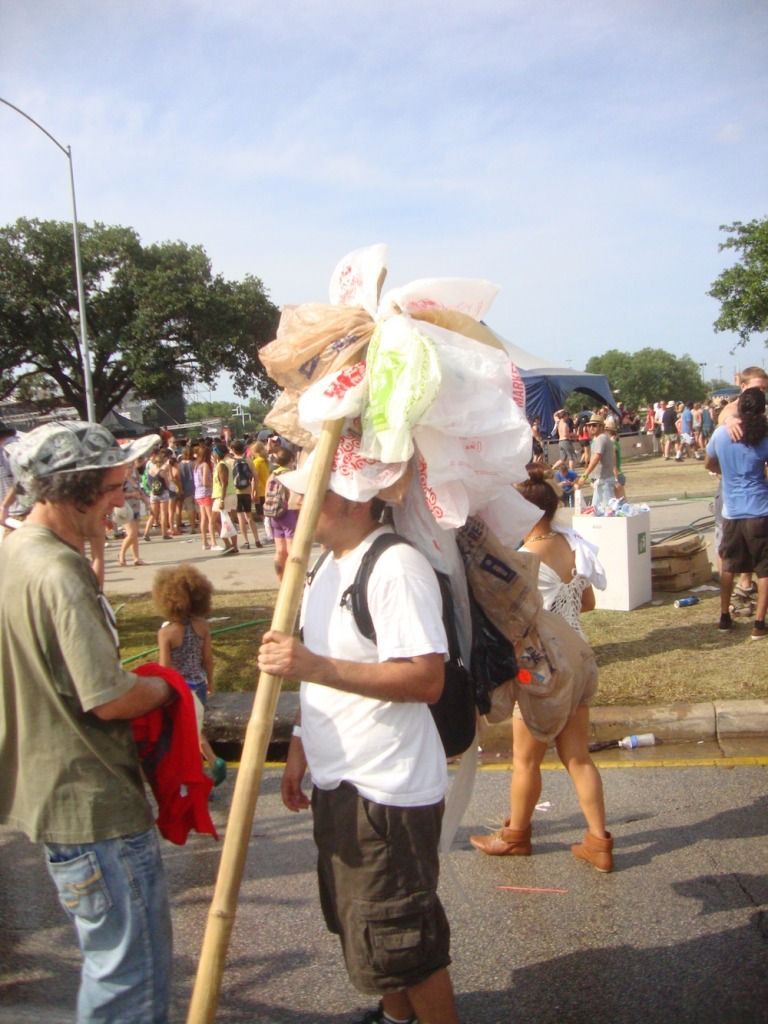
trash carrier
countercollectivecollectivecollective, Countercrawlture

I am pretty sure that these guys with plastic bindles were part of countercollectivecollectivecollective's Countercrawlture. So there was a mobile performance aspect (the bindle guys) and a stationary aspect.
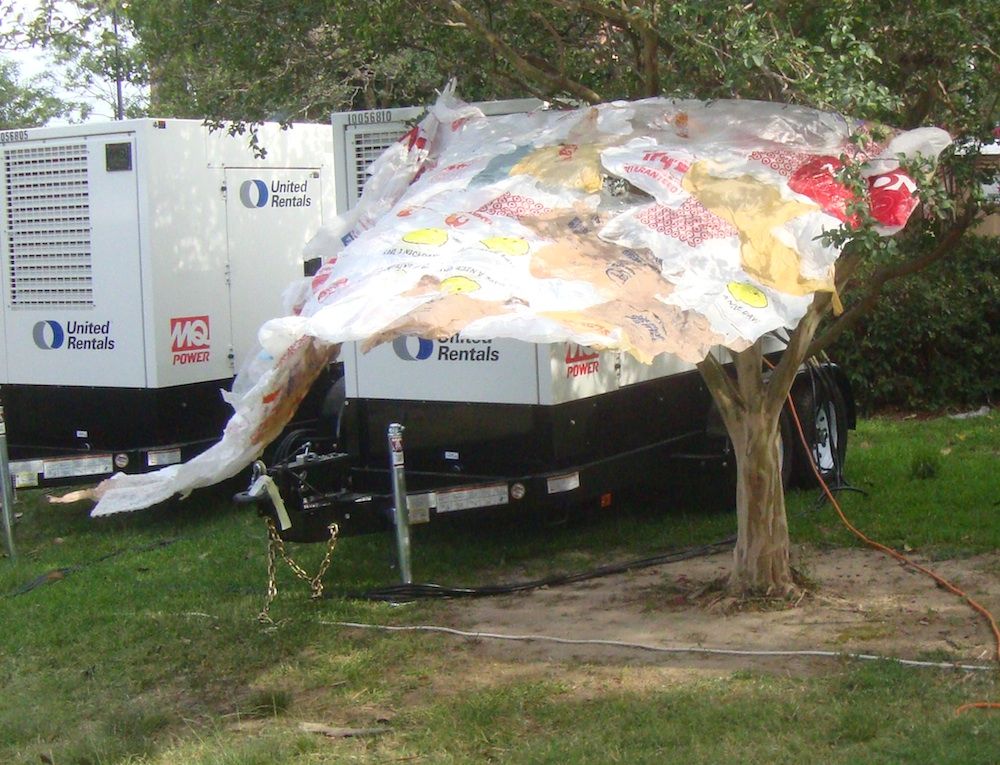
banner
countercollectivecollectivecollective, Countercrawlture

The stationary part included these banners made of plastic bags.
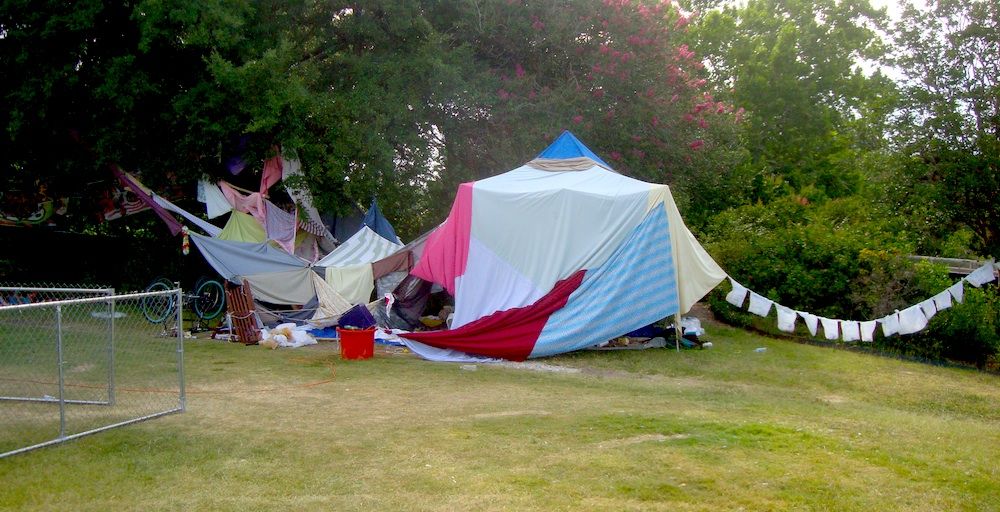
encampment
countercollectivecollectivecollective, Countercrawlture

Yes, right on the edge of Summer Fest, an orgy of consumption, was this art installation that looked like a homeless encampment. My understanding was that it was meant to be a place where you could get away from the crowds and take a nap. And it was in fact in a curiously peaceful part of the Summer Fest area--the area behind stage 3 where there was a group of oak trees providing shade. The part that looks like a laundry line on the right was a string of Walmart plastic bags with one bottle or can in each.

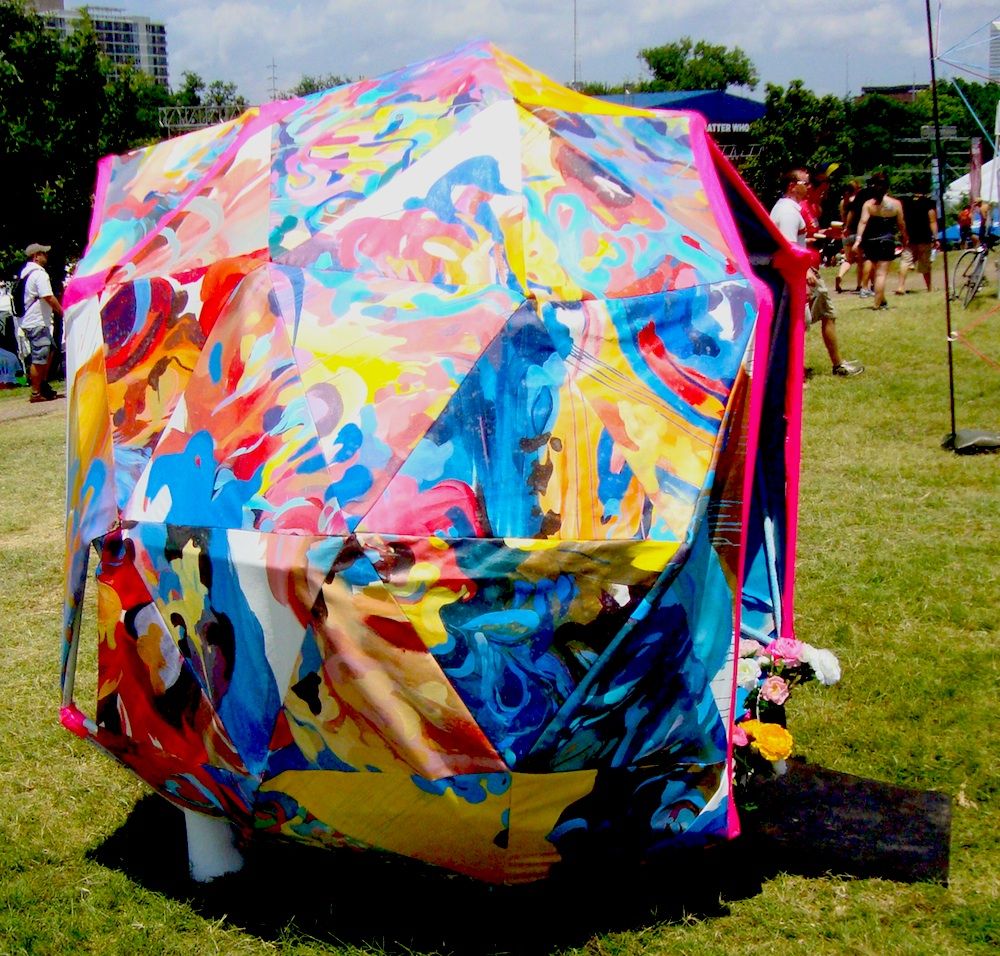
The work that worked best was, like Countercrawlture, interactive. I think that is one of the keys to a successful piece of art at Summer Fest. On that count, Stephanie Toppin's person-sized geodesic dome, Imaginary Head Space, worked.
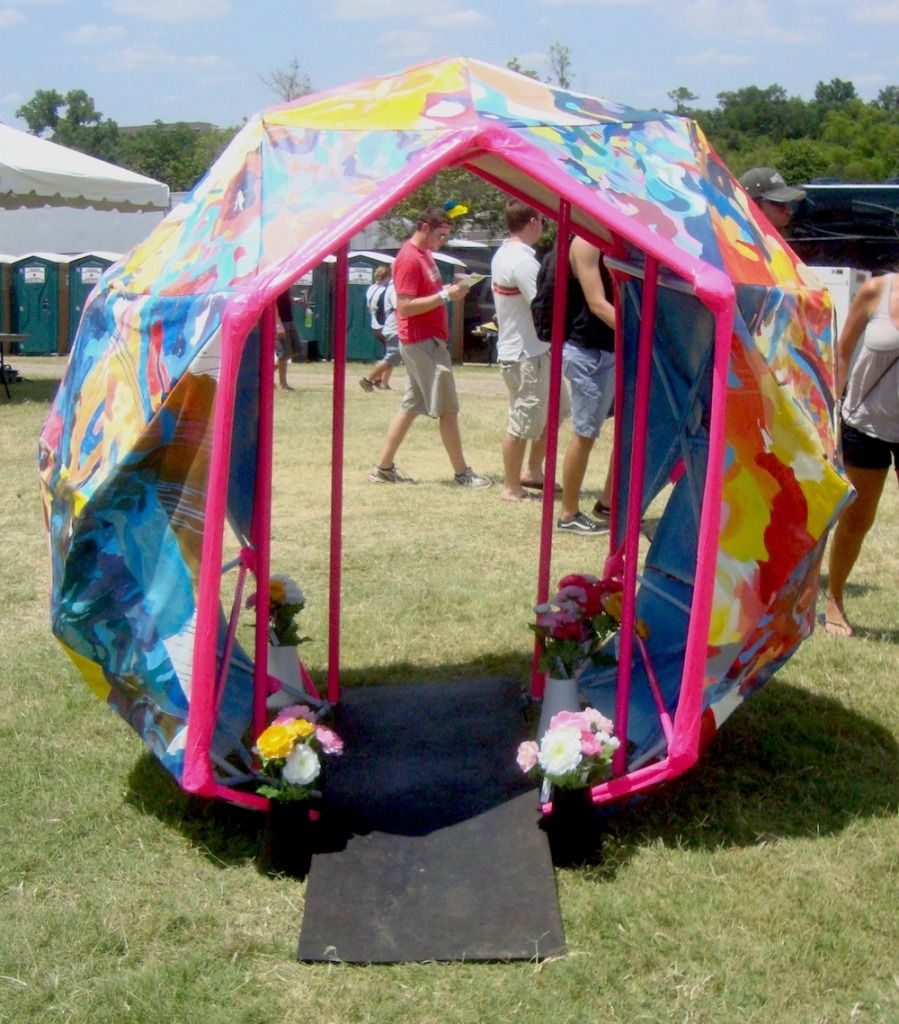
Imaginary Headspace
Stephanie Toppin, Imaginary Head Space
Imaginary Headspace
Stephanie Toppin, Imaginary Head Space

Imaginary Head Space was just big enough to accommodate one person--or maybe two if they were small. There wasn't anything to do inside it except get out of the sun and hang out. Toppin told me that she was worried that people would leave garbage or worse in it. Her nightmare was coming in Sunday morning and finding poop inside. However, mostly what people left was not bad--some people even left flowers in it.
Terra Antenna
Woody Golden, Terra Antenna, styrofoam and wood

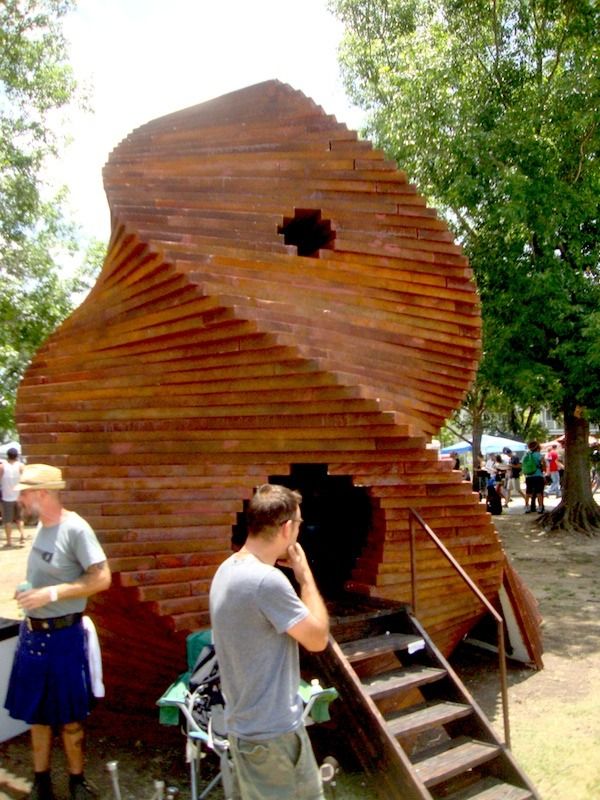
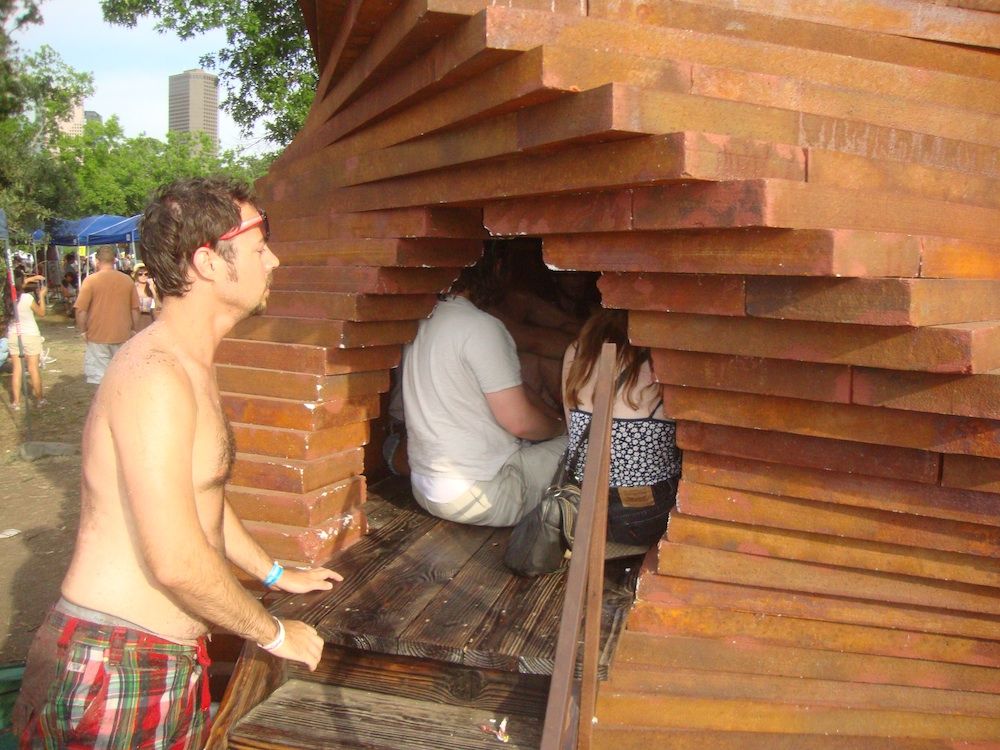
Another place to hang-out was Woody Golden's Terra Antenna. This enormous styrofoam and wood structure worked because it was large, it was in the way (you had to walk past it, pretty much), and it was interactive in that it had a space inside where people could chill out (and probably smoke some weed, but I never witnessed that).
Terra Antenna
Woody Golden, Terra Antenna, styrofoam and wood

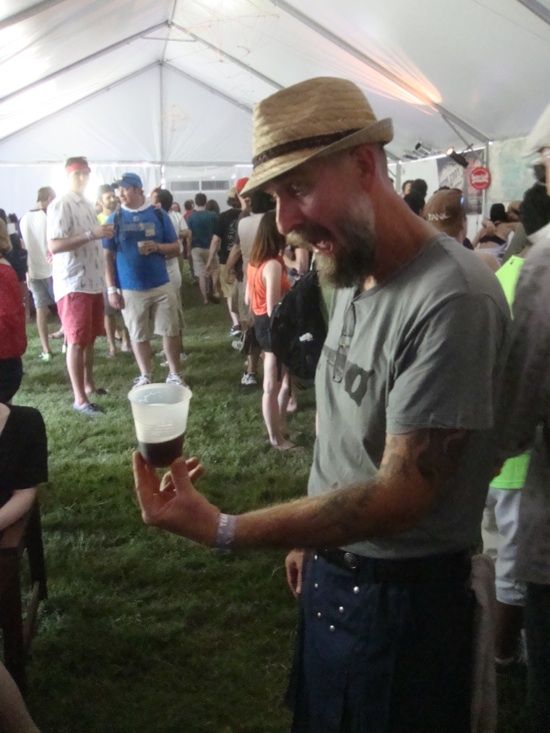
Like all the artists, Golden had free access to the Fancypants tent. But they didn't give the artists free beer. He was shocked when he learned the beers there cost $7, even for artists. An outrage!
Woody Golden
No respect for artists in the Fancypants tent

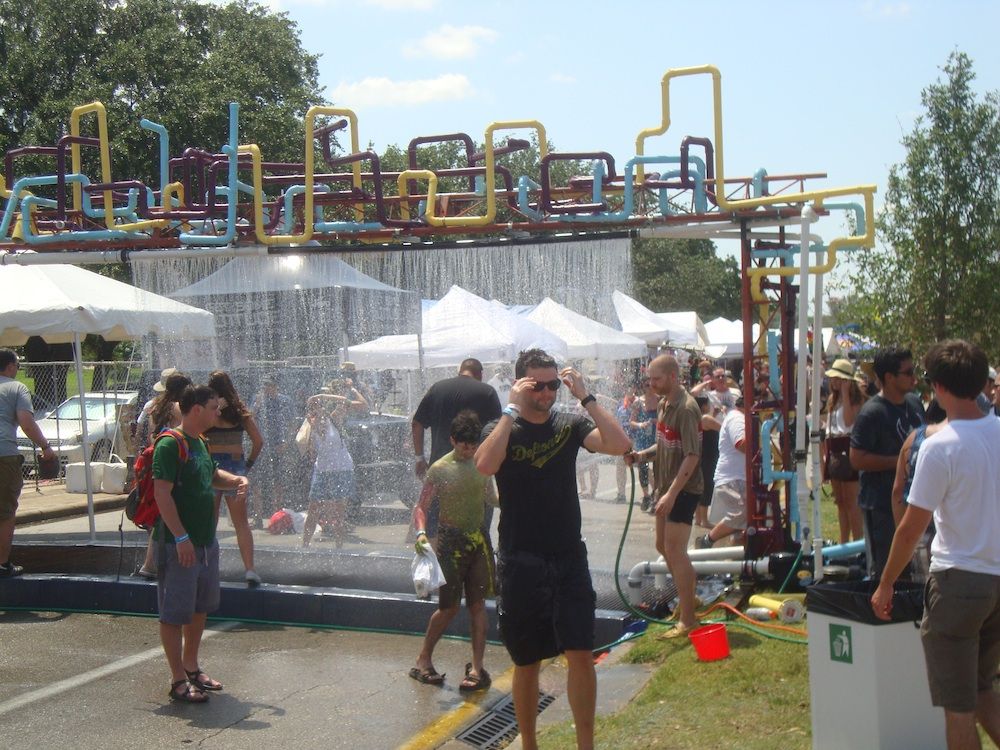
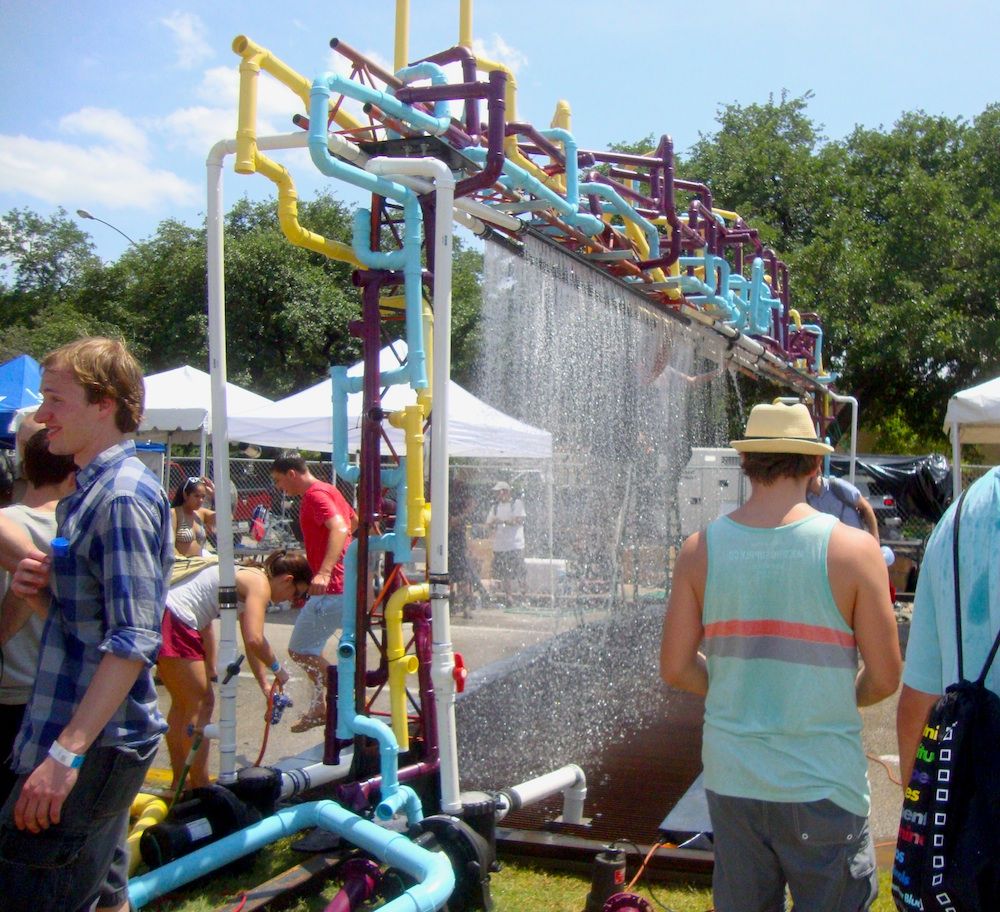
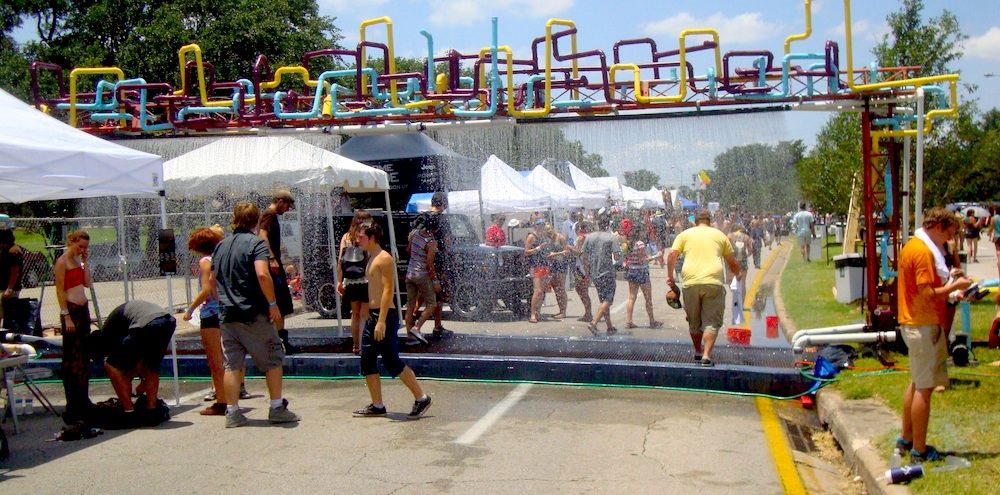
So I've established that the best pieces of art at Summer Fest should be highly visible, they should be big, they should be in the way, and they should be interactive. These are the pieces that people will notice among the general hullabaloo of a music festival. And the piece that best embodied all these qualities was Water Gate, a collaboration between Exurb and TX/RX Labs. These are two groups of artistic tinkerers that I would describe as engineering-oriented art collectives. (I've written quite a bit about Exurb in the past.) In a way, this seems like the perfect kind of art for Houston--we're a city lousy with engineers, after all. Houston needs its own E.A.T.
Water Gate
Exurb and TX/RX Labs, Water Gate, pvc pipe, electronic equipment, pumps, water

Water Gate straddled the westbound lanes of Allen Parkway. It rained a continuous curtain of water on overheated festival-goers who needed a spritz. And it had a motion detector that could tell if there was someone walking up--and a small gap in the curtain of water would appear whenever this happened.
Water Gate
Exurb and TX/RX Labs, Water Gate, pvc pipe, electronic equipment, pumps, water
Water Gate
Exurb and TX/RX Labs, Water Gate, pvc pipe, electronic equipment, pumps, water

The only problem with Water Gate was that they suffered technical problems. This is the danger with all engineering projects. The design may be sound, and the testing and commissioning may be perfect, but until you are operating in field conditions, you don't know what will happen. In this case, they failed to anticipate how dirty the people going through the gate would be. Specifically, a lot of people came through the Water Gate after having ridden on Patrick Doyle's Paint Slide. This was another interactive art piece (a highly successful one, judging by the number of paint-coated people I saw), where people literally slide down the side of a hill on a slide covered with wet paint. So these colorful, paint-spattered people would use Water Gate to clean off a bit. The paint (and dirt) ended up clogging one of the pumps that was circulating the water, and by late afternoon Sunday, Water Gate wasn't working anymore.

Disappointing, sure. But now they know--it's just an engineering problem to be fixed. The concept is sound and the piece is beautiful. Water Gate is exactly the kind of installation you would want to have a hot summer festival. I hope Exurb and TX/RX Labs work out the bugs and install it at other events this summer.


Share

Monday, October 31, 2011

Dennis Harper's Show of Shows

by Robert Boyd


I wanted to lead off with this statement. Have I ever mentioned how much I dislike artists' statements? If you had read this prior to making a decision about whether to go to the Joanna and see this thing, you'd stay home and watch reruns. The problem with artists' statements is that the make even really exciting art sound boring. Fortunately, I didn't read this statement until I got to the Joanna, so I was already committed.

So let me try to give you a flavor of the show--Dennis Harper invited his friends to come together for a one-night only evening of performance on October 22 at The Joanna. The structure was like an evening of broadcast TV, where you might have an Entertainment Tonight-like program followed by some comedy then by a game show, etc. Now The Joanna is a pretty bad place to see performance--it's a house, so the largest room is the relatively small living room. To get around this problem, Harper installed a closed circuit TV system. I think there were four screens in all--two in interior rooms, one on a walled-in porch, and one outside in the back yard. This way, everyone could see the performances. But Harper went an extra step--he created a fake TV studio out of paper--giant paper cameras, lights, microphones, etc. So while he had, in effect, a real TV studio (with tiny modern cameras feeding into Harper's computer, from which he directed the scene and controlled what was seen on the closed circuit monitors), on top of that he had layered a fake 1960s era TV studio.


Dennis Harper, paper microphone at iPageant, paper and PVC, 2011


Dennis Harper, fake TV studio for iPageant, mixed media, 2011

That's sculptor Woody Golden above operating one of the real cameras as various Houston art figures take their places for a game of What's My Line. The camera to the left is made of paper.


Dennis Harper, directing iPageant, 2011


Tina McPherson conducting red-carpet interviews

Tina McPherson, whose day job supervisor of the William R. Jenkins Art and Architecture Library at U.H., is also a local arts scenester. (Lots of local scenesters have day jobs that are tangentially related, at best, to their position within the local art scene.) She conducted interviews of arriving guests (pretty much anyone who came through) similar to those red-carpet interviews one might see on awards shows or celebrity-oriented shows. I've always thought it was weird how the backdrop to these interviews would be wallpaper printed with copies of corporate and/or product logos. iPageant parodied this tendency by putting up Tyvek, the super-strong water-proof paper that home builders use to cover the wooden framing of modern houses. Tyvek has its logo printed in a regular pattern, making Tyvek paper perfect for a red-carpet backdrop. McPherson treated everyone who came in as if they were a celebrity, whose answers to her repetitious questions were actually worth hearing. This went out live on the closed-circuit feed. Lots of people tried to fluster McPherson by giving outrageous answers to her questions, but she never broke character as far as I saw.

Then in the room to the left of the entryway, Herbert Melichar was taking headshot photos of everyone who walked in. He had lights set up and a black background. The photos were dramatic. He put them up in a gallery on his Facebook page and his Flickr page (whichever you prefer).


Nancy Douthey, iPageant perfomance on closed circuit TV

Next up was Nancy Douthey. As I mentioned in an earlier post, this performance was very much based on acting. Douthey was an old-fashioned telephone operator (a job rendered obsolete by technology). You've seen such operators in movies and on TV--they would be sitting before a bank of lights and sockets, and their job was to connect specific callers with specific receivers. Douthey uses practice to engage in a series of one sided conversations. It's not totally clear whether each conversation was meant to be a different person, or if it was the same person, whose personality changed depending on with whom she was speaking. The latter scenario was how I interpreted it, and I saw it as being about how our identity depends so much on other people--and other circumstances. We are not the same person when we are talking to our mother as opposed to when we are talking to our lover.


excerpt from Nancy Douthey's iPageant performance

Then it was time for the main event. both the fake television studio and the real one were set up in the Joanna's living room. A set for a game show was there with seats for four panelists, one host, and one contestant. This was a recreation of What's My Line, which was a weekly prime time game show from 1950 to 1967, and a daily syndicated show from 1967 to 1975. The idea behind the show is that the panelists, who wore blindfolds, would have to guess who the guest was based on a series of yes or no questions. If they failed to guess within a certain number of questions, the guest won (I'm assuming the guest, who was a celebrity, was playing on behalf of someone).


Two of the What's My Line panelists, Dennis Nance and Shane Tolbert

The host was played by Mat Wolf. The guests were Jenny Schlief, Dennis Nance, Shane Tolbert and Lane Hagood. The look was "natty."


It started off a little awkwardly, but as they got into the act, the players got better and better.


The first mystery guest was Blaffer director Claudia Schmuckli. It didn't take long for the panelists to guess who she was. The next contestant was a twist--two people, Cody Ledvina and Brian Rod, the guys behind The Joanna. The panelists never guessed who they were because of their confusing, contradictory answers.

Between each act, the closed circuit TV camera showed this sign.


I left after the "What's My Line" act (which I kind of wish could have gone on longer--how often do you say that about performance art, eh?), and because of this I missed some other things that apparently happened later (to go by the photographic evidence here).

What I didn't quite understand was what all this had to do with social networking. There were a few obvious references (the "like" sign in the place of an "applause" sign), but it seemed to have more to do with television and our shared history of television than anything. But on a little bit of signage showing all of Harper's collaborators, we do get an idea of the interconnectedness of one part of Houston's art scene.


I thought it was fantastic fun, and the format seems replicable. If Harper wanted to host additional performance nights, the fake TV studio with closed circuit monitors would be a good way to structure it. I'd go see them.


Share