by Robert Boyd
NADA is the New Art Dealers Alliance, a non-profit trade group founded in 2002. They had the smallest, most cramped art fair in New York the weekend before last, but for the viewer, it had one great advantage over Frieze and Pulse--it was
free. Here is what
they write about themselves on their webpage (emphasis mine).
Founded in 2002, New Art Dealers Alliance (NADA)
is a not-for-profit 501(c)(6) collective of professionals working with
contemporary art. Our mission is to create an open flow of information,
support, and collaboration within our field and to develop a stronger
sense of community among our constituency. We believe that the
adversarial approach to exhibiting and selling art has run its course.
We believe that change can be achieved through fostering constructive
thought and dialogue between various points in the art industry from
large galleries to small spaces, non-profit and commercial alike.
Through support and encouragement, we facilitate strong and meaningful
relationships between our members working with new contemporary and
emerging art; while enhancing the public’s interaction with contemporary
art.
Our international group of members includes both galleries (including
non-profit spaces) and individuals (art professionals, independent
curators, and established gallery directors). The various perspectives
and ideas offered by our diverse roster creates a network which, at its
most basic, is a resource which people could contribute to and take as
much (or as little) as they are inclined. We believe in a spirit of
friendly competition and the power of working collectively to gain
access to resources and to provide services to artists and the public
that we could not as individuals. The benefits for some may be a matter
of business, for others a source of intellectual or aesthetic
stimulation.
This is a strange mission for a bunch of art dealers. And this art fair, like every other art fair I've been to, seemed to be all about selling art. I wonder what they mean by the "adversarial approach." It strikes me that art galleries depend on cooperation to function. No artist, for example, has to sign with a particular dealer, and no collector has to buy from that dealer. These are voluntary exchanges, which is the essence of capitalism. But perhaps they are speaking of competition. But when I hear phrases like "friendly competition" and "working collectively," I start to worry about cartels.
But that's neither here nor there in discussing this art fair. As I said, it was quite cramped. There were three floors of exhibitors in a narrow building in Chelsea. They also used the roof of the building, where there was food and a tent with
Phaidon selling books. I started at the roof and worked my way down.
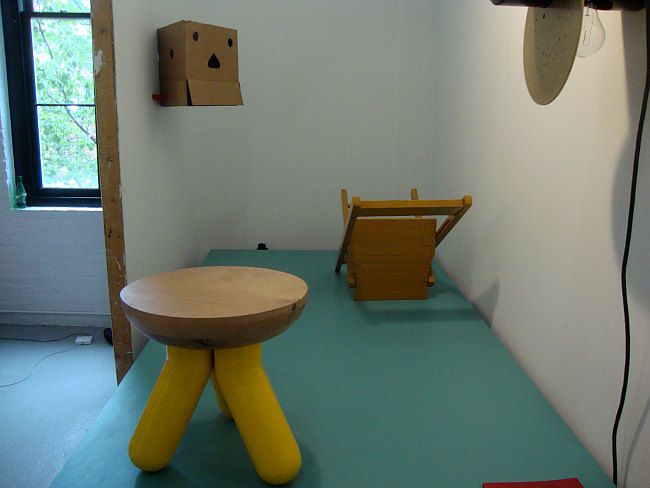 Koenraad Dedobbeleer at Clearing Gallery
I liked this piece by
Koenraad Dedobbeleer, but the weird thing is that it took up the entire floorspace of the booth except for one sliver at the end. (Because of this, it was impossible to photograph the whole piece.) At Frieze, a piece like this would have been surrounded by air on all four sides. Fortunately, his other piece could be hung on the wall out in the corridor between booths.
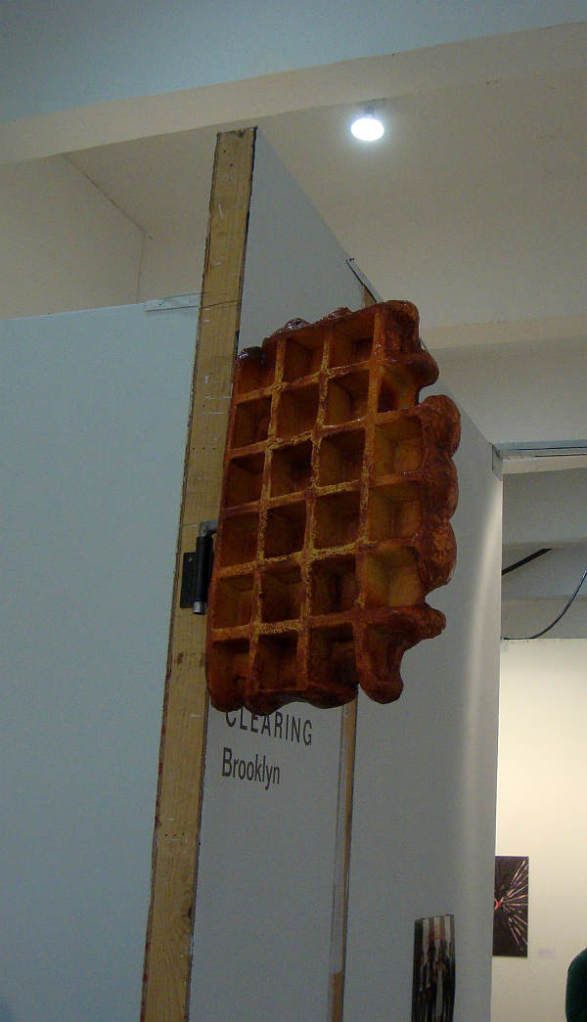 Koenraad Dedobbeleer at Clearing Gallery
It's make a good sign for a
Chicken and Waffles restaurant, no?
I also liked everything I saw at Toronto's
Tomorrow Gallery but I didn't get all the artists names. I don't think they had the art labelled. I talked to people there, but the artists names flew in one ear and out the other. I wasn't clever enough to take
notes. Either or both of these pieces could be by Egan Frantz, but I'm not sure. Any Pan readers know?
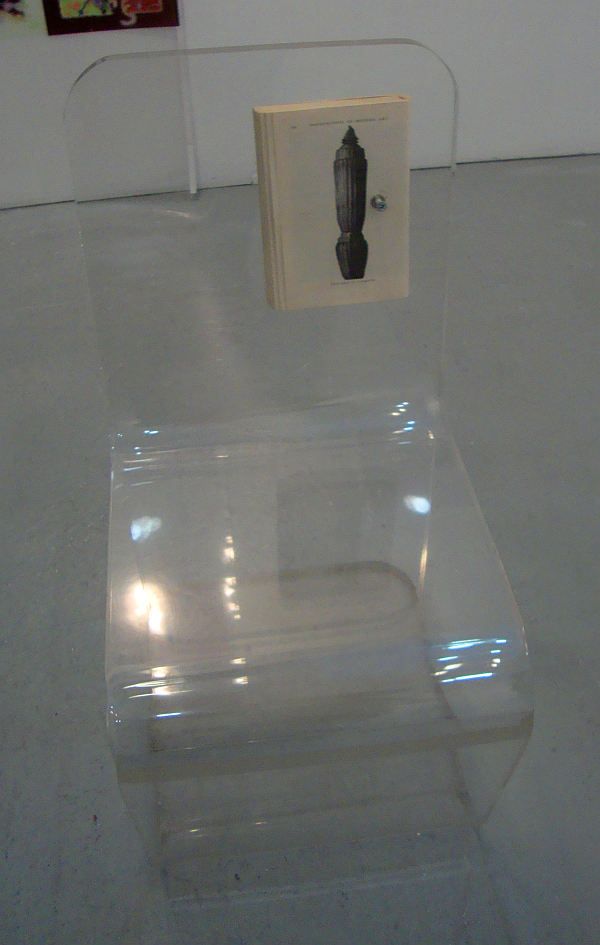 piece by an unknown artist at Tomorrow Gallery
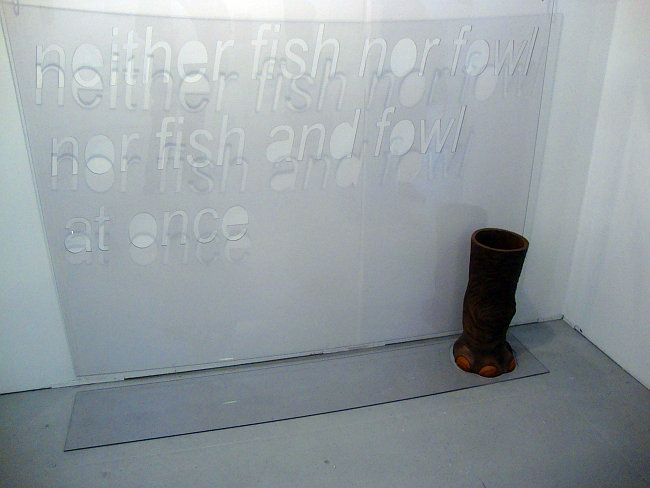 piece by an unknown artist at Tomorrow Gallery
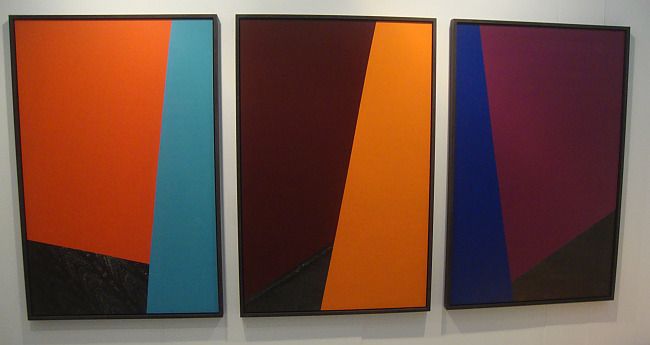 Chris Succo, (left to right) Flag Piece #8, Flag Piece #7, Flag Piece #9, 2012, b/w photography, laquer,
aluminum,mdf, artists frame at DUVE Gallery
Chris Succo, (left to right) Flag Piece #8, Flag Piece #7, Flag Piece #9, 2012, b/w photography, laquer,
aluminum,mdf, artists frame at DUVE Gallery
These three paintings by
Chris Succo were shown at Berline's
DUVE Gallery booth. They appear from a distance and in this photograph to be minimal abstractions--good ones, to my eye--but this is a case where there are other things happening in the work that can be easily shown in a photograph.
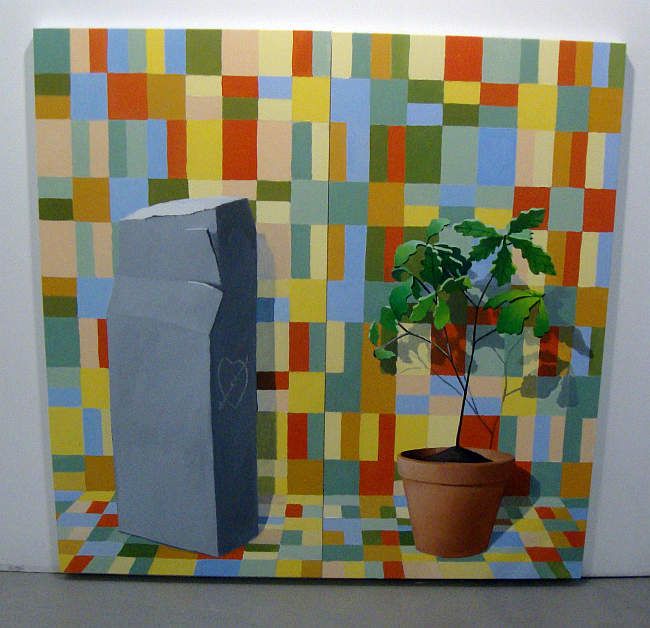
Cynthia Daignault, What came is gone forever, every time, 2012, Oil on linen at Lisa Cooley
Lisa Cooley Gallery had several things I liked, including this painting by
Cynthia Daignault. The very simple, flat painting of the foreground objects makes them look like they come from an old animated movie. But they really jump out at you against the patterned background. This is something I've seen Gary Panter do in some of his paintings.
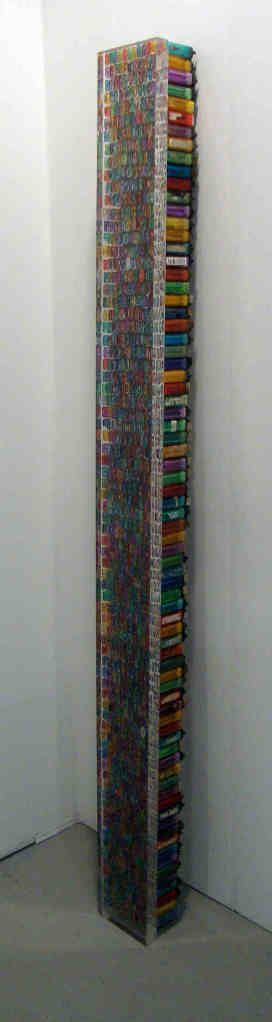 Andy Coolquitt at Lisa Cooley
Austin's
Andy Coolquitt had a show that just closed at
Lisa Cooley Gallery, and he had a few pieces in her space at NADA. He's the second Austin artist whose work I saw at the art fairs (Buster Graybill had work at
Frieze). I didn't see work by any Houston artists at any of the three shows, I'm sorry to report. But given the size of the shows, I might have overlooked it.
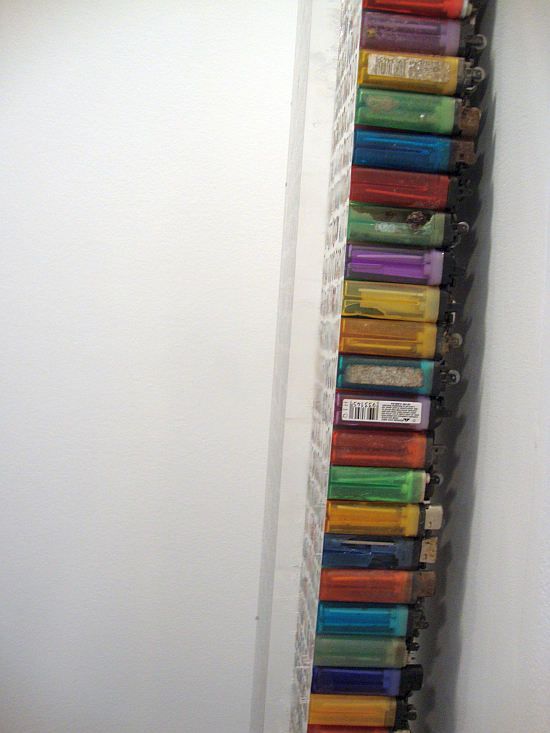 Andy Coolquitt at Lisa Cooley
Is Andy Coolquitt a heavy smoker, or does he just find all these used-up lighters in the street?
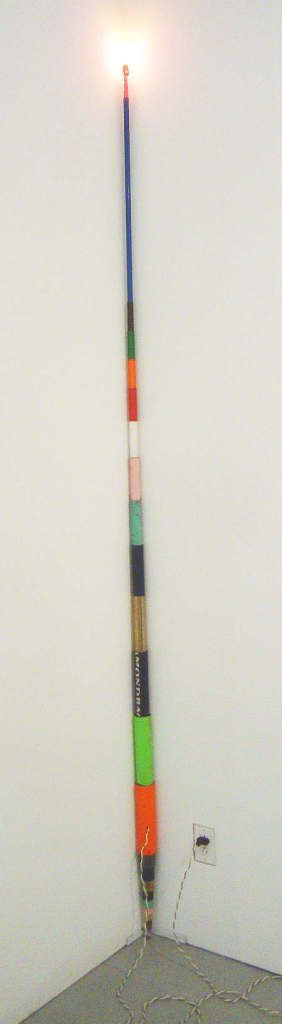 Andy Coolquitt at Lisa Cooley
Now here is a sculpture that doesn't take up too much space! I like its grungy elegance.
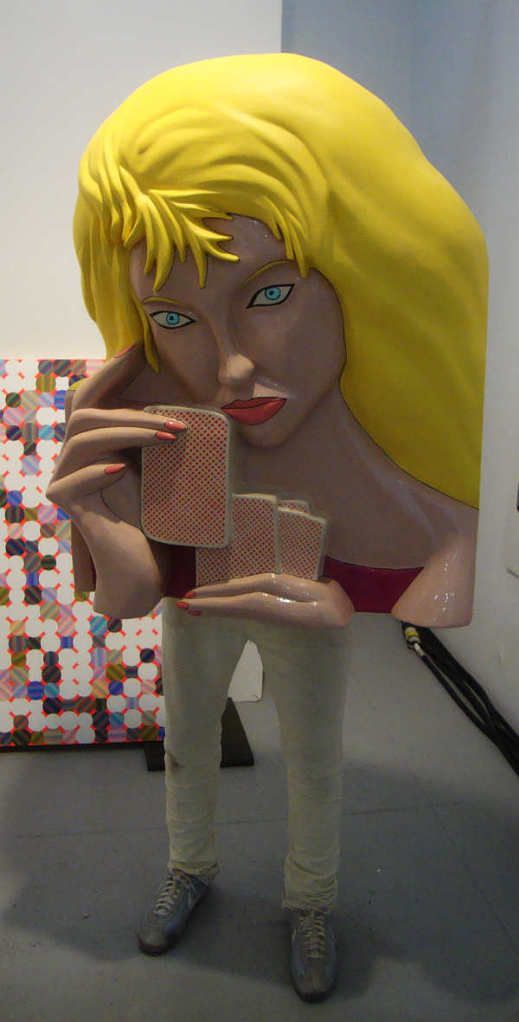 Ben Stone, So Fresh, 2005, Resin Coated Polystyrene, supported by a John Riepenhoff art stand at Western Exhibitions
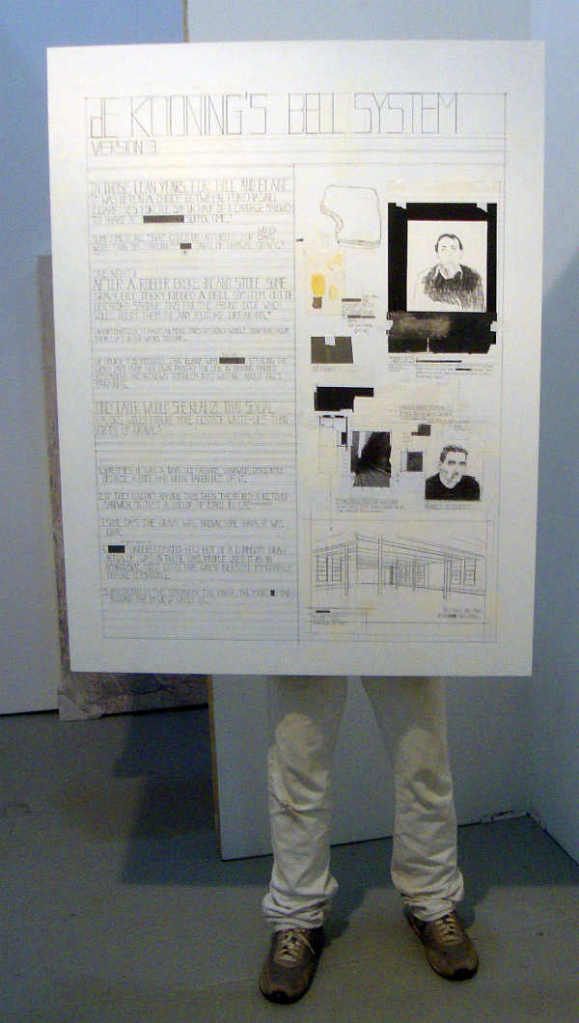 Deb Sokolow, de Kooning’s Bell System (Version 3, 2012 acrylic, graphite, charcoal, tape, collage on panel, supported by a John Riepenhoff art stand at Western Exhibitions
When you walk into
Western Exhibitions' booth, you think, "Oh my God, they hired a bunch of penniless artists to stand there and hold up the art!" But what's holding up these works by
Deb Sokolow and
Ben Stone is actually a group of functional sculptures by
John Riepenhoff.
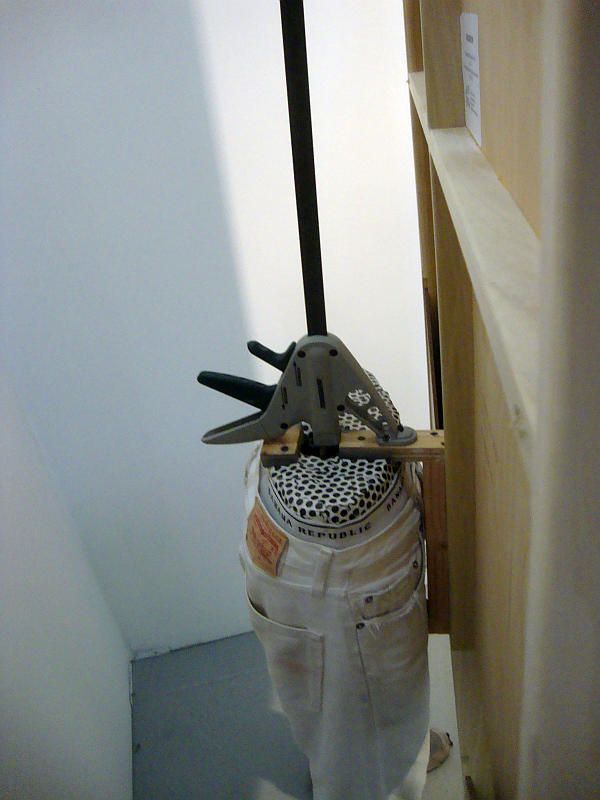 John Riepenhoff, Art Stand, at Western Exhibitions
The press release from Western Exhibitions says, "While Riepenhoff’s sculptures literally support
paintings, they also metaphorically represent his support for
other artists, simulating the perspective of the art-handler and
making visible the unseen laborer integral to exhibition-making." I'm
in favor of
that! Riepenhoff seems like he has done a lot to support artists over the years: "John Riepenhoff is a painter, he co-runs The Green Gallery in Milwaukee and has worked as a curator, art handler and art fair director (Milwaukee International, The Dark Fair)." But I can't get away how creepy it is to see these legs sticking out from under these artworks--it's uncanny.
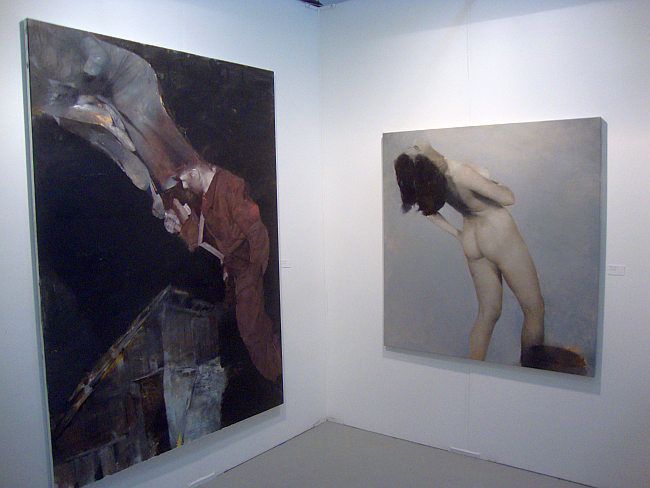 paintings by Razvan Boar at Ana Cristea
I found myself drawn to the paintings of
Razvan Boar, a painter from Romania. This is going to sound weird, but his work reminded me a little of the painting of Dorothy Hood. It's the way he handles edges that is similar to her edges. Of course, she was an abstractionist, and Boar is a figurative painter. But there is a continuity across these categories--and some painters move back and forth.
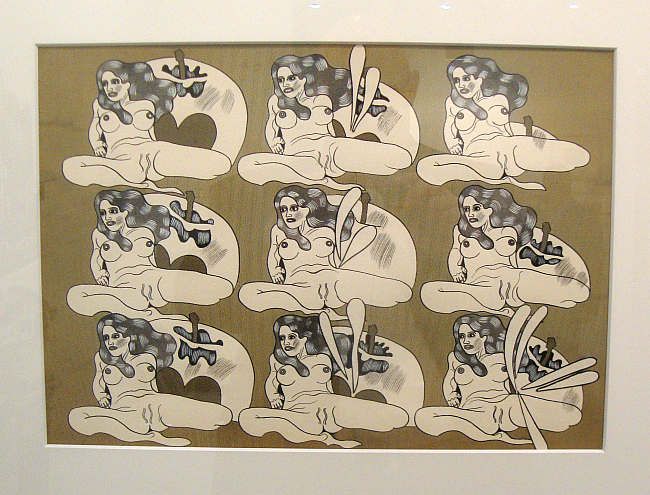 Keiichi Tanaami, 42nd street_melting apple, late 60s, ink and photo paper collage on paper at Nanzuka
I had never heard of
Keichi Tanaami before seeing this work at the
Nanzuka booth. Wikipedia describes him as "one of the leading pop artists of postwar Japan."But one thing that is different about him and American Pop Artists is that his work was obviously made for print. This piece is an example of that. The stuff surrounding the figures is half-tone film, which yellows with age (as collectors of original comic strip art know).
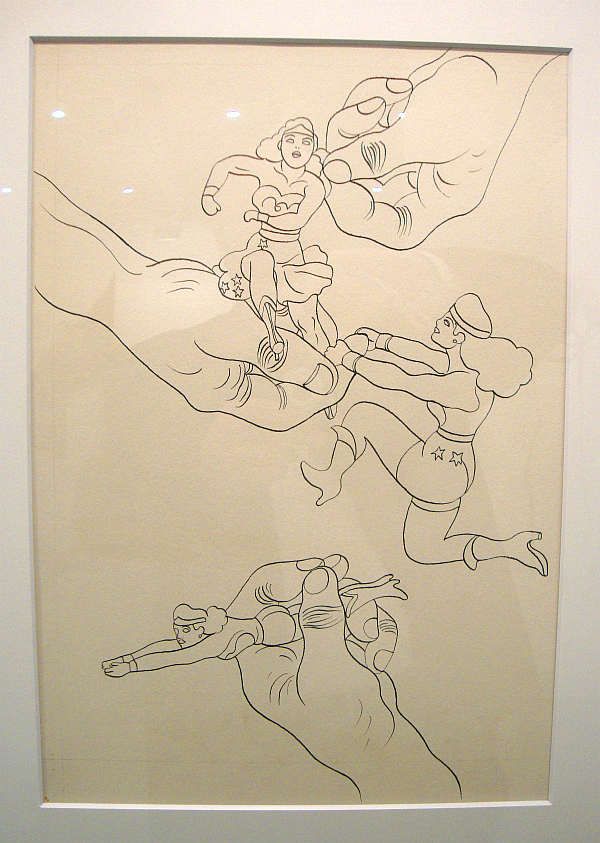 Keiichi Tanaami at Nanzuka
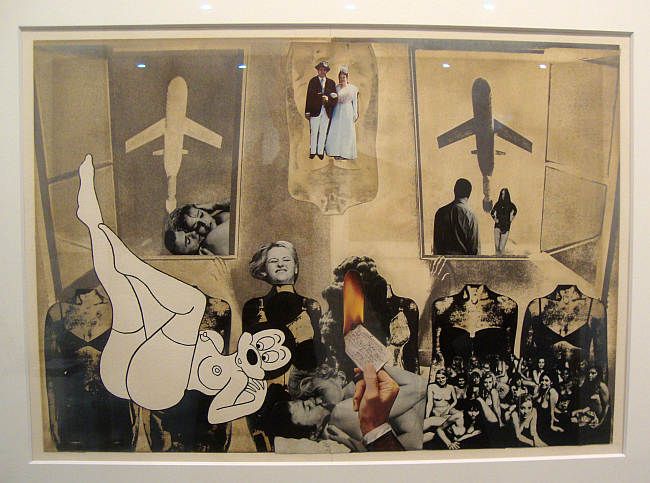 Keiichi Tanaami, 42nd street_burned letter, late 60s, ink and photo paper collage on paper at Nanzuka
Obviously there are similarities in
Tanaami's art to
Yokoo Tadanori's work. And even though the work has a very mod sensibility, they seem ineffably Japanese. Very cool.
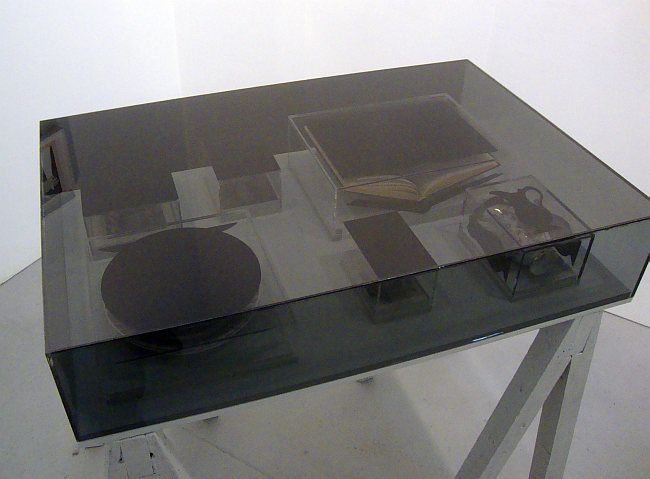 Erik Wysocan, (Tusen Och En Natt, 1958), 2011found copy of Tusen Och En Natt (A Thousand & One Nights) illustrated by Peter Weiss, found reproduction Sevres creamer, found Sevres plates, found postcard of Sevres factory workers, found postcard with image of the bust of Alexandre Brongniart, found etching with the image of Marat's memorial, acrylic, polarizing film, wood, paint at Laurel Gitlen
This dark vitrine by
Erik Wysocan where each object is covered by its own silhouette is one of those things that can't even begun to be understood without reading the wall text. Even with the wall text, the meaning of this disparate group of objects is obscure. Sure looks cool, though.
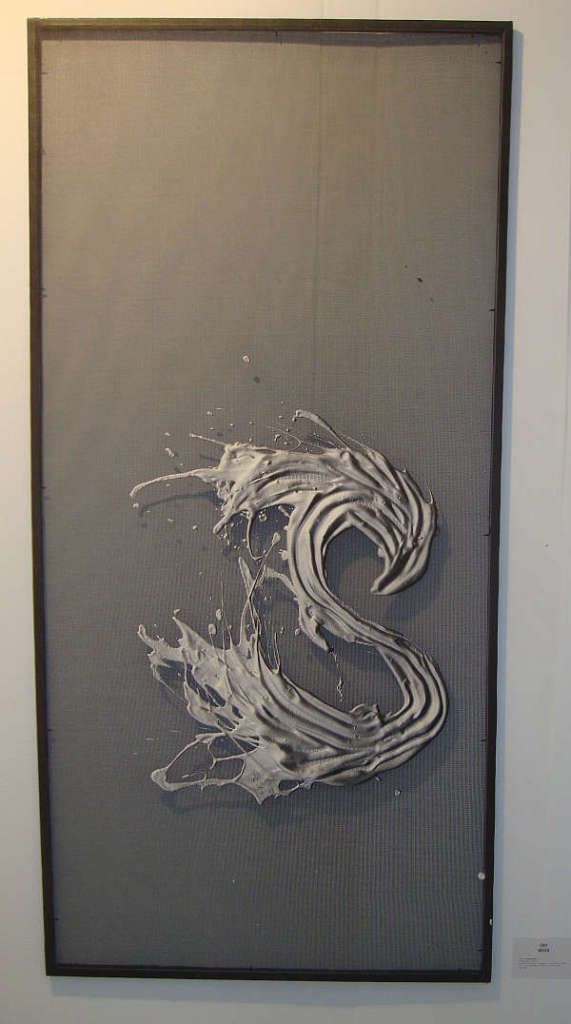 Ben Schumacher, untitled, 2012, window screen, plaster, acrylic, wood at Croy Nielson
There is something almost fake looking about this big splatter of acrylic paint on a window screen by
Ben Schumacher. This feeling is even more pronounced when you see it in person.
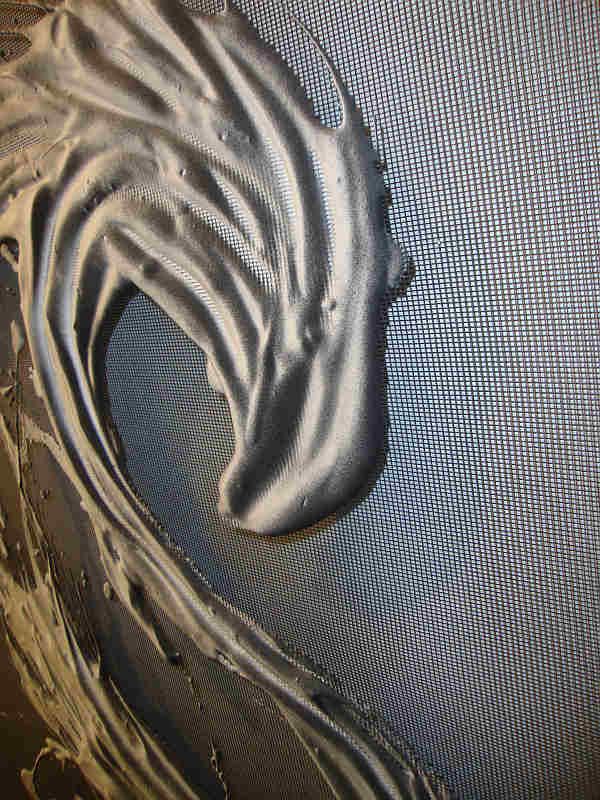 Ben Schumacher, untitled, 2012, window screen, plaster, acrylic, wood at Croy Nielson
I took this closeup in order to convince myself that the ridges in this impasto were real and some kind of trompe-l'oeil. It just didn't look right. It's a very cool effect--I wonder if it's intentional. I also wonder if Schumacher is, like Roy Lichtenstein did, making fun of painterly abstractionists.
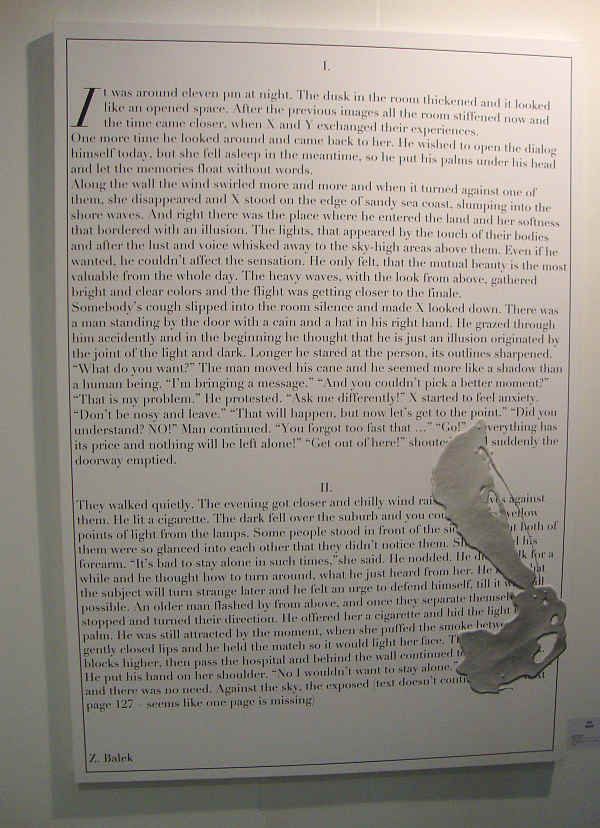 Ben Schumacher, Vokno Translations, 2012 at Croy Nielson
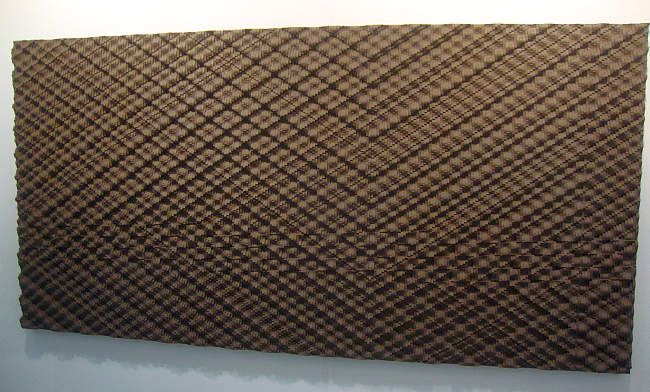 Ara Peterson, Intersecting Streams, acrylic paint on wood at Loyal
Ara Peterson
Ara Peterson, Intersecting Streams, acrylic paint on wood at Loyal
Ara Peterson had a bunch of amazing wall-reliefs up at Finnish gallery
Loyal. I looked him up on Google, and what do you know--he works with ex-
Fort Thunder dude
Jim Drain. He and Drain recently collaborated on
a giant installation at MOCA in LA that got lots of raves. His solo artwork is fantastic. It involves carved wood strips laid parallel so that the pattern of the carving is slightly shifted on each strip. I have to assume this is designed on computer before it is executed, but who knows? (Also, check out
his website.)
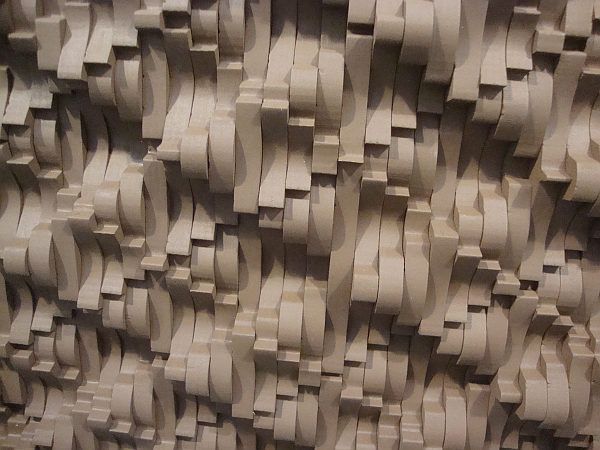 Ara Peterson, Intersecting Streams (detail), acrylic paint on wood at Loyal
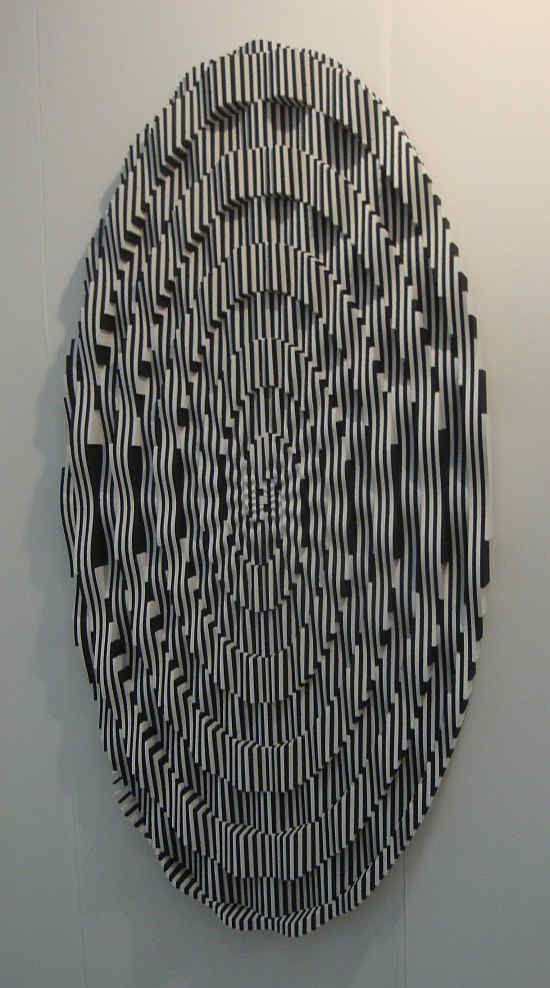 Ara Peterson, Forced Spiral One, 2012, acrylic paint on wood at Loyal
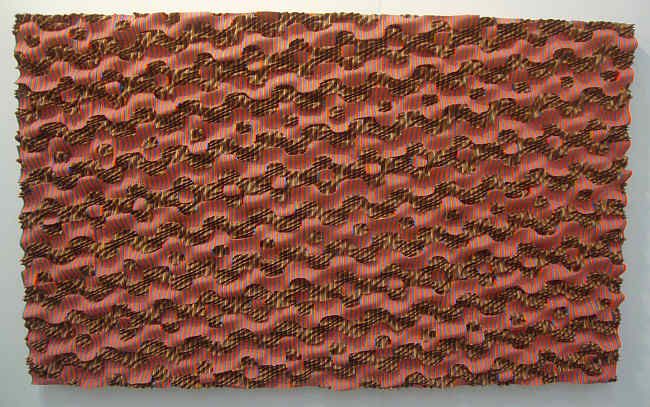 Ara Peterson, Dot Procession, 2012, acrylic paint on wood at Loyal
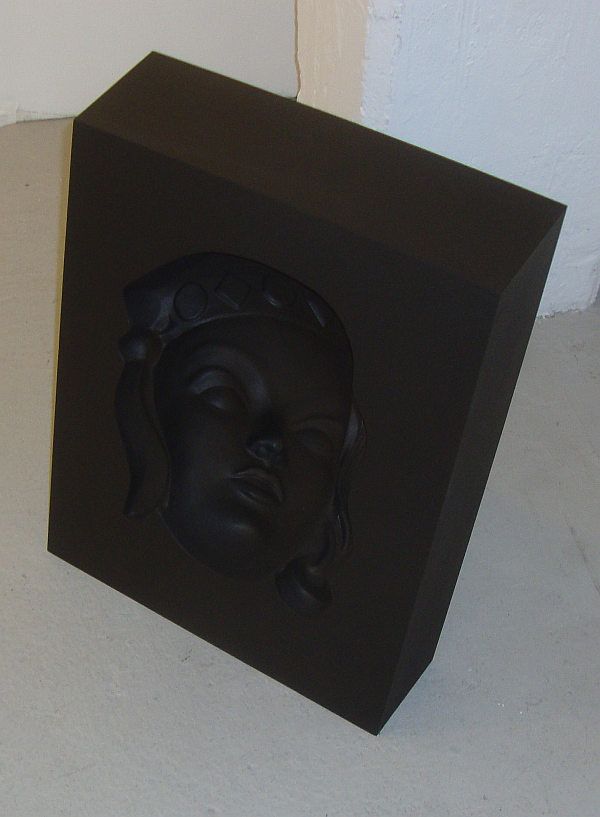 Anissa Mack, Marker A, 2012, painted aquaresin at Laurel Gitlen
Anissa Mack
Anissa Mack, Marker A, 2012, painted aquaresin at Laurel Gitlen
Anissa Mack's sculpture
Marker A is a little hard to see--a black solid rectangle with the negative image of a face in it--it's like black on black, pure negation. Nothing of her work I've seen online seems quite so dark (literally and metaphorically).
I suppose I'm should make a general statement about the art I saw here and comment on the place of NADA in the art world. The art was not shown at its best in these cramped booths--but then again, the way they were displayed here probably more accurately reflects what the pieces might look like hanging in a collector's home, which is likely a no less cluttered visual environment than NADA was. The art here seemed on average somewhat more challenging and intellectual than the work at the other shows--it was less crowd-pleasing, providing less visual punch. That was refreshing, actually.
A complaint about art fairs is that they force too much visual stimulation down your throat at once. More subtle work gets overlooked in the cacophony. The format is not conducive for contemplation of the work. All these criticisms are true. And despite that, I loved visiting
Frieze,
Pulse and NADA. The festive, hyperactive atmosphere of the fairs was, well, exciting. I like visual over-stimulation sometimes, and if I'm going for over-stimulation, I'd rather do it at an art fair than at, say, a summer blockbuster movie. For all my criticisms, I thoroughly enjoyed myself at these three art fairs.



.jpg)