Showing posts with label Jason Little. Show all posts

Wednesday, January 1, 2020

The Best Comics of The Decade

Robert Boyd

In 1990, I worked on one of my favorite publishing projects, a two-volume anthology called The Best Comics of the Decade, published by Fantagraphics Books and co-edited with Gary Groth and Kim Thompson. The thesis behind these volumes was that the 80s had seen an explosion of great comics in anthologies (like RAW and Weirdo), in newspapers (specifically in alternative newsweeklies), and in what at the time was called alternative comics (which included publishers like us, Fantagraphics Books). Another part of our thesis was that most of the greatest works had been in short stories. The age of the graphic novel hadn't yet arrived, although Maus volume 1 had been published in 1986.


Our volumes excluded superheroes from Marvel and DC, partly because we were snobs about mainstream comics, but partly because we didn't have access to that material. If we had, would we have included something? Maybe an excerpt from Watchmen? We did include an Alan Moore story which we loved, called "Pictopia," which is a weird story about how the innocent fun of old-time heroes in comics had been replaced by a grim and cynical type of superhero--one that Alan Moore himself is partly responsible for (along with Frank Miller).

The thing about assembling this volume was that we editors felt that knowing what comics actually were published in the 80s was a doable task. We had each read thousands of pages of comics and felt like we had a grasp of what had been published. (Because we thought that book buyers back then would never shell out for a 240-page book of comics, we published it in two volumes. That's another thing that has changes a lot in the past 30 years.)


Things have changed. Back then, "alternative comics" (i.e., anything that wasn't super-hero comics) were eking out an existence on the fringes. While superheroes now dominate our pop culture, in the world of comics, they are no longer utterly dominate comics mind-space as they once did. They still do to a certain extent--I know when I tell someone I am interested in comics, they usually ask about superheroes. As I have pointed out many times before, I am interested in comics as a category of art, like literature, theater, music, film, visual art. (To limit it to one genre or format is something I am not willing to do, especially a genre controlled by two large entertainment megacorporations, Warner Brothers--which owns DC Comics and all its properties--and Disney--which owns Marvel and all its properties.)

But in the 2010s, so many comics have been published that there is almost no way one person could have read them all. (I would fear for the sanity of anyone who tried.) Nonetheless, some brave souls have attempted to construct their own "best of the decade" lists. This decade has been dominated by book-sized publications, which is reflected in their lists. The lists I looked at were:
The best list in my opinion is Comic Books Are Burning in Hell's, and it is also the shortest. The Beat's is the longest. The total of all five lists is 130 titles (or 129, because there is some overlap on a Batman title). The lists are mostly unranked. (I'll put the whole list at the bottom of this post.)

It occurred to me that one way to rank the comics would be to look at which ones appeared on multiple lists. So with a long morning of Excel-ery, I have made a list of the most highly regarded comics of the decade by that criterion (appearing on multiple best-of lists).

Here are all the titles that appeared on at least two lists:
  • Hawkeye, Matt Fraction and David Aja, 4
  • Mister Miracle, Tom King, Mitch Gerads, and Clayton Cowles, 3
  • The Unbeatable Squirrel Girl, Ryan North, Erica Henderson, Derek Charm, 3
  • Prince Of Cats, Ron Wimberly, 3
  • Hark! A Vagrant!, Kate Beaton, 3
  • Lumberjanes, Grace Ellis, Noelle Stevenson, Shannon Watters, Kat Leyh, Brooklyn A. Allen, Carolyn Nowak, Carey Pietsch, Ayme Sotuyo, Maarta Laiho, Aubrey Aiese, with Brittney Williams, Faith Erin Hicks, Aimee Fleck, Rebecca Tobin, Felicia Choo, and T. Zysk, 3
  • Daytripper, Gabriel Bá and Fábio Moon, 3
  • My Favorite Thing Is Monsters, Emil Ferris, 3
  • Saga, Brian K. Vaughan, Fiona Staples, 3
  • Batman, Scott Snyder and Greg Capullo, 2
  • Copra, Michel Fiffe, 2
  • The Nib, Matt Bors and a cast of thousands, 2
  • Monstress, Marjorie Liu, Sana Takeda, and Rus Wooton, 2
  • This One Summer, Mariko Tamaki and Jillian Tamaki, 2
  • The Wicked + The Divine, Kieron Gillen, Jamie McKelvie, 2
  • The River At Night , Kevin Huizenga, 2
  • House Of X/Powers Of X, Jonathan Hickman, Pepe Larraz, R.B. Silva, Marte Gracia, Clayton Cowles, and Tom Muller, 2
  • Giant Days, John Allison, Max Sarin, Lissa Treiman, Whitney Cogar, and Jim Campbell, 2
  • Black Hammer, Jeff Lemire, Dean Ormston, 2
  • Thor, Jason Aaron, Russell Dauterman, 2
  • The Love Bunglers, Jaime Hernandez, 2
  • Goodnight Punpun, Inio Asano, 2
  • You & A Bike & A Road, Eleanor Davis, 2
  • Last Look, Charles Burns, 2
  • O Human Star, Blue Delliquanti, 2 
I have only read six of these in their entirety. The Nib would be difficult to read all of--it's a political comics site that one dives in in bits and pieces. But I've read a LOT of the comics there; I highly recommend it. I've read a bit of Lumberjanes and Copra, but didn't really connect with them. I haven't read any of the superhero titles because that's a genre I've outgrown in comics. And as for the rest, I've heard of most of them...

Perhaps a better way to look at it would be to see which authors and artists were referenced most frequently by appearing on multiple lists with multiple titles. Of course, I made a similar list.
The number refers to the number of times a person appeared anywhere on any of the lists. Several appeared in anthologies that made the list (Mould Map 3 and Smut Peddler 2012 Edition, specifically).

I'm willing to agree with the consensus in one small way: Eleanor Davis is the comics artist of the decade. What a privilege is has been to see her blossom as a cartoonist.

It is interesting to look at this list and see who among them were also in The Best Comics of the Decade in 1990. The only three who made both were Charles Burns, Jaime Hernandez and Alan Moore (three giants, to be sure).

OK, given that I have read only a small fraction of the comics that were published between 2010 and 2019 (and given that I have only read some on the master list that I will reproduce below), here are my favorites, selected by perusing my bookshelves 10 minutes ago:


  • Over Easy by Mimi Pond (Drawn & Quarterly, 2014)


  • Berlin by Jason Lutes (Drawn & Quarterly, 2018)


I have personal connections with many of the artists here, and I've met all of them except for Julia Wertz and David B.

This is the most I've thought about comics in one sustained burst in a long time.  I wish I had insights about the past decade to share. I don't except to note how that book has become the dominant form and that female artists and artists of color are now the dominant figures in art of comics. They make up more than 50% of my personal list, at least. That's a big shift.

I want to dedicate this post to the memory of my friend Tom Spurgeon, who died in November.

Addendum: Some additional best-of lists made me want to revise these compiled lists, which I have done here.

Here is the combined best-of list mentioned above:
  • “Time” by Randall Munroe
  • 20th Century Boys by Naoki Urasawa
  • A Silent Voice by Yoshitoki Olma and Steven LeCroy
  • Afterlife With Archie by Robert Aguirre-Sacasa, Francesco Francavilla, and Jack Morelli
  • All-New Wolverine by Tom Taylor, David Lopez, David Navarrot, Marcio Takara, IG Guara, Bob Wiacek, Victor Olazaba, Walden Wong, Nik Virella, Scott Hanna, Djibril Morissette-Phan, Leonard Kirk, Cory Hamscher, Marc Deering, Terry Pallot, Juann Cabal, Marco Failla, Ramon Rosanas, Nathan Fairbairn, Jordan Boyd, Mat Lopes, John Rauch, Michael Garland, Jesus Aburtov, Erick Arciniega, Nolan Woodard, and Cory Petit
  • Archival Quality by Ivy Noelle Weir and Christina “Steenz” Stewart
  • Arsène Schrauwen by Olivier Schrauwen
  • Basquiat by Julian Voloj and Søren Mosdal
  • Batman by Scott Snyder and Greg Capullo
  • Batman: The Black Mirror by Scott Snyder, Jock, Francesco Francavilla, David Baron, Jared K. Fletcher, and Sal Cipriano
  • Batman: The Court of Owls by Scott Snyder and Greg Capullo
  • Beautiful Darkness by Fabien Vehlmann and Kerascoët
  • Becoming Unbecoming by Una
  • Berlin by Jason Lutes
  • Big Kids by Michael DeForge
  • Bitch Planet by Kelly Sue DeConnick, Valentine DeLandro, Cris Peters, Kelly Fitzpatrick, and Clayton Cowles
  • Black Hammer by Jeff Lemire and Dean Ormston
  • Black Panther by Ta-Nehisi Coates and Brian Stelfreeze
  • Boxers & Saints by Gene Luen Yang and Lark Pien
  • Brazen by Pénélope Bagieu
  • Building Stories by Chris Ware
  • Check, Please! by Ngozi Ukazu
  • Clyde Fans by Seth
  • Copra by Michel Fiffe
  • Criminal by Ed Brubaker and Sean Phillips
  • Daredevil by Mark Waid, Chris Samnee, Javier Rodriguez, Matt Wilson, and Joe Caramagna
  • Daytripper by Gabriel Bá and Fábio Moon
  • Dotter of Her Father’s Eyes by Mary M. Talbot and Bryan Talbot
  • Exit Stage Left: The Snagglepuss Chronicles by Mark Russell, Mike Feehan, Mark Morales, Sean Parsons, Howard Porter, Jose Marzan Jr., Paul Mounts, and Dave Sharpe
  • Fatherland: A Family History by Nina Bunjevac
  • FF by Matt Fraction and Mike Allred
  • Frontier #7 by Jillian Tamaki
  • Gawain’s Girlfriend and the Green Knight by Polly Guo
  • Generous Bosom by Conor Stechshulte
  • Giant Days by John Allison, Max Sarin, Lissa Treiman, Whitney Cogar, and Jim Campbell
  • Girl Town by Carolyn Nowak
  • Goodnight Punpun by Inio Asano
  • Grip by Lale Westvind
  • Guts by Raina Telgemeier
  • Hark! A Vagrant! by Kate Beaton
  • Hawkeye by Matt Fraction and David Aja
  • Hellboy in Hell by Mike Mignola
  • Helter Skelter by Kyoko Okazaki
  • Here by Richard McGuire
  • Hilda & The Black Hound by Luke Pearson
  • Hip Hop Family Tree by Ed Piskor
  • Hot Comb by Ebony Flowers
  • House Of X/Powers Of X by Jonathan Hickman, Pepe Larraz, R.B. Silva, Marte Gracia, Clayton Cowles, and Tom Muller
  • How To Be Happy by Eleanor Davis
  • How to Understand Israel in 60 Days or Less by Sarah Glidden
  • Hyperbole and a Half by Allie Brosh
  • Is This How You See Me? by Jaime Hernandez
  • It Never Happened Again by Sam Alden
  • Julio's Day by Gilbert Hernandez
  • Killing and Dying by Adrian Tomine
  • Last Look by Charles Burns
  • Laura Dean Keeps Breaking Up With Me by Mariko Tamaki and Rosemary Valerio-O’Connell
  • Lore Olympus by Rachel Smythe
  • Lumberjanes by Grace Ellis, Noelle Stevenson, Shannon Watters, Kat Leyh, Brooklyn A. Allen, Carolyn Nowak, Carey Pietsch, Ayme Sotuyo, Maarta Laiho, Aubrey Aiese, with Brittney Williams, Faith Erin Hicks, Aimee Fleck, Rebecca Tobin, Felicia Choo, and T. Zysk
  • March by Rep. John Lewis, Andrew Aydin and Nate Powell
  • Margot’s Room by Emily Carroll
  • Mister Miracle by Tom King, Mitch Gerads, and Clayton Cowles
  • Monstress by Marjorie Liu, Sana Takeda, and Rus Wooton
  • Mould Map 3 by Aidan Koch, Amalia Ulman, Angie Wang, Ben Mendelewicz, Blaise Larmee, Brenna Murphy, CF, Cody Cobb, Daniel Swan, Dmitry Sergeev, Gabriel Corbera, GHXYK2, Hugh Frost, Jacob Ciocci, James Jarvis, Joseph Kelly, Jonas Delaborde, Jonathan Chandler, Jonny Negron, Julien Ceccaldi, Karn Piana, Kilian Eng, Lala Albert, Lando, Leon Sadler, Matthew Lock, Noel Freibert, Olivier Schrauwen, Robert Beatty, Sam Alden, Sammy Harkham, Simon Hanselmann, Stefan Sadler, Viktor Hachmang & Yuichi Yokoyama
  • Ms Marvel by G. Willow Wilson, Adrian Alphona, Jacob Wyatt, Elmo Bondoc, Takeshi Miyazawa, Nico Leon, Francesco Gaston, Marco Failla, Diego Olortegui, Ian Herring, Irma Knivila, and Joe Caramagna, with Saladin Ahmed, Rainbow Rowell, Hasan Minhaj, Devin Grayson, Eve L. Ewing, Jim Zub, Gustavo Duarte, Joey Vazquez, Kevin Libranda, Minkyu Jung, Juan Vlasco, and Bob Quinn
  • My Favorite Thing Is Monsters by Emil Ferris
  • My Friend Dahmer by Derf Backderf
  • My Hero Academia by Kohei Horikoshi, Caleb Cook, and John Hunt
  • My Lesbian Experience With Loneliness by Kabi Nagata
  • Nimona by Noelle Stevenson
  • O Human Star by Blue Delliquanti
  • Octopus Pie by Meredith Gran
  • On A Sunbeam by Tillie Walden
  • Patience by Daniel Clowes
  • Peplum by Blutch
  • Poochytown by Jim Woodring
  • Prince Of Cats by Ron Wimberly
  • Prison Pit by Johnny Ryan
  • Providence by Alan Moore and Jacen Burrows
  • Rock Candy Mountain by Kyle Starks and Chris Schweizer
  • Sabrina by Nick Drnaso
  • Saga by Brian K. Vaughan, Fiona Staples
  • Scott Pilgrim’s Finest Hour by Bryan Lee O’Malley
  • Sex Criminals by Matt Fraction and Chip Zdarsky
  • Sex Fantasy by Sophia Foster Dimino
  • Silver Surfer by Dan Slott and Michael Allred
  • Sir Alfred no. 3 by Tim Hensley
  • Smile by Raina Telgemeier
  • Smut Peddler 2012 Edition by Rebecca Ruby, Megan Furesz, Trisha L. Sebastian, Erin Basie, M. Magdalene, Mr. Darcy, Betty Jean Doe, Nora Riley, Kel McDonald, Rennie Kingsley, Erika Moen, Leia Weathington, Algesiras, Dwam, Argets, Ursula Wood, Jennifer Doyle, E.K. Weaver, Magnolia Porter, Shari Hes, Steve Horton, Erica Leigh Currey, Alice Fox, B. White, Ambrosia, Alice Hunt, Dechanique, Carla Speed McNeil, Karate McDanger, Jess Fink, Blue Delliquanti, Nechama Frier, Pupcake Jones, Lee Blauersouth, Abby Lark, Theo Lorenz, C. Spike Trotman, Diana Nock, Amanda Lafrenais
  • Southern Bastards by Jason Aaron, Jason Latour
  • Spider-Gwen by Jason Latour, Robbi Rodriguez
  • Sunburning by Keiler Robert
  • Sunny by Taiyo Matsumoto
  • Super Late Bloomer by Julia Kaye
  • The Art of Charlie Chan Hock Chye by Sonny Liew
  • The Best We Could Do by Thi Bui
  • The Encyclopedia of Early Earth by Isabel Greenberg
  • The End of the F@(U$*#+g World by Charles Forsman
  • The Fifth Beatle by Vivek Tiwary, Andrew Robinson
  • The Hard Tomorrow by Eleanor Davis
  • The Hospital Suite by John Porcellino
  • The Immortal Hulk by Al Ewing, Joe Bennett
  • The Love Bunglers by Jaime Hernandez
  • The Multiversity by Grant Morrison, Ivan Reis, Joe Prado, Chris Sprouse, Karl Story, Walden Wong, Ben Oliver, Frank Quitely
  • The Nao of Brown by Glyn Dillon
  • Nemo by Alan Moore and Kevin O'Neill
  • The Nib by Matt Bors and a cast of thousands
  • The Oven by Sophie Goldstein
  • The Passion Of Gengoroh Tagame by Bruno Gmuender
  • The Private Eye by Brian K. Vaughan, Marcos Martin
  • The Property by Rutu Modan
  • The River At Night by Kevin Huizenga
  • The Sandman: Overture by Neil Gaiman, JH Williams III and Dave Stewart
  • The Unbeatable Squirrel Girl by Ryan North, Erica Henderson, Derek Charm
  • The Vision by Tom King, Gabriel Walta, Jordie Bellaire
  • The Walking Dead #193 by Robert Kirkman, Charlie Adlard
  • The Wicked + The Divine by Kieron Gillen, Jamie McKelvie
  • This One Summer by Mariko Tamaki and Jillian Tamaki
  • Thor by Jason Aaron, Russell Dauterman

Monday, December 27, 2010

The Motel Art Improvement Service

Robert Boyd 


One of my favorite books from the Brooklyn Comics & Graphics Festival is one I have been waiting for since 2004, The Motel Art Improvement Service by Jason Little. This is the sequel to Shutterbug Follies. Both feature a young woman, Bee, as the protagonist and both could broadly be called crime thrillers. The first was a more-or-less straightforward thriller, the latter a bit more episodic and picaresque, like an Elmore Leonard or Charles Willeford novel filtered through an artsy hipster sensibility. But the thing that interested me most about both is that they center around the doings of artists.

Shutterbug Follies had three artist characters. One of them is a young artist with some creepy habits. The other two are much worse--one a murderer, the other a potential murderer. Then in Motel Art Improvement Service, the artist character is a thief and a drug-addict. OK, maybe Little has a thing against artists. But the weird thing is that each of these artists is, in his or her own way, really good. Furthermore, Little has them creating art that is interesting. It's always a problem when comics artists or filmmakers make artists their characters. The "art" almost always looks terrible. (Novelists have it comparatively easier--they can describe the art without having to show you the art.) Furthermore, the art in movies and comics never seems quite believable in terms of milieu. It doesn't ever seem like art you would actually see in a gallery. And when galleries or studios are depicted, they come off as artificial. Much of this is, I suppose, simply lack of familiarity. It's similar to the fact that so many superhero cartoonists can't draw people in suits, as Eddie Campbell observed.

The first thing Little gets right is the kind of art. Two of the artists in Shutterbug Follies are photographers, and one is an installation artist who makes stuff out of consumer items. In the past decade, photographic art and installation/assemblage art have been two of the dominant types of art in galleries, art spaces, and contemporary art museums. Cyrus, the artist character in Motel Art Improvement Service, is a painter--but his approach to painting is very conceptual and very site-specific.

OK, let's back up. Bee is not an art maven. She meets Cyrus completely by accident. At the beginning of a cross-country bike ride, she has an accident...


Jason Little, Motel Art Improvement Service page 27

She is forced to spend several nights in a local motel. There, she observes the cleaning man, Cyrus, engaged in some very odd behavior. She finally figures it out. He is taking the bad motel paintings and customizing them. It seems a project a little like Wayne White. White takes cheap lithographs he finds at flea markets and thrift stores and paints on them, adding something (usually words rendered as objects in space) to the original. The difference between White and Cyrus is that White sells his work. These pieces end up in galleries and in the hands of collectors. Cyrus is returning the improved paintings to the motel walls, where he leaves them.

Bee and Cyrus become friends and when Cyrus has finished "improving" all the paintings in the motel where they met, it's time to move on down the road. This time, though, instead of going to a small-town motel, Cyrus leads Bee to a modern airport hotel in Newark. Cyrus gets a job there, and since Bee is bike-less, he helps her get a job as well. They share a room in an unremodeled part of the hotel.


Jason Little, Motel Art Improvement Service page 60

Even though Bee has figured out his painting activities, she still hasn't deduced that Cyrus is a pill-head. While one reason he works in motels is that he can "improve" the paintings, the other reason is that he can steal prescription medicine from the guests. (Interestingly, misuse of prescription medicine was a major plot point in Shutterbug Follies as well.) Cyrus's hobby will feature into another subplot of the book, a slapstick encounter with a pair of college-age ecstasy manufacturers and a drug dealer on leave from the Army. But Cyrus's drug hobby is bound up with his art, as when he tells Bee how he came to start doing his bizarre art project.


Jason Little, Motel Art Improvement Service page 93

Little employs one of comics' best tricks--the fact that there are at least two possible narratives at any given time, the visual narrative and the text narrative. Usually these are intertwined, but there is no reason they have to be. Cyrus is a proverbial unreliable narrator when speaking to Bee, but the images tell the truth about his life.


Jason Little, Motel Art Improvement Service page 94

Little also plays a bit with the question of what is an image and what is real. Cyrus and Bee begin a sexual relationship (her first), and in this page, Cyrus sketches her nude.


Jason Little, Motel Art Improvement Service page 102

Then later we see one of the motel paintings that Cyrus has altered--he has placed Bee's nude figure within the picture.


Jason Little, Motel Art Improvement Service page 189

Cyrus's whole endeavor is based on the notion that the work he has altered will be back on the walls of motels, where random travelers will encounter it. It is a deeply uncommercial concept of art. He makes his living working in the motels, nit selling the art. Even if someone notices how strange and interesting the paintings are, they won't associate it with Cyrus. Since the 1960s, there have been numerous artists who have chosen to not make work that can be sold. Some even dropped out of art (in any visible sense) altogether. Some remained involved in art, but in decidedly uncommercial ways (Gordon Matta-Clark, for example). Cyrus explains why he won't engage the commercial art world when he encounters a gallerist who has been pursuing him across the country.


Jason Little, Motel Art Improvement Service page 166


Jason Little, Motel Art Improvement Service page 167

The problem for Cyrus is that if the market wants you, it's hard to not be a part of it. The dealer has been buying Cyrus's paintings from the motel owners. An exhibition will go ahead, with Cyrus's participation or without.

Motel Art Improvement Service is a silly, entertaining adventure. That Little has some interesting observations about art and artists is icing on the cake. I highly recommend it.

Thursday, December 16, 2010

Comics I Got in Brooklyn, part 4

Robert Boyd

If you're reading this, then you probably have read my other three reviews of comics and other items published at the Brooklyn Comics & Graphics Festival. A note on method: I'm not choosing comics to review that go together thematically or that make interesting contrasts. I have most of the comics I bought in a red canvas bag given to me by Koyama Press. So I have been reaching into the bag and pulling out four or five items at random to review. The stuff in the bag tends to be smaller, thinner items--comic books, minicomics, pamphlets, etc. I also bought several graphic novels which, being larger and heavier, are stacked separately. I'll review them once I'm done with the contents of the Koyama bag. But I wanted to mention the Koyama bag because it gives me an excuse to mention Koyama Press, which is exemplary of one aspect of what this festival is about: the fuzzing of the line between the art world and the comics world. This is how Koyama Press describes itself: "In addition to publishing books, Koyama Press has financed such diverse projects as zines, comics, artist designed t-shirts, installations, photo montage work, print folios, letterpress cards and more." And if you look at their catalog, you will find--in addition to comics--a lot of books that look much more like art books (or artists' books) than comics. Koyama Press does not come off as a comics publisher or even as a comics publisher that dabbles in art books on the side. It's an art publisher that includes comics proudly in its mix. This is something I will return to later in this review.


Gabrielle Bell, All My Dreams Come True cover, 2010

This minicomic (published by Lightful Press) by Gabrielle Bell is formatted with one panel per page. So although the story is 62 pages long, it is not terribly complex or involved. This is not to say it is uneventful. The protagonist, after an encounter on a train that leaves her with a strange man's briefcase, is flung into a series of dangerous situations in various locales. It seems to be taking place in the 30s or 40s, but it's vague. The lack of solid grounding and logic make it seem like a transcribed dream, but it is not fantastic like a dream. Motifs repeat as the scenes subtly change. I was reminded a bit of Donald Barthelme stories like "A Picture History of the War." A traditional story has anchors holding it fast to the "real world"; even a science fiction story attempts to do this, usually with a lot of exposition to explain why it could be real. Fantasy stories are praised for internal consistency, which means while they might not be anchored to the reaf world, at least they make sense on their own terms. This story (like many of Donald Barthelme's), dispenses with those anchors. It's unsettling.


Gabrielle Bell, All My Dreams Come True pp. 31-32, 2010

Update: Commenter Volsticks mentions that this story was in Kramers Ergot #7. I had completely forgotten that. The format was completely different, of course. Kramers Ergot #7 was the tabloid-sized issue, and Bell's story was presented complete on one page. So, does it change a story to present it in two drastically different ways? The art was identical in each case.


Jason Little, Gimmick Illustrated #1: Vlak chapter 1 cover, 2010

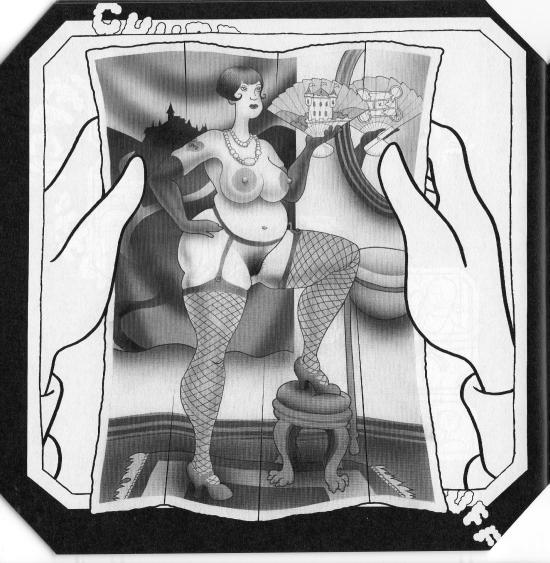
Another quasi-suspense story set partly on a train is Vlak by Jason Little. Little premiered his new graphic novel, Motel Art Improvement Service, at the festival--I will be reviewing it later. But he also had this intriguing comic. It is mostly wordless. A man arrives in an Eastern European city sometime in the early 20th century and loses his top hat. He goes to a hat store and buys a new hat. The store owner stuffs a piece of paper into the brim to help the hat fit better. Later on a train, the man discovers the piece of paper in the hat. He pulls it out, and sees this:

Vlak
Jason Little, Gimmick Illustrated #1: Vlak chapter 1 p. 30, 2010

He is mortified by this, at least at first.


Jason Little, Gimmick Illustrated #1: Vlak chapter 1 p. 31, 2010

There is not enough here to feel out where the story is going. It has numerous little surreal touches (the steam engine is powered not by coal but by burning books) and hints of an Eric Ambler-like thriller (secret police on the train, etc.) Also, you will notice that in the pornographic photo, the woman is holding a fan. We can see the back of the fan in the mirror behind her, and on the back of the fan is a floorplan of a building--presumably the castle depicted on the front of the fan. So this suggests a spy-thriller. In any case, I am eager to see where this goes.


Madeleine Fairbairn and Robbie Guertin, Epic Love cover, 2009

Robbie Guertin and Madeleine Fairbairn are a couple, and this mini is a series of cartoons about their couple-hood. Each of the two take turns drawing cartoons.The book is consequently pretty episodic. There is no story arc here--we are plunked down in the middle of this relationship and see fairly trivial glimpses of it.


Madeleine Fairbairn and Robbie Guertin, Epic Love pp. 6 & 7, 2009

As you can see, Fairbairn and Guertin have fairly distinct drawing styles. I think Guertin is on the left and Fairbairn is on the right. These two cartoons are typical--the feel of this is casual, a fun little project that a couple can do together. They aren't particularly funny cartoons and the drawing is nothing special. In short, it's OK for a minicomic, but not something they could push much further.


Gary Panter, Jimbo cover, March 24, 2010

Gary Panter is one of the giants of comics, a somewhat polarizing figure (at least in the past) because his work skitters on (and often over) the edge of readablility. There is so much to say about Panter that I don't even want to try. Suffice it to say that he is the embodiment of this fuzzy intersection of the art world and the comics world. And this is not just because he is a painter who shows his work in galleries, but also because while most great alternative cartoonists' work can reasonably be described as literary to an extent, Panter is the one whose work feels least literary and feels most like other contemporary visual art in its approach and concerns.


Gary Panter, Jimbo pp 4 & 5, April 13, 2010 and April 15, 2010

So it's funny to pick up this Jimbo minicomic at this festival. Of all comics shows, this is one where Panter work in its most radical manifestation would be highly welcome. His progeny were present in force. And yet, this is perhaps the most straightforward Panter comic I have ever read. It has a comprehensible story with a beginning, middle and end. The dialogue is straightforward, legible, in commonplace word balloons. The panels are neatly ruled and arranged  in a traditional way. The drawing is crisp and the spaces depicted have a Renaissance perspective logic to them. What's going on here?! I don't know, but this was an amusing minicomic--a trifle--by a master. A minicomic like this is a little like, I dunno, György Ligeti writing a minuet in the key of C, just to remind people that he could if he felt like it.


Joel Spaesmaker, Forest Small Book Series, Book One: La Recoleta Cemetery, Buenos Aires, Argentina., 2008

This, at first glance, could be mistaken for a minicomic. The format is minicomic-like. And if you go by Scott McCloud's hyper-formalist definition, it is a minicomic. (For a bunch of reasons, I hold no truck with that definition or any essentialist definition of comics. But many do.) And, more importantly, it was being sold at a comics show. It's in the world of comics. But when you read it, or any of the other books in the series, it's pretty clear that they aren't comics. They are closer to artists' books.


Joel Spaesmaker, Forest Small Book Series, Book Two: Of Great Masses Moving at Visionary Speeds., 2008

What is an artist's book? Here's how Wikipedia defines it:
Artists' books are works of art realized in the form of a book. They are often published in small editions, though sometimes they are produced as one-of-a-kind objects referred to as 'uniques'.
Artists' books have employed a wide range of forms, including scrolls, fold-outs, concertinas or loose items contained in a box as well as bound printed sheet. Artists have been active in printing and book production for centuries, but the artist's book is primarily a late 20th century form.
Maybe the best known artist's books are those by Edward Ruscha. At least, best known to me. These include such little books as Royal Road Test and Various Small Fires and Milk. So artists' books seems pretty close to a lot of the minicomics and other small publications I've been reviewing the last few days, right?


Joel Spaesmaker, Forest Small Book Series, Book Three: Things on Walls, Volume One., 2008

By total coincidence, I have been reading a manuscript of a book by a friend of mine that has a chapter on this very subject--the differences and similarities between comics, artists' books, and children's picture books.  I don't want to quote it or even name the book (it will be published in Fall of 2011 and I think is going to be an important book for anyone thing seriously about comics as art going forward). But what this chapter spoke of was how despite very real similarities between certain artists' books and certain comics, they were still viewed institutionally as distinct classes. It's the word "institutional" that is key here. A store specializing in artists' books like Printed Matter is pretty obviously not a comic book store. Even if you search the word for comics, you end up with entries that describe a book as "being told in comics format." They actually have to explain to their customers that a comic is a comic.

But comics--particularly "minicomics" in the sense of handmade comics--are very similar to artist's books, and I think we are seeing comics that cross the boundary, that inhabit both worlds. Just like we are seeing artists that inhabit both worlds. And that's why after an initial feeling of surprise, seeing this set of artist's books at the Brooklyn Comics & Graphics Show felt OK.


Joel Spaesmaker, Forest Small Book Series, Book Four: Lessons Learned, Volume One., 2008

I like Joel Spaesmaker's Small Books.  They deal with his fascinations and document his life in an interesting, elliptical way. I initially picked up the set because of Book One. I once spent two days wandering around in this cemetery, La Recoleta, looking at the amazing mausoleums of Buenos Aires' elite. I was looking for Borges' grave (he is buried in Switzerland, apparently--but the internet wasn't around when I made my fruitless search). I thought it was cool that Spaesmaker had been there and recorded his trip in this 'zine. Looking back, I think it is perfect that books like this were mixed in at a comics show. Comics shows almost always include some non-comics stuff. That stuff, though, is usually stuff aimed at genre fans--movie merchandise, toys, etc. Because the Brooklyn Comics & Graphics Festival deliberately positions itself as an art comics show, it is only appropriate that the extra stuff in this show come more from the art world than from the genre entertainment world.


Joel Spaesmaker, Forest Small Book Series, Book Five, We Are Children of the Earth & Sun., 2008

Many more reviews to come. I have a little time off, so I should be able to write them all before the beginning of next year. And of course, you can read the earlier Brooklyn posts at part 1, part 2, and part 3.

Monday, December 6, 2010

The Brooklyn Comics and Graphics Festival

I mentioned back in September that I was going to the Brooklyn Comics and Graphics Festival. I went, had fun, took photos. I also got a lot of books and comics, and I'll be writing about them in the coming month. But this post will be about the experience--and I'm writing it mostly as an excuse to inflict my terrible photos on you all. (If you want to see much better photos of the event, read this.) Now Pan readers who come here for the art coverage might find their eyes glazing over. But this festival is relevant to art lovers--it was put on and attended by a bunch of people who view comics as art, and among them are many who cross-over to the gallery world, whether in their own practice or just as people interested in art. I still think there is a distance between these two worlds that doesn't need to be there, but the Brooklyn Comics and Graphics Festival certainly represents to largest overlap of comics and the fine arts world. (Many in the comics world would cringe at this. But I guess what I want, and what I think this show represents in a way, is a comics world that is engaged with serious culture as opposed to one that is only engaged with the kitsch of the world, which is what you would mostly find at the San Diego ComicCon, for example.)


Gary Panter, Matt Groening, Bill Griffith and a bunch of other people

The people who were there were amazing--guests, exhibitors, and attendees. This is a young person's show, but the organizers made certain that a lot of people of my generation and of older generations were present. The show was put together (I think) by Dan Nadel of Picture Box, Gabe Fowler from Desert Island, and comics scholar Bill Kartalopoulos. Nadel is one of many people involved in comics who has been working on creating a new history of comics. By this, I mean trying to imagine a different canon. He has work in this regard in his two books Art Out of Time and Art In Time and to a certain extent in what he publishes in Picture Box. This kind of project is appealing to me. People are always reclaiming history (aesthetic or otherwise) to understand the present. See for example art critic Rapheal Rubenstein's The Silo.

Why this is relevant is that this show featured older guests--an attempt, maybe, to school the young hipster guests. Hence guests like Mark Alan Stamaty, who is not someone who is well-remembered in comics despite the fact that he produced a number of brilliant books over the years, especially the great MacDoodle Street.


Mark Alan Stamaty

He shared a panel with Jordan Crane, Brian Chippendale and Keith Jones, mostly on the subject of horror vacuii. 


Mark Alan Stamaty, Jordan Crane, Keith Jones and Brian Chippendale

The panels were quite nice. Lynda Barry and Charles Burns were great--Barry is hilarious in person. While Sammy Harkham (editor and publisher of Kramer's Ergot) and Francoise Mouly (co-editor of Raw and current art editor of The New Yorker) tended to ramble, they were entertaining.


Sammy Harkham and Francoise Mouly


Kim Deitch

So this revised history puts underground cartoonists like Kim Deitch in a pantheon.


Charles Burns and adoring fans

And creates a situation where a cartoonist like Charles Burns gets mobbed.


For me, it was great to see old friends like Jordan Crane...

 
Jon Lewis and Sam Henderson...


Doug Allen...


Jessica Abel and Matt Madden...


And Jason Little...


Little was debuting his new book, The Motel Art Improvement Service. I'll definitely be reviewing it later, but one thing that is really interesting about this book and the preceding volume, Shutterbug Follies, is Little's familiarity with contemporary fine art. Here he was dressed, as he always does for conventions, in an extravagant outfit. He used to include a straw boater or top hat with costumes, but he told me that when he would wear a top hat, he would end up getting bothered by steampunk fans, thinking that they had found one of their own. (Fiction fans may be interested to know that Little is married to novelist Myla Goldberg. The main character in his graphic novels is named Bee, which can't be a coincidence, can it?)

The space was packed with humanity. Despite temperatures outside in the 30s, it got really toasty in the church hall where the festival was held. Little asked me to spot his table so he could go to the restroom and shed his longjohns. This is what his table looked like from the driver's seat perspective.


Pat Ausilio

I think this is Pat Ausilio, who did a comic called Abstracted Comics. I liked this because despite the fact that it was 80-something degrees in the building, he kept his toque on. That is hipsterism above and beyond the call of duty.


Johnny Ryan

This is Johnny Ryan, the lowbrow cartoonist embraced by highbrow comics lovers.


Bob Sikoryak

This guy was so hardcore that he worked on a comic while attending a panel. Tight deadline, I guess. Update: This is apparently Bob Sikoryak.


Chris Pitzer and Josh Cotter

This is Chris Pitzer (proprietor of AdHouse) and one of the artists he publishes, the excellent cartoonist Josh Cotter.


Ben Catmull

Ben Catmull had a space right next to Jason Little's.


Gabrielle Bell and Tomasz Kaczynski

This is Gabrielle Bell and (I think) Tomasz Kaczinski. Bell was selling her original art, which is literally the smallest original art I have ever seen except maybe for Drew Friedman. In addition to selling individual pages, she was also selling individual panels. As I understood it, these were panels she completed but decided not to use. I bought one of those-- 2.75" square.

One final photo. I stayed in a hotel two blocks from the festival. And just around the corner was Desert Island, which I have to say is my ideal comic shop.


It is filled 100% with art comics and pretty much nothing else.