Showing posts with label Tim Hensley. Show all posts

Wednesday, January 1, 2020

The Best Comics of The Decade

Robert Boyd

In 1990, I worked on one of my favorite publishing projects, a two-volume anthology called The Best Comics of the Decade, published by Fantagraphics Books and co-edited with Gary Groth and Kim Thompson. The thesis behind these volumes was that the 80s had seen an explosion of great comics in anthologies (like RAW and Weirdo), in newspapers (specifically in alternative newsweeklies), and in what at the time was called alternative comics (which included publishers like us, Fantagraphics Books). Another part of our thesis was that most of the greatest works had been in short stories. The age of the graphic novel hadn't yet arrived, although Maus volume 1 had been published in 1986.


Our volumes excluded superheroes from Marvel and DC, partly because we were snobs about mainstream comics, but partly because we didn't have access to that material. If we had, would we have included something? Maybe an excerpt from Watchmen? We did include an Alan Moore story which we loved, called "Pictopia," which is a weird story about how the innocent fun of old-time heroes in comics had been replaced by a grim and cynical type of superhero--one that Alan Moore himself is partly responsible for (along with Frank Miller).

The thing about assembling this volume was that we editors felt that knowing what comics actually were published in the 80s was a doable task. We had each read thousands of pages of comics and felt like we had a grasp of what had been published. (Because we thought that book buyers back then would never shell out for a 240-page book of comics, we published it in two volumes. That's another thing that has changes a lot in the past 30 years.)


Things have changed. Back then, "alternative comics" (i.e., anything that wasn't super-hero comics) were eking out an existence on the fringes. While superheroes now dominate our pop culture, in the world of comics, they are no longer utterly dominate comics mind-space as they once did. They still do to a certain extent--I know when I tell someone I am interested in comics, they usually ask about superheroes. As I have pointed out many times before, I am interested in comics as a category of art, like literature, theater, music, film, visual art. (To limit it to one genre or format is something I am not willing to do, especially a genre controlled by two large entertainment megacorporations, Warner Brothers--which owns DC Comics and all its properties--and Disney--which owns Marvel and all its properties.)

But in the 2010s, so many comics have been published that there is almost no way one person could have read them all. (I would fear for the sanity of anyone who tried.) Nonetheless, some brave souls have attempted to construct their own "best of the decade" lists. This decade has been dominated by book-sized publications, which is reflected in their lists. The lists I looked at were:
The best list in my opinion is Comic Books Are Burning in Hell's, and it is also the shortest. The Beat's is the longest. The total of all five lists is 130 titles (or 129, because there is some overlap on a Batman title). The lists are mostly unranked. (I'll put the whole list at the bottom of this post.)

It occurred to me that one way to rank the comics would be to look at which ones appeared on multiple lists. So with a long morning of Excel-ery, I have made a list of the most highly regarded comics of the decade by that criterion (appearing on multiple best-of lists).

Here are all the titles that appeared on at least two lists:
  • Hawkeye, Matt Fraction and David Aja, 4
  • Mister Miracle, Tom King, Mitch Gerads, and Clayton Cowles, 3
  • The Unbeatable Squirrel Girl, Ryan North, Erica Henderson, Derek Charm, 3
  • Prince Of Cats, Ron Wimberly, 3
  • Hark! A Vagrant!, Kate Beaton, 3
  • Lumberjanes, Grace Ellis, Noelle Stevenson, Shannon Watters, Kat Leyh, Brooklyn A. Allen, Carolyn Nowak, Carey Pietsch, Ayme Sotuyo, Maarta Laiho, Aubrey Aiese, with Brittney Williams, Faith Erin Hicks, Aimee Fleck, Rebecca Tobin, Felicia Choo, and T. Zysk, 3
  • Daytripper, Gabriel Bá and Fábio Moon, 3
  • My Favorite Thing Is Monsters, Emil Ferris, 3
  • Saga, Brian K. Vaughan, Fiona Staples, 3
  • Batman, Scott Snyder and Greg Capullo, 2
  • Copra, Michel Fiffe, 2
  • The Nib, Matt Bors and a cast of thousands, 2
  • Monstress, Marjorie Liu, Sana Takeda, and Rus Wooton, 2
  • This One Summer, Mariko Tamaki and Jillian Tamaki, 2
  • The Wicked + The Divine, Kieron Gillen, Jamie McKelvie, 2
  • The River At Night , Kevin Huizenga, 2
  • House Of X/Powers Of X, Jonathan Hickman, Pepe Larraz, R.B. Silva, Marte Gracia, Clayton Cowles, and Tom Muller, 2
  • Giant Days, John Allison, Max Sarin, Lissa Treiman, Whitney Cogar, and Jim Campbell, 2
  • Black Hammer, Jeff Lemire, Dean Ormston, 2
  • Thor, Jason Aaron, Russell Dauterman, 2
  • The Love Bunglers, Jaime Hernandez, 2
  • Goodnight Punpun, Inio Asano, 2
  • You & A Bike & A Road, Eleanor Davis, 2
  • Last Look, Charles Burns, 2
  • O Human Star, Blue Delliquanti, 2 
I have only read six of these in their entirety. The Nib would be difficult to read all of--it's a political comics site that one dives in in bits and pieces. But I've read a LOT of the comics there; I highly recommend it. I've read a bit of Lumberjanes and Copra, but didn't really connect with them. I haven't read any of the superhero titles because that's a genre I've outgrown in comics. And as for the rest, I've heard of most of them...

Perhaps a better way to look at it would be to see which authors and artists were referenced most frequently by appearing on multiple lists with multiple titles. Of course, I made a similar list.
The number refers to the number of times a person appeared anywhere on any of the lists. Several appeared in anthologies that made the list (Mould Map 3 and Smut Peddler 2012 Edition, specifically).

I'm willing to agree with the consensus in one small way: Eleanor Davis is the comics artist of the decade. What a privilege is has been to see her blossom as a cartoonist.

It is interesting to look at this list and see who among them were also in The Best Comics of the Decade in 1990. The only three who made both were Charles Burns, Jaime Hernandez and Alan Moore (three giants, to be sure).

OK, given that I have read only a small fraction of the comics that were published between 2010 and 2019 (and given that I have only read some on the master list that I will reproduce below), here are my favorites, selected by perusing my bookshelves 10 minutes ago:


  • Over Easy by Mimi Pond (Drawn & Quarterly, 2014)


  • Berlin by Jason Lutes (Drawn & Quarterly, 2018)


I have personal connections with many of the artists here, and I've met all of them except for Julia Wertz and David B.

This is the most I've thought about comics in one sustained burst in a long time.  I wish I had insights about the past decade to share. I don't except to note how that book has become the dominant form and that female artists and artists of color are now the dominant figures in art of comics. They make up more than 50% of my personal list, at least. That's a big shift.

I want to dedicate this post to the memory of my friend Tom Spurgeon, who died in November.

Addendum: Some additional best-of lists made me want to revise these compiled lists, which I have done here.

Here is the combined best-of list mentioned above:
  • “Time” by Randall Munroe
  • 20th Century Boys by Naoki Urasawa
  • A Silent Voice by Yoshitoki Olma and Steven LeCroy
  • Afterlife With Archie by Robert Aguirre-Sacasa, Francesco Francavilla, and Jack Morelli
  • All-New Wolverine by Tom Taylor, David Lopez, David Navarrot, Marcio Takara, IG Guara, Bob Wiacek, Victor Olazaba, Walden Wong, Nik Virella, Scott Hanna, Djibril Morissette-Phan, Leonard Kirk, Cory Hamscher, Marc Deering, Terry Pallot, Juann Cabal, Marco Failla, Ramon Rosanas, Nathan Fairbairn, Jordan Boyd, Mat Lopes, John Rauch, Michael Garland, Jesus Aburtov, Erick Arciniega, Nolan Woodard, and Cory Petit
  • Archival Quality by Ivy Noelle Weir and Christina “Steenz” Stewart
  • Arsène Schrauwen by Olivier Schrauwen
  • Basquiat by Julian Voloj and Søren Mosdal
  • Batman by Scott Snyder and Greg Capullo
  • Batman: The Black Mirror by Scott Snyder, Jock, Francesco Francavilla, David Baron, Jared K. Fletcher, and Sal Cipriano
  • Batman: The Court of Owls by Scott Snyder and Greg Capullo
  • Beautiful Darkness by Fabien Vehlmann and Kerascoët
  • Becoming Unbecoming by Una
  • Berlin by Jason Lutes
  • Big Kids by Michael DeForge
  • Bitch Planet by Kelly Sue DeConnick, Valentine DeLandro, Cris Peters, Kelly Fitzpatrick, and Clayton Cowles
  • Black Hammer by Jeff Lemire and Dean Ormston
  • Black Panther by Ta-Nehisi Coates and Brian Stelfreeze
  • Boxers & Saints by Gene Luen Yang and Lark Pien
  • Brazen by Pénélope Bagieu
  • Building Stories by Chris Ware
  • Check, Please! by Ngozi Ukazu
  • Clyde Fans by Seth
  • Copra by Michel Fiffe
  • Criminal by Ed Brubaker and Sean Phillips
  • Daredevil by Mark Waid, Chris Samnee, Javier Rodriguez, Matt Wilson, and Joe Caramagna
  • Daytripper by Gabriel Bá and Fábio Moon
  • Dotter of Her Father’s Eyes by Mary M. Talbot and Bryan Talbot
  • Exit Stage Left: The Snagglepuss Chronicles by Mark Russell, Mike Feehan, Mark Morales, Sean Parsons, Howard Porter, Jose Marzan Jr., Paul Mounts, and Dave Sharpe
  • Fatherland: A Family History by Nina Bunjevac
  • FF by Matt Fraction and Mike Allred
  • Frontier #7 by Jillian Tamaki
  • Gawain’s Girlfriend and the Green Knight by Polly Guo
  • Generous Bosom by Conor Stechshulte
  • Giant Days by John Allison, Max Sarin, Lissa Treiman, Whitney Cogar, and Jim Campbell
  • Girl Town by Carolyn Nowak
  • Goodnight Punpun by Inio Asano
  • Grip by Lale Westvind
  • Guts by Raina Telgemeier
  • Hark! A Vagrant! by Kate Beaton
  • Hawkeye by Matt Fraction and David Aja
  • Hellboy in Hell by Mike Mignola
  • Helter Skelter by Kyoko Okazaki
  • Here by Richard McGuire
  • Hilda & The Black Hound by Luke Pearson
  • Hip Hop Family Tree by Ed Piskor
  • Hot Comb by Ebony Flowers
  • House Of X/Powers Of X by Jonathan Hickman, Pepe Larraz, R.B. Silva, Marte Gracia, Clayton Cowles, and Tom Muller
  • How To Be Happy by Eleanor Davis
  • How to Understand Israel in 60 Days or Less by Sarah Glidden
  • Hyperbole and a Half by Allie Brosh
  • Is This How You See Me? by Jaime Hernandez
  • It Never Happened Again by Sam Alden
  • Julio's Day by Gilbert Hernandez
  • Killing and Dying by Adrian Tomine
  • Last Look by Charles Burns
  • Laura Dean Keeps Breaking Up With Me by Mariko Tamaki and Rosemary Valerio-O’Connell
  • Lore Olympus by Rachel Smythe
  • Lumberjanes by Grace Ellis, Noelle Stevenson, Shannon Watters, Kat Leyh, Brooklyn A. Allen, Carolyn Nowak, Carey Pietsch, Ayme Sotuyo, Maarta Laiho, Aubrey Aiese, with Brittney Williams, Faith Erin Hicks, Aimee Fleck, Rebecca Tobin, Felicia Choo, and T. Zysk
  • March by Rep. John Lewis, Andrew Aydin and Nate Powell
  • Margot’s Room by Emily Carroll
  • Mister Miracle by Tom King, Mitch Gerads, and Clayton Cowles
  • Monstress by Marjorie Liu, Sana Takeda, and Rus Wooton
  • Mould Map 3 by Aidan Koch, Amalia Ulman, Angie Wang, Ben Mendelewicz, Blaise Larmee, Brenna Murphy, CF, Cody Cobb, Daniel Swan, Dmitry Sergeev, Gabriel Corbera, GHXYK2, Hugh Frost, Jacob Ciocci, James Jarvis, Joseph Kelly, Jonas Delaborde, Jonathan Chandler, Jonny Negron, Julien Ceccaldi, Karn Piana, Kilian Eng, Lala Albert, Lando, Leon Sadler, Matthew Lock, Noel Freibert, Olivier Schrauwen, Robert Beatty, Sam Alden, Sammy Harkham, Simon Hanselmann, Stefan Sadler, Viktor Hachmang & Yuichi Yokoyama
  • Ms Marvel by G. Willow Wilson, Adrian Alphona, Jacob Wyatt, Elmo Bondoc, Takeshi Miyazawa, Nico Leon, Francesco Gaston, Marco Failla, Diego Olortegui, Ian Herring, Irma Knivila, and Joe Caramagna, with Saladin Ahmed, Rainbow Rowell, Hasan Minhaj, Devin Grayson, Eve L. Ewing, Jim Zub, Gustavo Duarte, Joey Vazquez, Kevin Libranda, Minkyu Jung, Juan Vlasco, and Bob Quinn
  • My Favorite Thing Is Monsters by Emil Ferris
  • My Friend Dahmer by Derf Backderf
  • My Hero Academia by Kohei Horikoshi, Caleb Cook, and John Hunt
  • My Lesbian Experience With Loneliness by Kabi Nagata
  • Nimona by Noelle Stevenson
  • O Human Star by Blue Delliquanti
  • Octopus Pie by Meredith Gran
  • On A Sunbeam by Tillie Walden
  • Patience by Daniel Clowes
  • Peplum by Blutch
  • Poochytown by Jim Woodring
  • Prince Of Cats by Ron Wimberly
  • Prison Pit by Johnny Ryan
  • Providence by Alan Moore and Jacen Burrows
  • Rock Candy Mountain by Kyle Starks and Chris Schweizer
  • Sabrina by Nick Drnaso
  • Saga by Brian K. Vaughan, Fiona Staples
  • Scott Pilgrim’s Finest Hour by Bryan Lee O’Malley
  • Sex Criminals by Matt Fraction and Chip Zdarsky
  • Sex Fantasy by Sophia Foster Dimino
  • Silver Surfer by Dan Slott and Michael Allred
  • Sir Alfred no. 3 by Tim Hensley
  • Smile by Raina Telgemeier
  • Smut Peddler 2012 Edition by Rebecca Ruby, Megan Furesz, Trisha L. Sebastian, Erin Basie, M. Magdalene, Mr. Darcy, Betty Jean Doe, Nora Riley, Kel McDonald, Rennie Kingsley, Erika Moen, Leia Weathington, Algesiras, Dwam, Argets, Ursula Wood, Jennifer Doyle, E.K. Weaver, Magnolia Porter, Shari Hes, Steve Horton, Erica Leigh Currey, Alice Fox, B. White, Ambrosia, Alice Hunt, Dechanique, Carla Speed McNeil, Karate McDanger, Jess Fink, Blue Delliquanti, Nechama Frier, Pupcake Jones, Lee Blauersouth, Abby Lark, Theo Lorenz, C. Spike Trotman, Diana Nock, Amanda Lafrenais
  • Southern Bastards by Jason Aaron, Jason Latour
  • Spider-Gwen by Jason Latour, Robbi Rodriguez
  • Sunburning by Keiler Robert
  • Sunny by Taiyo Matsumoto
  • Super Late Bloomer by Julia Kaye
  • The Art of Charlie Chan Hock Chye by Sonny Liew
  • The Best We Could Do by Thi Bui
  • The Encyclopedia of Early Earth by Isabel Greenberg
  • The End of the F@(U$*#+g World by Charles Forsman
  • The Fifth Beatle by Vivek Tiwary, Andrew Robinson
  • The Hard Tomorrow by Eleanor Davis
  • The Hospital Suite by John Porcellino
  • The Immortal Hulk by Al Ewing, Joe Bennett
  • The Love Bunglers by Jaime Hernandez
  • The Multiversity by Grant Morrison, Ivan Reis, Joe Prado, Chris Sprouse, Karl Story, Walden Wong, Ben Oliver, Frank Quitely
  • The Nao of Brown by Glyn Dillon
  • Nemo by Alan Moore and Kevin O'Neill
  • The Nib by Matt Bors and a cast of thousands
  • The Oven by Sophie Goldstein
  • The Passion Of Gengoroh Tagame by Bruno Gmuender
  • The Private Eye by Brian K. Vaughan, Marcos Martin
  • The Property by Rutu Modan
  • The River At Night by Kevin Huizenga
  • The Sandman: Overture by Neil Gaiman, JH Williams III and Dave Stewart
  • The Unbeatable Squirrel Girl by Ryan North, Erica Henderson, Derek Charm
  • The Vision by Tom King, Gabriel Walta, Jordie Bellaire
  • The Walking Dead #193 by Robert Kirkman, Charlie Adlard
  • The Wicked + The Divine by Kieron Gillen, Jamie McKelvie
  • This One Summer by Mariko Tamaki and Jillian Tamaki
  • Thor by Jason Aaron, Russell Dauterman

Tuesday, November 13, 2012

The Brooklyn Comics and Graphics Festival Was Less Fun Than I Would Have Liked

Robert Boyd

This weekend I flew into New York to visit the Brooklyn Comics and Graphics Festival (aka the BCGF) for the second time. I loved it the first time, so I had high hopes. Things went wrong right from the start, though. My hotel, down in the Meatpacking District, had been flooded. Although they had light and heat, the elevator and the wifi were still out. The former was a drag (especially after long days spent on my feet), but the latter was crippling. I was expecting to be able to post from the road, and now I couldn’t. I had lugged my heavy lap-top all the way to New York for no reason. My mood was soured.

I got in Thursday night and spent all day Friday gallery-hopping with a friend, first in Chelsea (the Trenton Doyle Hancock show was a standout—I’ll have more to say about it later), then over to Brooklyn to check out some of the shows associated with the festival. But we didn’t look at the schedule closely and realized we were early for two of the exhibits. They were still hanging work when we showed up.


B.ü.L.b. at Beginnings Gallery

The B.ü.L.b. show at Beginnings Gallery, however, was up, but disappointingly contained no original art. The visuals were mostly uncut sheets from their various publications.


B.ü.L.b. is a design studio/comics publisher from Switzerland. Their website is in French, but you can read their manifesto in an approximation of English here. One thing they create are little boxes with several tiny accordion fold comics in each. These comics, the 2[w] collection, are done by the very best art comics artists all over the world and printed by silkscreen. They are lovely objects. The boxes started with “A” in 1997 and they have been heading steadily toward “Z”—they are on “Y.” I propose that they continue the 2[w] series employing other alphabets—Greek, Russian, Arabic, etc.


Some 2[w] comics boxes with a Jim Drain comic in the foreground

I think the satellite art exhibits were new this year. Working with galleries in Brooklyn, the BCGF arranged to have several solo and group shows for a variety of the guest artists. The tricky thing with something like this is timing. If you have all the openings on the same day as the show, it is impossible for visitors to attend them all. But if you spread them out too far, it may be impossible for artists to attend both their opening and the festival. Also problematic was that the gallery spaces were spread out pretty far. It wasn’t convenient to get from one gallery to the next. I suspect that if you are from the neighborhood, it’s not too bad, though. My lack of familiarity was a handicap here.

I got back to my hotel Friday night dead tired, but happy having had a very entertaining day looking at art. The one bad thing was that my dogs were barking. Twelve hours of walking had done a number on me.

The festival opened its doors at noon on Saturday, but the panel discussions started at 11 am. Instead of having the panels at  Our Lady of Mt. Carmel Church, they conducted them several blocks away at The Knitting Factory, a well-known music venue. But it turns out that the Knitting Factory is quite small. It was completely packed for a discussion between Art Spiegelman, Chris Ware and Richard McGuire (whose story “Here” Chris Ware claimed changed his life). The Knitting Factory seemed far less spacious than the big open floor of the church where these discussions had previously been held. But that space was no longer available. There were now two floors full of exhibitors.

You could see how popular the BCGF was by noting how many people were hanging around outside the church.


Just some of the people at BCGF

I felt like an old fuddy-duddy compared to these hipsters. But I'm resigned to that. I entered the church and the cool air of outside instantly turned palpably warm and humid. The crowd was so dense that the air was stagnant and redolent of sweat. This is the kind of atmosphere one associates with mainstream comics festivals, with their immense numbers of nerdy fanboys. I was surprised to encounter it here.


Don't yell "Fire!"

I have been to several alternative comics festivals in the past, including the BCGF two years ago, and I had never seen one this crowded (and hot and sweaty). Even with twice as much space devoted to exhibitors, trying to move around was next to impossible. Browsing was a completely unpleasurable experience. I was interested in buying original artwork, and I saw some for sale--for instance, at Lisa Hanawalt's table--but the environment was unconducive for that kind of purchase. I want to spend a little quality time with a piece before I buy it--spread out the artist's portfolio and carefully flip through. This was impossible.

Now I'm being totally subjective here. If I put myself in the shoes of an exhibitor, I imagine the festival was an exhausting but utterly rewarding experience. I suspect tons of books, comics, mini-comics, and pieces of original art were sold over the course of the day. Exhibitors who traveled to be here (and some traveled all the way from Europe) might have made back their travel costs and even made a profit. Likewise, the people putting on the festival must have been thrilled by the crowds. But they ruined the experience for me. I bought some books, some of which I may review later after absorbing them a bit, but I did this as quickly as possible and got out of there as fast as I could. I returned later in the afternoon to see if the crowds had thinned out, but if anything, there were even more people.

Consequently, I spent most of the day at the Knitting Factory. The festival had a series of interviews and panel discussions there. A discussion on sexuality in comics was marred by inarticulate panelists (to the obvious irritation of the moderator, Karley Sciortino). However, that was followed by a completely delightful Q&A of New Yorker cartoonist Roz Chast conducted by Richard Gehr. People who are funny on paper are not always funny in real life, but Chast was an exception to this rule. She commented on the differences between hip Brooklyn today versus the resolutely unhip Brooklyn she grew up in.

Tom Spurgeon, publisher of The Comics Reporter and former editor of The Comics Journal, was moderating a panel with Tim Hensley, Charles Burns and Anouk Ricard called "The Narrative Collage." He confessed to me that he had no idea how to approach this subject with these artists, and asked for advice. We discussed it a little bit, then went in. The place was again packed--all the seats were filled, and many people were sitting on the floor or standing.


Even Gary Panter was forced to sit on the floor. As the panel began, I realized that Spurgeon had been having me on. He was very well-prepared, and had a series of questions for each of the artists that related their work to the central theme. The artists, on the other hand, were not quite sure how to approach the subject. Cartoonists are often reticent about their own work, as if there is something slightly vain about talking about your work. I often decry artists statements in this blog, but one thing they do is force an artist to develop a way of speaking or writing about what they do. Cartoonists, who exist largely outside the world of grants and residencies and who therefore rarely have to write any kind of statement about their work, end up being relatively inarticulate.


Tim Hensley, Charles Burns, Tom Spurgeon, Anouk Ricard

I was particularly disappointed in Tim Hensley, an artist whose work I perceive as being fiercely intellectual, marrying modernist literary concerns with post-modernist strategies of appropriation. See his book Wally Gropius: The Umpteen Millionaire, for example. He was unable or unwilling to address the complexities of his work, coming across instead as a naive artist who wasn't totally aware of the effects he was achieving. But I don't believe that's really true. I suspect he wasn't comfortable discussing the work this way.

I had an invite to an after party, but I was too pooped to go. Over all, it was not a great festival for me. I attribute 75% of this to my own personal circumstances--I tried to cram too much stuff into the weekend and ended up exhausting myself (and reminding myself that I'm not 25 anymore); I was staying at a terrible hotel that was too far from the festival; by the day of the festival, I had walked so much that my feet were aching; etc.

However, the crowding is a real issue. The festival has outgrown Our Lady of Mt. Carmel Church. It needs to be in a location with larger floorspace (and wider aisles) and better climate control. The panels need to be held in spaces larger than the Knitting Factory so that Gary Panter can watch one without being forced to sit on the floor. The problem is that larger spaces cost more money. But I think that problem can be solved by charging a modest admission to the fair. Given the enormous crowds I saw, the demand is there.

Why is this festival so crowded? Spurgeon told me that all the alternative festivals are crowded these days. This kind of comics--"art comics," broadly speaking--have a large devoted following, but bad distribution. Some of them make it into stores--cool comics stores like The Beguiling in Toronto or Austin Books and Comics, and alternative bookstores like Quimby's in Chicago or Domy in Houston and Austin. But none of these venues carry the selection that I saw at the BCGF. These smaller alternative festivals provide an alternative distribution route for many self-publishers. And for fans, a show like this is the only time they will be able to see a lot of this work. That BCGF is so popular is a great achievement. But the next step for the BCGF should be to improve the experience for the average visitor.

(For a far less sour and more complete report of the festival, read Tom Spurgeon's post.)

Share

Saturday, December 18, 2010

Comics I Got in Brooklyn, part 5

I'm over the hump on these Brooklyn Comics and Graphics Festival reviews. If you've been reading all these, thanks! And for my usual readers who are looking for reviews of Houston area visual art, I haven't forgotten you! I'll have more reviews of art shows soon.


Noah Lyon, Retard Riot #24 cover, 2008

This is the smallest mini I got (4.5 x 2.5 inches, 16 pages). I picked it up because I liked the bleak hopeless cover. With a name like Retard Riot, one figures Noah Lyon is a punk cartoonist who values shock value highly. Think of Johnny Ryan, for example.


Noah Lyon, Retard Riot #24 pp. 8-9, 2008

He lacks Ryan's demented irony, though. This comic strikes me as unrelentingly dark, black humor with an extra helping of grim.


Jordan Crane, Smoke Signal #7 cover, December 2010

Smoke Signal is quarterly tabloid published by Desert Island Comics. (Here's a tangential Desert Island Comics story I heard last night, by the way. I was talking to a guy who used to live in that neighborhood. Now you may recall that Desert Island is located where a bakery used to be. They kept part of the old sign.

My friend used to go to that bakery frequently, but one day he was walking down that street--which is very busy--and saw that someone had been hit by a truck in front of it. It was the owner of the bakery. He recalled the horror of seeing her shoe in the road. I wonder how long after that did Desert Island take over the space? Did the bakery shut down because of her death? It seems like almost like a parable of gentrification. Old super-practical neighborhood business, owner dies, artsy hipster business takes its place.)

So anyway, Smoke Signal. It's a thick anthology where artists have one or two huge tabloid pages to work with. That said, lots of what is here are obviously just parts of longer stories, some which seem to be serialized in Smoke Signal, some I'm not sure of. So it can be a bit of a frustrating reading experience.


Tim Lane, detail from Belligerent Piano, 2010

One artist who used the large tabloid pages very effectively was Tim Lane. This image is just a small part of the page--the whole page has 37 tiny panels of unremitting psychological torture. At first, as I read it, I thought it was too much. OK, I get it--dude with the gun is a sadist and his victim is scared shitless. But the gunman's dialogue just keeps going, referencing Horishima and the Holocaust as examples of when guiltless people die. It's so intense that it ends up having a powerful cumulative effect. This effect is amplified by the constant change in perspective--looking up, looking down, looking up, looking down, etc.


Tim Hensley, Psycho & Vertigo, 2010

Tim Hensley does the back cover, a series of "Little Lulu"-like episodes from the life of Alfred Hitchcock. They're excellent little bits of minimalism. This approach is a surprisingly good way to paint a portrait of a real historical figure.


Sammy Harkham, Crickets #3 cover, 2010

Crickets #3 by Sammy Harkham was one of the big deals of the show. Apparently it was meant to be published by Drawn & Quarterly, but ended being self-published. Why? I don't exactly know. A review in Comics Comics mentions that in this issue, Harkham took a serious turn for a more literary style of comic making. Harkham is known as a splendid cartoonist but is perhaps best known for editing Kramers Ergot, which was really the most important "art comics" anthology. It really pushed forward the concept of non-literary comics. So Crickets #3 is kind of a dramatic switch.

It works, though. The first story, "The New Yorker Story" is about a man trying to write a story for The New Yorker. Ironically, the story itself could be a New Yorker story, and I mean that in the best way possible. It's a perfect little short story.


Sammy Harkham, "Blood of the Virgin" p. 28, 2010

The second story, "Blood of the Virgin", is set in the late 60s. Seymour is a film editor for Roger Corman-style B-movie studio. The story loops around his personal life and his life as part of this commercial enterprise, and it's an interesting, complex story. One aspect, which comes out on this page and elsewhere, is Seymour's disdain for (if not ressentiment of) anything arty, whether it be French films or even some of the work of his coworkers. This is something that's going to have echoes for lots of people working in creative fields. The mainstream comics worker who sniffs at the pretensions of art comics, or the comics creator of any stripe who resents the art world with its incomprehensible artwork and superior attitude. The examples are plentiful. And Seymour is contrasted in this regard to his colleague Oswald, who also turns out to be a professional rival.


John Mejias, Paping: The Teachers Edition, 2007

John Mejias' Paping: The Teachers Edition is a collection of stories about being a K-8 art teacher that were published in his minicomic Paping. Mejias taught in the Bronx and on Long Island. The stunning cover is probably the best part of this collection--the interior suffers from some indifferent production (bits of panels get cut off, for example) and extremely episodic story-telling--appropriate for minicomics, but less so for a large, integrated work.

That said, there is a lot to like here. When cartoonists do autobiographical work or realistic fiction, we often see a lot of lifestyles of the poor and hipsterish. People don't have jobs or they work as artists for a living. One ends up with a lot of comics about doing comics or other highly introspective works. This is not necessarily bad--see Gabrielle Bell's Diary, which is the next comic I'm reviewing--it's just that one hungers to see some other part of the world. Mejias' work is about himself, but it's also about his students and fellow teachers and the whole educational system.


John Mejias, The Teacher's Edition p. 7 (detail), 2007

Early on, you get a lot of bitterness about the weird world of New York City teaching. (The next chapter is called "No Good Deed Goes Unpunished.") And the insane explanations given for whitewashing Mejias's murals are certainly enough to make someone bitter. But fortunately, the rest of the book isn't like this. It's more observational, and while he deals a lot with his own state of mind, he gradually lets other characters take center stage--certain students, some colleagues, etc. Eventually, he brings in other voices, illustrating a story by fellow teacher Jody Buckles, and printing a story by Shawn Cheng about being a student in Taiwan and in New York. And Mejias incorporates some of the work of his students into his comics as in this story, where one of his colleagues, school psychologist Dr. "Doc" Adams, has died suddenly of a heart attack.


John Mejias, The Teacher's Edition p. 42 (detail), 2007


John Mejias, The Teacher's Edition p. 43 (detail), 2007

I loved this. I like the idea of incorporating student work into one's own work. I guess you have to be careful that you aren't exploiting them. In this case, Mejia was mourning his close friend, and his student managed to produce something highly moving that spoke to Mejia's own grief.


Gabrielle Bell, Diary cover, 2010

This is the second Gabrielle Bell reviewed in this spasm of reviews. Diary is drastically different from All My Dreams Come True. Diary is autobiographical and told with dense, wordy panels.


Gabrielle Bell, Diary p. 5, 2010

And as you would expect in a diary, Bell doesn't try to give you a big picture. These comics are relentlessly focused on what is happening to her, which could be deadly. But Bell is funny and self-deprecating, which makes them work.


Gabrielle Bell, Diary p. 18, 2010

This story, about Bell's attempt to adopt The S.C.U.M. Manifesto by Valerie Solanis, seems to be entirely fictional (although it's hard to tell). It's a story about over-promising, and hilariously builds a matryoshka doll of falsehoods--which doesn't even really unravel when she finally "comes clean" at the end.

Bell was selling original art at her table. I was struck by how tiny her originals were. In addition to selling finished pages, she was also selling individual panels. These were panels that she drew but ended up changing in the finished works. I bought one from the Valerie Solanis story.


Gabrielle Bell, untitled, 2010

If you compare this panel to the one that got printed, the only difference I can find is that Bell's mouth is open in the printed version and closed here. By the way, the size of this original panel is 2.75 inches square.

Friday, July 30, 2010

More Recently Read Comics

http://wordpress.nobrow.net/wp-content/uploads/2010/04/bclose_slide01.jpg

Birchfield Close by Jon McNaught
This tiny book is a designer's notion of a good comic. It contains a variety of suburban vignettes, all of which appear as if you are an observer standing some distance away from them, quietly observing them and taking note. They don't cohere into a story or even have much relationship to one another. You see part of some television show. You see a cyclist fall off his bike and pick himself up. You see the aerial ballet of a large flock of birds. It's all rather impersonal, and the art reflects that. It's a lovely, gemlike piece of work.

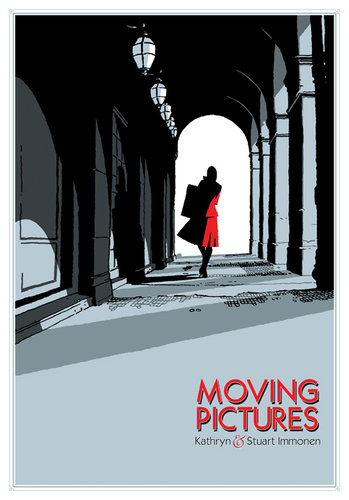
http://www.topshelfcomix.com/catalog/covers/moving_pictures_cover_72dpi_copy0_lg.jpg
Moving Pictures, written by Kathryn Immonen and drawn by Stuart Immonen
Set in an interesting milieu (the Louvre during World War II), this book is doomed by its pointlessly oblique storytelling, its terrible dialogue, and its characterless art. Apparently Stuart Immonen is a popular mainstream (i.e., super-hero) comics artist. I am unfamiliar with that work, but here he seems to be attempting a clear line style. His work resembles that of Paul Grist, but he lacks Grist's dynamism and humanity.

http://www.fantagraphics.com/components/com_virtuemart/shop_image/product/12d6af332d9149fb90ba621506717443.jpg
Weathercraft by Jim Woodring
One doesn't "review" a story like this. One genuflects before it. Mysterious as usual, we see what seems like a near redemption of that most human of creatures, Manhog.

http://www.fantagraphics.com/components/com_virtuemart/shop_image/product/77108c12893e7e39a842c13dc76e8b16.jpg
Wally Gropius by Tim Hensley
Hensley has always been a talent to watch. Prior to this book, the coolest thing I had from him was a soundtrack he recorded for Dan Clowes' Like a Velvet Glove Cast in Iron. This book takes a lot from Clowes. Like Clowes, Hensley has an interest in the minimalist anonymous comics for small children from the 1960s and 70s. Wally Gropius is not merely a pastiche of them. I hesitate to say it is a deconstruction, because that implies a certain logical approach. Instead, Wally Gropius reads like an attempt by an alien civilization to communicate with us, having only read these comics prior to the attempt. Meaning is struggling to come to the surface of this sea of signs.

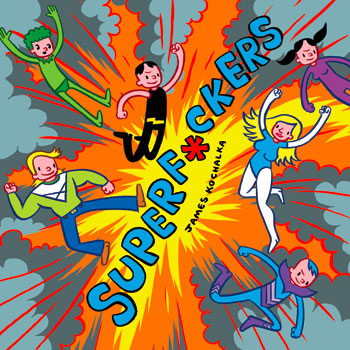
http://www.topshelfcomix.com/catalog/covers/superfckers350_lg.jpg
Superf*ckers by James Kochalka
Superf*ckers is a seriously funny idea, and it works for a good chunk of this book. It starts to run out of steam in the end, though. The superhero team here are a bunch of hard-partying teenagers. Instead of  incomprehensible teenage super teams like the New Mutants or the Teen Titans, this team acts more like the cast of a reality show. And that's really funny. Kochalka's intensely colored art here is really pleasing as well.

http://www.powells.com/cgi-bin/images.cgi?isbn=9781770460072&p=1
Wilson by Dan Clowes
Really deserves a long, analytic review. Suffice it to say here that Wilson is really good--a story of a deeply unpleasant misanthrope told in a visually interesting and formally inventive way. It's good to see Clowes not working on mediocre movies and instead doing really great comics--the thing he was born to do.

http://www.fantagraphics.com/components/com_virtuemart/shop_image/product/61ea59da94be69e191eb41be31947050.jpg
It Was the War of the Trenches by Jacques Tardi
Another book that deserves a long, detailed review. It's a great one that you must own if you are serious about comics as art. One thing that struck me is how indebted Tardi is to Louis Ferdinand Celine. Celine's cynical "fuck it" attitude permeates French cultural production, and It Was the War of the Trenches is no exception. In this series of short stories, the luckless protagonists seem to be asking, over and over again, "Can you believe how fucked up this is?"