Monday, June 20, 2011

Link Panic

by Robert Boyd

Photobucket

How many actual proletarians will be buying "proletariat" level tickets for Diverse Works's gala? In addition to a blind auction, Diverse Works is offering art via "Luck of the Draw" at their annual gala this Wednesday, June 22. Here's how it works: 112 artists donated pieces. If you paid $1000, you get first choice from all these pieces. If you paid $500, you get choices two through five. If you are one of the 15 people who bought $250 tickets, you get to choose the next 15 pieces. At this point, there will be 91 pieces left (assuming each artist donated just one piece). Then if you bought a ticket at the "Proletariat" level (I'm not kidding--that's what it's called) for $125, you get to choose from whatever scraps your richer brethren left for you. (Diverse Works)

What Lubbock needs is a larger-than-life-sized statue of the great god Pan. TxDOT put this charming statue on a freeway in 2004:
Photobucket
There was a concerted, organized effort by Christian extremists to get it removed. Why? Because it was "pagan." Then on August 13, 2004, vandals defaced it with a sledgehammer. It looked like this:
Photobucket
No one knows why it was defaced--the vandals didn't take credit. The assumption--and it's just an assumption--is that someone took all this "pagan" nonsense seriously. Shades of Bamiyan Buddha statues, also destroyed by religious fanatics. The good news is that TxDOT is going to put up a new Windy Man reliefs. Their plan to prevent fanatics from repeating 2004? They are going to put it up really high. (KCBD, hat tip to Glasstire)

Can there be an art bubble? After Nouriel Roubini (aka "Dr. Doom") tweeted "I am in Basel for Art Basel. Thee is a bubble in contemporary art", Marion Maneker responded:
The economist’s definition of a bubble is when assets trade at values determined by their exchange, not their use. When the price of a stock, bond, house, commodity contract or any other financial asset becomes too divorced from price of its fundamentals—profits, interest or use value—the asset is said to be in a bubble.[...] With art, there is no financial or use value. There is no rational value. Every work of art has the potential to become valueless.
I can see the logic here, but if it's true, what do we call the most infamous bubble of all, tulipmania--the bubble that sent the prices of tulip bulbs in Holland to insane levels in 1637? I think I'm with Roubini on this one. (Art Market Monitor)

Charles Jencks, Post-Modern Theorist and Megalomaniac. Charles Jencks is known to me primarily as one of the earliest theorists of post-modernism. I was quite taken by his writing about architecture back in the 90s. Since then, he has apparently been heavily involved in landscape architecture. His latest project is a half-mile long landscape-sculpture of a woman's body, entitled Northumberlandia. (artdaily)

Photobucket
Charles Jencks, Northumberlandia drawing



Share

Sunday, June 19, 2011

Too Many Dicks on the Dance Floor

by Robert Boyd

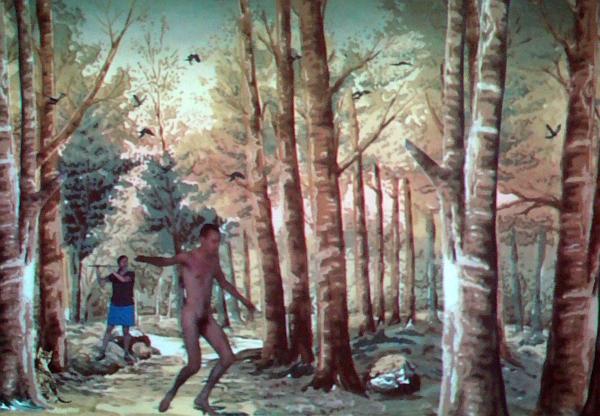
I was at Box 13 last night and one impression I got was that there were a lot of dicks in this show. For example, all the pieces by Joey Fauerso featured a naked guy in a landscape, as in this video, The Clearing.

 Photobucket
Joey Fauerso, still from The Clearing, video

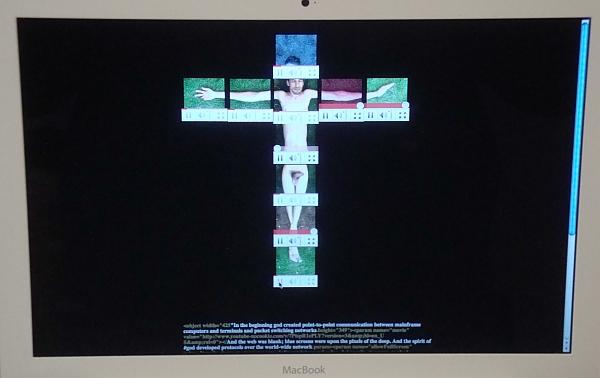
Then in a show called #notmethough, curated by Cameron Blaylock and Steven J. Thomson, Jonatan Lopez produced this self-portrait, #godmethough.html, where the viewer sees Lopez's body through a bunch of tiny embedded YouTube videos, including one of his junk.

Photobucket
Jonatan Lopez, #godmethough.html, social media and html, 2011

Well, everything thesis has its antithesis, and as far as dicks go, Cody Ledvina's performance eschewed them, as this disclaimer implies:
Photobucket
Cody Ledvina, Gawd parents: I am real poster (detail), 2011

 As a board member of Box 13, I am pretty much required to take responsibility for any dicks in any piece of art we exhibit. If you were offended by the numerous dicks in this show, I sincerely want to hear from you. Write me at: Robert Boyd, c/o Santa Claus, Santa's Workshop, North Pole.


Share


Saturday, June 18, 2011

What I did at Nohegan East art camp this summer

By Dean Liscum

Have you heard of the Skowhegan School of Painting and Sculpture's nine week summer arts residencies in which 65 artists are provided studios and housing in Maine and encouraged to produce art through workshops and collaborations with their peers? Great. This ain't that even though it's loosely modeled after it sans the studios and housing, time (additional 8 1/2 weeks), and idyllic weather.

It's also not a bohemian weekend of sex, alcohol, drugs, rock and roll, and nude horseback riding by sensitive artists who feel entitled to such things to create their art.

What Nohegan East is is "an art-making weekend with a focus on community" organized and run by Elaine Bradford, Dennis Nance, and Emily Link. Participants eat, drink, make merry, and participate in workshops lead by attending artists.

During it, I made a blanket fort.

lead by Brit Barton and Caitlin McCollom
I learned how to do sun prints.

as taught by Dennis Nance and Emily Link
I learned how to make a dream catcher-magic stick combo.
as lead by Carlos Rosales-Silva
I learned how to make a boat out of trash (and escape a repressive government run by an out-of-touch, meglo-maniacial figurehead...not Rick Perry but good guess).

lead by Paul Middendorf
I learned how to properly package a piece of art work for shipping.

lead by Jonathon Leach
I learned how to underwater basket weave.

lead by Sasha Dela (sans water)
I learned how to self-publish an exhibition catalog (or any other type of publication) on the cheap.

lead by Rachel Hooper (avec water)
However, I didn't do everything. Campers also made a pilgrimage to the Blue Bell Ice Cream "factory", filmed a video, got career advice from other artists, showed classic movies, danced to a live band, and fondled livestock (both real and bronze "dolls").


Wanna know more? You'll have to visit the exhibition about Nohegan East in August 2011 at Box 13.


Share

Friday, June 17, 2011

Meet the Hooks

I can think of two cases off the top of my head where the parent or parents and child or children are all artists. I'm thinking of the Woodmans and the Smiths. Francesca Woodman, the brilliant photographer daughter of two artist parents, committed suicide when she was 22. (Their story was told in the powerful, disturbing documentary, The Woodmans.) Kiki Smith and dad Tony Smith could have had a joint exhibit before he died in 1980, but it would have been quite an odd mixture of work. The thing that stands out about the joint exhibit of Wendy Hook (mother) and Steven Hook (son) at Darke Gallery is how well their work compliments one another's.

Photobucket
Wendy Hook, Intersections, commercial and hand-dyed cotton

Wendy is a quilter. The only thing I can find out about her on line is that she won a prize in the category of "art quilt" from the Trinity Valley Quilters Guild. The notion that there is a separate category of quilts known as "art quilts" is highly intriguing, especially if we already accept that quilting is an artform. It suggests that within the quilting world (a world about which I am completely ignorant), there are quilters who distinguish their own work from the mainstream of quilting. Such a distinction exist within the world of comics, and the phrase "art comics" is a fairly sharp but contentious distinction within the world of comics. Perhaps it's the same for quilters.

If we use a definition based on the site of the work, per George Dickie, we can say that Wendy's quilts are art quilts because they are in an art gallery. They are denied their functionality by being hung on the wall or from the ceilings. Consequently, we look at them as art objects--particularly as arrangements of color on a mostly flat surface. (We look at them this way while keeping in mind that they could be used to keep us warm in bed, in theory.)

The thing I noticed first was how perfectly chosen Wendy's colors were. For example, in the highly rhythmic quilt, Intersections, reds and pinks dominate with a smaller amount of contrasting greens, an even smaller amount of blue-purple, all framed with blacks and whites that accentuate the rhythms.

Photobucket
Wendy Hook, Rings of Saturn I, commercial and hand-dyed cotton and cotton sateen

This one has a similar color idea--a dominant color, a secondary color, and smaller bits of other colors. But it has something else going on. It sacrifices the jaunty rhythm of Intersections in order to have a nautilus-like spiral expansion. Just as the chambers of a nautilus expand as you go outward in the spiral, we see the squares in this quilt getting bigger the same way. The smallest squares are in the upper left portion. If you look closely, you can see that they gradually get bigger until you get to the largest of them, a large truncated square in the lower left hand corner

Photobucket
Wendy Hook, Zigzag, commercial and hand-dyed cotton

This blue and purple quilt has an abstract design, as quilts traditionally do, but creates a sense of depth by superimposing the four central squares partially over the eight outer squares.

Photobucket
Steven Hook, Not Right This Minute, paper, gouache, acrylic collage on canvas

Layering is what Steven does with his pieces. This act of layering and collage connects his work with his mother's quilting, as does his coloring. That's what was so unusual about this show--that the two artists would be so similar. I'm curious about the direction of the influence (if any).

Photobucket
Steven Hook, installation view, paper, gouache, acrylic collage on canvas

Hook adds an element--language. The phrases are suggestive without quite being meaningful (much less clever, like those in the work of Wayne White or Tara Conley). Just like a quilt, where a whole is created by reusing bits of the same piece of cloth, Stevens work builds up from repeating the word or phrase over and over. This could be read as an echo, or perhaps as the way a person who has suffered a head trauma will repeat a word or phrase when trying to communicate.

Pairing Steven and Wendy Hook was an unusual move, but one that worked because their respective works share just enough to create an interesting dialogue.


Share


Thursday, June 16, 2011

Preview Lawndale's Big Show from the Comfort of Home

Lawndale has been posting photos of some of the entries for The Big Show on their Flickr page. It's well worth checking out! I wish I could embed a few here but they have them on "all rights reserved" mode. But I see art by Kelly Allison, Brian Neal Sensabaugh, Maria Smits, and Deborah Bright, as well as many folks I've never heard of. Looking forward to seeing who makes the final cut.

Myke Venable's Big Squares

by Robert Boyd

Myke Venable's art almost dares you to say something about it. It mainly just is. Describing any particular painting in this show is a trivial, unenlightening task.

Photobucket
Myke Venable, MV 32 Sage/DD Orange (Dare Devil Orange), latex on canvas, 2011

Two square canvases, each hung at a 45 degree angle. the larger one is a pale yellow-green and the smaller one a bright orange. The larger is to the left of the smaller from the viewer's point of view, and the two touch each other ever-so-slightly. Once you've said all this, then what? And Venable doesn't give you anything in the titles. He's not like Barnett Newman, who would give his paintings titles like Achilles or Vir Heroicus Sublimus. Nope, Venable goes for just the facts, ma'am. Each painting is named after the color of paint used.

Photobucket
Myke Venable, MV 32 Sage/DD Orange (Dare Devil Orange), latex on canvas, 2011

These paintings are so minimal that it's reasonable to ask if they are paintings at all. They aren't framed and the colors extend over the edge of the canvas. They have a certain sculptural presence. And if one is an arch-formalist, then flatness and integrity of the picture plane are important indicators that you are in the presence of pure painting. These aren't really flat.

Photobucket
Myke Venable, MV 24 Orange, acrylic on canvas, 2011

If you go into the Gallery Sonja Roesch, it seems designed for "pure painting"--the interior is a big white neutral box. In many ways, it seems like the ideal setting to allow big modernist paintings to just be themselves--no distractions, no visual clutter.

Photobucket
Myke Venable, MV 30 CadRed/Sky Blue, latex on canvas, 2011

It's a totally neutral space except for one thing--it has narrow clarestories on the east and west walls. So early in the morning and late in the afternoon (when the opening for this exhibit occurred), the sunlight will shoot like a laser through the windows into the space. The floor is so highly polished that it reflects the sunbeam back up. The effect of this dramatic light was to highlight the angles on Venable's wall-sized painting MV 30 CadRed/Sky Blue, which was hanging on the north wall of the gallery. So you have a painting that in a dramatic way is in dialogue with the light in the room.

This is a fundamental quality of minimalist paintings, whether Ellsworth Kelly or Agnes Martin or Venable. There is a kind of humility in these paintings, even when they are very large. The humility comes from knowing that they aren't really finished in the studio, but instead only becomes complete in situ--and this last step is not something the artist can fully control.

For example, Venable often uses fluorescent colors in his painting. If a fluorescent color is somewhere where sunlight (which contains ultraviolet light as part of its spectrum) hits it, it will have a kind of glow. But if it is an interior space that only receives artificial light, that glow will be absent. Venable doesn't control the final disposition of the painting--he doesn't know what shadows will be cast on it, what kind of light will be hitting it, etc. This is ironic. These works seem austere and hermetic, but really they depend on engagement with the world to achieve completion.

Photobucket
Myke Venable, MV 25 Silver/Scarlet Red/Black, acrylic on canvas, 2011

Photobucket
Myke Venable, MV 26 Purple/Fluorescent Pink, acrylic on canvas, 2011

(Author's note: I own two small Myke Venable paintings.)


Share

Wednesday, June 15, 2011

Llliiinnnkkksss

by Robert Boyd

Photobucket

The Big Show: Tomorrow (Thursday, June 16) at 5 pm is the deadline for dropping off your art at Lawndale for The Big Show. I know there is a picture you made with construction paper, glue and dried noodles back in your closet somewhere that is a freaking masterpiece--bring it down to Lawndale and enter it!

Man Bartlett Interview: Twitter performance artist Man Bartlett is interviewed by Jane Harris in an article that includes a photo from #24hClerk, the performance he did here at Skydive. (Houston's own Nancy Douthey makes a cameo appearance.) The headline describes Bartlett as a "Rising Art Star." Awesome--maybe the two Man Bartlett collages I bought after his performance will help pay for my retirement! (Huffington Post)

Photobucket
The odds are long, but you can't win if you don't play


What Are Your Chances of Winning An Art Prize? Christine Wong Yap crunches the numbers for you in an article that looks at applicant pools for various residencies and prizes available to artists. I like reading these articles where someone has taken data and crunched some numbers about the art world (see Claire Ruud's current series on Glasstire for another example of the genre). (Temporary Art Review)

The Most Hilarious Headline Prize goes to "Dale Chihuly Mounts World's Biggest Bong Retrospective." The review, by Kyle Chayka, is pretty awesome, too. By the way, am I the only person who has noticed that some of Chihuly's Chandeliers (made of delicate, beautiful hand-blown glass) look really similar to Aurora Robson's Lift over at Rice (made of trash)? (Hyperallergic)


Share